
Moldovan parliament might establish voting hour at plenary meetings
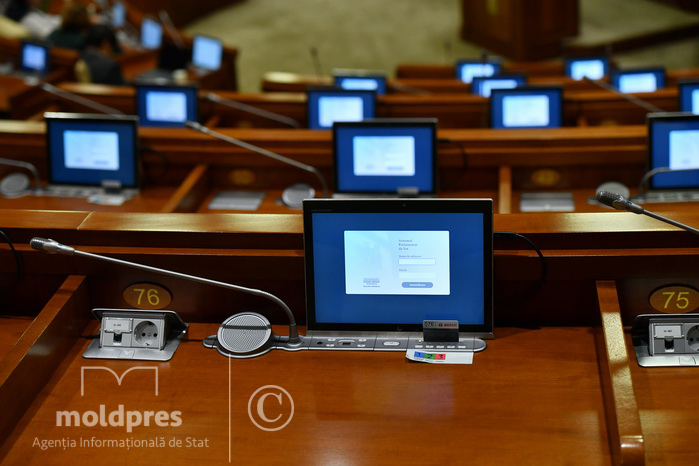
The parliament might establish a voting hour during plenary meetings. This proposal is set to be discussed at the public consultations on the development of the draft Code focusing on the organization and work of the legislative institution. Parliament Speaker Igor Grosu today made statements to this effect.

According to the official, the draft aims to improve the organizational and legislative process.

"At the public consultations, we will discuss all proposals, such as the voting hour. Why not have a voting hour like in the USA, Romania, the Netherlands, Sweden, which would allow for good organization. This would mean that there's a part of the meeting when debates, questions and answers take place, followed by the voting process. This is a general practice," said Igor Grosu.

The speaker noted that public discussions on this topic would be organized in the next session.

"We have two commitments to fulfill by the end of the current year. It is about the establishment of the Commission for European Integration and the approval of the new Parliamentary Code. So far, the commission has been established, and the only outstanding matter is the approval of this Code, which is very large and needs public consultation, in order to discuss all issues," emphasized Igor Grosu.

The Moldovan parliament has recently initiated the development of the Code regarding the organization and work of the legislative institution. The adoption of the document takes place in the context of meeting the recommendations of the European Commission, set out in the Enlargement Reports for 2024 and 2025, as well as aligning with the EU acquis.

At present, the legislative process is regulated by the parliament’s regulation. The document was adopted in 1996 and needs to be adapted to new realities, in order to outline more explicitly the basic duties of the Legislature. The new Code will replace the parliament’s regulation, which contain outdated provisions. The Code will regulate more explicitly the institutional functional balance, in order to ensure the parliament's proper work and the balanced distribution of tasks among the legislative institution's working bodies, namely between the standing bureau, permanent commissions and the legislative forum convening at plenary meetings.

The draft Code is in progress, considering the need for further study of best practices from the European Parliament's Rules of Procedure, normative acts for organizing and work in other EU member states' parliaments, aligning the content with Constitutional Court Decisions, and examining received opinions, especially the ones from the OSCE Office for Democratic Institutions and Human Rights.

The initiative is to be subjected to public consultations starting February 2026, inviting all interested parties – civil society, international organizations, development partners, parliamentary and extra-parliamentary political forces.
 Facebook
 Instagram
 X/Twitter
 Telegram
Ben Gurion Airport in Tel Aviv remains closed until 16 April
National airspace overflown by Shahed drone
Perspectives on Moldova's European integration: experts says joint declaration announced today by officials from seven states good political signal
European Union member states' MPs call for speeding up EU accession talks with Moldova; declaration to this effect signed in Chisinau
Moldovan president to meet Moldovans living in Ireland
PHOTO // Republic of Moldova opened Honorary Consulate in Almaty, Kazakhstan
President on 108 years since Union of Bessarabia with Romania
Prime Minister conveys message on anniversary of Bessarabia's Union with Romania
Speaker - 108 years after Union of Bessarabia with Romania
PHOTO // Moldovan foreign affairs minister meets Romanian senators
Moldovan government holds extraordinary meeting to introduce new measures on emergency state period
Moldovan president in Bratislava says country chooses path to peace, freedom, prosperity in European family, not to abandon it
Slovakian president says Moldova proved it is ready to accelerate process of accession to European Union
Romania’s support for Moldova highlighted in Parliament
Prime Minister visited agricultural business in Unguri village, Ocnița district
Minister of Labor and Social Protection: Deficit of state social insurance budget decreased to 3.6 billion lei in 2026
Prime Minister visited rescuers and firefighters unit in Ocnița
Energy and infrastructure – essential pillars in Ukraine’s reconstruction
 National Bank of Moldova
Proposals for improving efficiency of ministries discussed at roundtable
Prime Minister visited agricultural business in Unguri village, Ocnița district
Prime Minister visited rescuers and firefighters unit in Ocnița
Weekly meeting of Joint Control Commission of 2 April 2026
Deputy Prime Minister for Reintegration meets Ambassador of Romania to Moldova

Weekly meeting of Joint Control Commission of 2 April 2026
Energy and infrastructure – essential pillars in Ukraine’s reconstruction
Specialized international exhibitions Moldconstruct and Moldenergy open at Moldexpo
Deputy Prime Minister for Reintegration meets Ambassador of Romania to Moldova
Speaker about permanent withdrawal from CIS statutory bodies: Moldova has sovereign and independent right to decide which union to be part of
Moldovan government representatives to present to parliamentary factions actions taken during emergency state, proposals on future developments
VIDEO // Solidarity puzzle: social experiment in Moldovan parliament to raise autism awareness
Moldovan PM has discussions with mayors from Ocnita district
Parents who do not pay child support risk arrest or community service in Moldova
PHOTO // Non-reimbursable funding for entrepreneurs of Moldova: 81 companies receive grants worth 43 million lei
Moldovan foreign affairs minister meets MEP: continuing reforms, leveraging EU support on agenda
Moldovan PM visits settlement in northern district, where 260 households benefit from access to water with government's support
Moldovan PM in Ocnita district says government continues investing in projects that matter to people
Moldovan parliament amends procedure for appointment, dismissal of members of governing bodies of National Bank of Moldova
Parliament votes for Moldova’s definitive withdrawal from Commonwealth of Independent States
Moldovan president conveys message on World Autism Awareness Day
Receive the latest news directly to your email

Receive the latest news directly to your email