
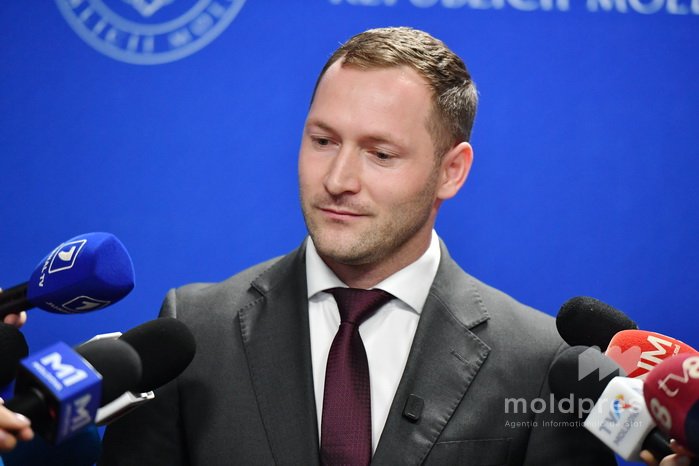
Environment Minister: Oil pollution level in Dniester returned to admissible limits
The authorities are examining the resumption of water supply in the north of the country after petroleum product parameters in the Dniester River have returned to admissible limits. Minister of Environment Gheorghe Hajder made the statement before today’s Government meeting.

According to him, for the first time since the onset of the crisis, all three critical points – Naslavcea, Cosăuți and Rezina – reached, on March 17, the level of 0.1 mg/l, considered the admissible limit.

“This is clear evidence that the oil discharges upstream have been strongly reduced, and the absorbent barriers have done their job,” the minister stated.

The authorities will continue to monitor how the situation evolves over the next 48 hours. If the test results remain within admissible limits or improve, the reopening of the Cosăuți pumping station will be considered. This station supplies water to the districts of Soroca, Sângerei, Florești and the municipality of Bălți. The minister specified that confirmation is required through at least two consecutive tests, conducted at an interval of no less than 24 hours.

Data presented by the official show a downward trend in pollution levels. At Naslavcea, the entry point into the country, the concentration of petroleum products exceeded the admissible limit fourfold on March 15, then subsequently decreased and returned to normal on March 17. At Cosăuți, the exceedances recorded on March 15 were eliminated in the following days, while at Rezina the level gradually decreased from values three times above the limit to within admissible parameters.

The Minister of Environment noted that smaller-volume leaks are still being recorded and that the authorities will maintain intervention measures to reduce the impact on the river and on the population. To support these efforts, additional equipment and materials for water treatment at the Cosăuți intake are being shipped from Romania.

Investigations into the total amount of discharged petroleum products are also continuing. According to preliminary data, it is at least 1.5 tonnes, though the authorities believe the actual volume may be higher. Laboratory analyses confirm the presence of compounds derived from petroleum products.

The minister further stated that, after the crisis is overcome, a comprehensive assessment of the environmental impact will be carried out in order to establish the extent of the damage caused. At present, the Ministry of Environment has requested official information from the Ukrainian side regarding the source of the pollution.

At the same time, the authorities continue to ensure the delivery of drinking and technical water to the population of the municipality of Bălți, a measure that will be maintained until the safe resumption of the regular water supply.
 Facebook
 Instagram
 X/Twitter
 Telegram
Director of National Probation Inspectorate resigns after tragedy in central Moldova settlement; electronic monitoring system to be reformed
Local Public Administration Reform // Moldovan government prepares normative amalgamation phase for 254 mayoralties
Ministry of Defense to receive grant of about €4.32 million to equip National Army
Local Public Administration Reform // From 890 to 292 town halls and 4.5 billion lei in funding starting in 2027
Approved by Government: Public-sector employees to receive one-off payment of up to 4,000 lei
Scholarships of 1,200 lei for Roma students
Students, pupils, citizens invited to activities dedicated to democracy at Moldova's parliament
Education Minister at start of school year: School shapes people who think freely
PHOTO GALLERY // Dream of saving lives begins here. USMF student oath
PHOTO GALLERY // September 1st, emotions and new beginning in Moldovan schools
PHOTO GALLERY // Great National Dictation in pictures: Romanian language unites us
Education Minister: Romanian language must be bridge, and state must give everyone chance to learn it
Prime Minister at opening of Great National Dictation: If you live here, it’s natural to learn Romanian
VIDEO // Thousands of people wrote together in Romanian at Great National Dictation
Maria Bieșu International Opera and Ballet Festival opens in Chișinău
Opera “Lucia di Lammermoor” raises curtain on 34th edition of Maria Biesu International Opera and Ballet Festival in Moldova
Moldovan PM attends ceremony on marking 50 years of work of Chisinau-based Holy Trinity Municipal Clinical Hospital
Moldovan foreign affairs minister has talks with Lithuanian MPs: support for European path, security cooperation on agenda
Moldova withdraws from Commonwealth of Independent States agreement on exchange of publications between libraries
Moldova's social insurances budget for 2026 increases by 1.37 billion lei
Positions of deputy headmasters in schools to be filled through contest in Moldova; first contracts end on September 7
 National Bank of Moldova
Moldovan PM attends ceremony on marking 50 years of work of Chisinau-based Holy Trinity Municipal Clinical Hospital
Moldovan PM attends ceremony celebrating 35th anniversary of foundation of Customs Service
President meets with Ambassador of Turkey at end of term
Prime Minister and Denmark’s Ambassador approach new opportunities for investment and economic cooperation
Head of state, at 35th anniversary of National Army's establishment, says peaceful Moldova needs Moldova capable of defending its peace

Public sector employees of Moldova to receive one-time allowances of up to 4,000 lei; parliament approves budget's revision in first reading
Hydrological situation on Dniester, Prut stays worrying; water levels in Novodnestrovsk, Stanca-Costesti reservoirs continue to drop
Moldovan foreign affairs minister has meeting with Lithuanian President in Vilnius
Moldovan parliament speakers responds to Russian ambassador-designate: “The only and most dangerous state in this part of the world is the Russian Federation”
PHOTO // Lithuania’s foreign affairs minister says Moldova ready to open remaining negotiation clusters, Lithuania strongly supports accelerating this process
Special measures taken at Chisinau Airport during transit of Hasidic pilgrims
All schools of Moldova to switch to electronic gradebooks
Moldovan PM attends ceremony celebrating 35th anniversary of foundation of Customs Service
Moldovan deputy PM for European integration attends informal meeting of General Affairs Council
PHOTO GALLERY // Customs Service - 35 years at Moldova’s economic border
Military personnel from Moldova, Romania and United States participating in Fire Shield 2026 exercise
Provisional licensing of grain and oilseed imports
DOC // Education 2030 Program published in Official Journal
Convergence Fund aimed at bringing two banks of Dniester closer
Customs Service marks 35th anniversary of establishment
Deputy Prime Minister for Reintegration on Russia’s intention to open polling stations in Transnistrian region
Receive the latest news directly to your email

Receive the latest news directly to your email