
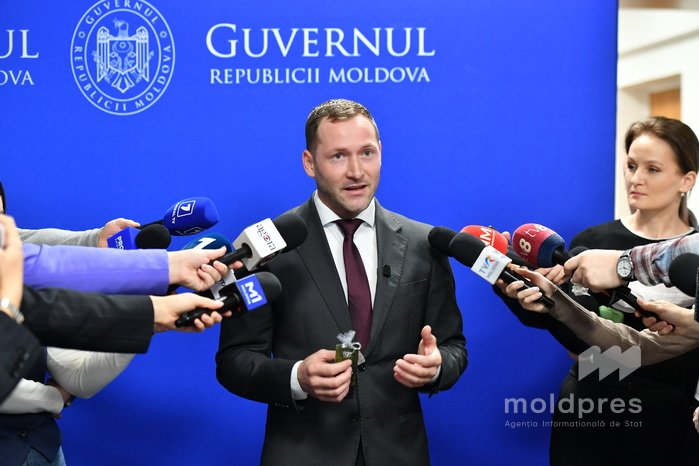
VIDEO // Environment Minister: We installing capture filters to prevent pollution of Dniester
Environmental authorities have intervened to limit the impact of oil slicks that have appeared on the Dniester River in the northern area of the Republic of Moldova. Environment Minister Gheorghe Hajder stated that the responsible institutions are mobilized and working in a coordinated manner to prevent the spread of pollution and to collect the substances on the water surface.

According to the minister, following an emergency meeting attended by representatives of the General Inspectorate for Emergency Situations (GIES), the Environmental Protection Inspectorate, the Environment Agency and the National Authority “Apele Moldovei”, it was decided to install special filters to capture petroleum products.

“In the next few hours, a filter, a capture barrier, will be installed in the area of the Căsăuți water station so that we can gather and collect all this waste. The goal is to prevent the spreading of these substances along the river course,” said Gheorghe Hajder.

The minister specified that water samples were taken in the very first hours after the incident was reported, and the preliminary results of the analyses are to be made public during the day.

“The preliminary analyses, which were collected as early as yesterday morning, will be available this afternoon and we will communicate them to the public. Until then, we are maintaining the precautionary recommendations announced earlier,” Hajder said.

Authorities emphasize that, so far, there is no indication that the petroleum products pose a risk to the drinking water consumed by the population. The Environment Minister explained that these products remain on the water surface, and the existing hydrotechnical infrastructure provides an additional level of protection.

“This water has not reached Chișinău, and the Dubăsari dam functions as a natural filter that does not allow these petroleum substances to pass, since they remain on the surface of the water. Nevertheless, we will make sure they are removed before they can travel further downstream,” the minister noted.

In parallel, the authorities of the Republic of Moldova have requested official information from Ukraine in order to clarify the circumstances under which the discharges of petroleum products may have occurred.

“We have sent an official request to the Ukrainian side to find out exactly what caused these leaks. At this time, there is only preliminary information and we do not wish to provide unconfirmed data,” said Gheorghe Hajder.

According to preliminary data received from Ukraine, it is a quantity of approximately one to one and a half tons of petroleum products that reached the water. The Environment Minister mentioned that although petroleum products do not mix directly with water, they can pose a danger to the ecosystem if they are not collected quickly.

“Any substance that accidentally reaches the water presents a potential danger. That is why we need to intervene proactively and reduce the risks as much as possible,” the official stressed.

The responsible institutions continue to monitor the situation on the Dniester and to collect water samples from several points in order to assess the environmental impact. The authorities assure that they will inform the public as soon as the final analysis results are available and that they will take all necessary measures to prevent contamination of the watercourse.
 Facebook
 Instagram
 X/Twitter
 Telegram
President conveys message of appreciation on International Women’s Day
Prime Minister: Women in Moldova keep country moving
PHOTO // Woman of Moldova: portrait of changing society
International Women’s Day marked in Moldova and worldwide
Security restrictions in Israel extended until 9 March; outbound flights to resume gradually
Moldovan President condemns Russian attacks on Ukrainian cities
Crisis Cell: Embassies maintain direct contact with Moldovan citizens in Middle East and provide consular assistance
PHOTO // Mărțișor celebrated in Baku at event with Moldovan diaspora
PHOTO // Roadmen working on days-off to fill potholes on national roads
Fairs offering local products organized in several districts of capital
PHOTO // Moldovan president visits south of country: modernization of two ports in Giurgiulesti, construction of Cahul regional hospital, talks with young people
New rules against digital piracy: Moldovan parliament approves administrative sanctions
UPDATE // Heavy cross-border traffic at Sculeni crossing point eased
Over 90% of food products tested in 2025 compliant. ANSA publishes pesticide residue report
VIDEO // Moldagrotech exhibition 2026 brings together over 100 exhibitors in Chisinau: farmers discover new technologies for agricultural season
Support for EU accession: parliamentary commissions of Moldova, Romania to convene in Chisinau
Deputy Prime Minister for European Integration, students from France discuss European path of Moldova
Head of State in Vilnius Parliament: Moldova counts on Lithuania’s voice in Brussels. Help us follow your path in family of free European nations
VIDEO // Environment Minister: We installing capture filters to prevent pollution of Dniester
VIDEO // Pilot program to modernize elevators in residential blocks
PHOTO, VIDEO // NATO Secretary General: Moldova has ambitious reform path, and NATO ready to provide support
 National Bank of Moldova
Moldovan government supports farmers: new facilities for refunding of value added tax, preparations for reimbursement of excise on diesel
Moldovan president gives speech in plenum of Lithuania's Parliament
Moldovan President’s speech to Lithuanian Parliament on Independence Restoration Day
Stricter rules on use of veterinary medicines to ensure food safety
Moldova and Korea to develop economic cooperation based on new agreement

Moldovan President’s speech to Lithuanian Parliament on Independence Restoration Day
VIDEO // Pilot program to modernize elevators in residential blocks
PHOTO, VIDEO // NATO Secretary General: Moldova has ambitious reform path, and NATO ready to provide support
Drivers of vehicles registered in other states to be sanctioned for traffic violations on roads in Moldova
Stricter rules on use of veterinary medicines to ensure food safety
Approved by Government: Moldova launched procedures for permanent withdrawal from CIS statutory bodies
Moldova and Korea to develop economic cooperation based on new agreement
Government initiates Moldova's withdrawal from statutory bodies of CIS
VIDEO // Agriculture Minister: Farmers to be supported to continue agricultural work
Prime Minister about situation in energy sector
New deputy head appointed at Service for Prevention and Combating of Money Laundering
Next steps in EU accession process and regional security developments discussed by Deputy Prime Minister Mihai Popșoi with Kaja Kallas
Clearer rules for sanctioning traffic violations committed with vehicles registered in other countries
Moldova denounces Agreement establishing Commonwealth of Independent States
BTA Presents English-Language Publications at London Book Fair
Moldovan president among honorary members of European Order of Merit – award provided for significant contributions to promotion, defense of European values
Receive the latest news directly to your email

Receive the latest news directly to your email