
Martisor brings spring back into people’s hearts: ancient tradition, Music Festival on March 1 in Chisinau
Spring makes its presence felt in Moldova through the beloved symbol of national identity, Martisor. On March 1, the tradition returns to the spotlight, and in Chisinau, the Martisor International Music Festival is inaugurated, an event that brings to the stage renowned artists of the country and from abroad.

Ethnologist Varvara Buzila said that Martisor represents a national value deeply rooted in the Romanian cultural space.

“Martisor is a national value and is very important in our Romanian space. It marks the transition from the cold winter to spring or even summer. It is a symbolic amulet through which people show solidarity with nature. Martisor also symbolizes the beginning of a new agricultural year. Martisor is present in all our cultural structures,” the researcher emphasized.

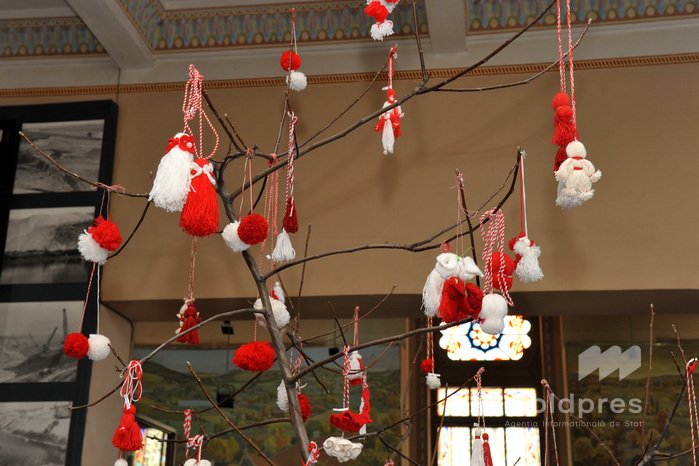
In its traditional form, the Martisor consists of a red and white cord, to which a small decorative object is attached. The colors have multiple meanings: red is associated with life, fire and fertility, while white is linked to light and wisdom. Their intertwining symbolizes the balance and unity of opposites.

The origin of the custom is ancient. Legend has it that the thread was spun by Baba Dochia on her way to the mountains, thus becoming the “thread of the year.” Archaeological discoveries made at Schela Cladovei in Romania have brought to light amulets about 8,000 years old, similar to the Martisor, made of small stones painted in white and red.

In written sources, the tradition is mentioned for the first time by scholar Iordache Golescu. Folklorist Simion Florea Marian noted that in Moldova and Bukovina, children wore around their necks a gold or silver coin tied with a red-and-white cord, considered to bring good luck.

In the past, girls wore the Martisor during the first days of March, then hung it on the branches of a blossoming tree, in a ritual meant to bring a fruitful year.

Today, in addition to the traditional cord, Martisor charms include flowers, figurines or other decorative symbols. Regardless of the form, they remain the expression of a tradition specific to the Carpathian area, preserved and passed down from generation to generation.

The tradition of Martisor, as well as the customs and cultural practices associated with March 1, was inscribed on UNESCO’s Representative List of the Intangible Cultural Heritage of Humanity in December 2017, as the result of a joint nomination submitted by Moldova, Romania, Bulgaria and North Macedonia.
 Facebook
 Instagram
 X/Twitter
 Telegram
BTA: Martenitsa: Bulgarians Celebrate Spring with Centuries-Old Tradition
Legend of Martisor on stage in France
PHOTO GALLERY // Martisor retrospective
Schedule of Martisor Festival 2026 // Cultural events begin in Chisinau, across Moldova
Spring Fair brought charm of Chinese culture to Chisinau; Chinese Ambassador: “Let us continue cultural exchanges and cooperation”
PHOTO GALLERY // Eugen Doga – 89 years since birth of maestro who brought Moldova’s music to world
Moldovan writer among finalists for European Union Prize for Literature
Corner of China in heart of capital: Spring Festival brings Chinese traditions closer
Republic of Moldova highlighted in Italian press after participating in BIT Milano 2026
Martisor across the Country programme returns with over 40 cultural events in Moldova
PHOTO GALLERY // Premiere of documentary War Road 2: From Heart to Heart, about solidarity and courage
Ministry of Culture requests authorities be informed before inviting foreign artists
“Porcelain War” screened in Chișinău
PHOTO GALLERY // Exhibition dedicated to Constantin Brâncuși inaugurated in Chișinău
Romanian Embassy in Moldova says creation of Relations with Romania Service strengthens bilateral cooperation
Improved access for people with disabilities in Moldova: 30 ramps to be installed in public institutions hosting polling stations
VIDEO // Moldovan government transfers land needed to continue work on bridge across Prut river at Ungheni, connecting Moldova and Romania
Ana Racu elected vice-chair of UN Committee Against Torture
Victims of the organized famine from 1946–1947 to be commemorated in central Moldova settlement
Moldova strengthens economic diplomacy under coordination of Foreign Affairs Ministry
Moldovan PM pays tribute to maestro Gheorghe Urschi
 National Bank of Moldova
Moldovan PM pays tribute to maestro Gheorghe Urschi
Moldova consolidates mechanism for implementing international sanctions with EU's support
Government accelerates development of regional waste management infrastructure
Government Program Youth Capital approved by cabinet
Allocation of housing for participants in Chernobyl disaster response – clearer and fairer process

Three students of Moldova receive honourable mentions at European Girls’ Mathematical Olympiad
LIVE, VIDEO // Republic of Moldova in mourning: Gheorghe Urschi laid to rest with state honors
Moldova consolidates mechanism for implementing international sanctions with EU's support
New 1+1 meeting to take place in Tiraspol on April 16; Moldovan deputy PM for reintegration announces agenda of discussions
Gasoline and diesel stocks increasing: 33 thousand tons of fuel imported in recent days
Mourning rally and final tribute on stage for Gheorghe Urschi, master who united country through laughter
Mark Tkaciuk leaves parliamentary faction of Alternative Bloc: I do not understand point of such a faction’s existence
Deputy Prime Minister: Moldova to officially leave CIS on 8 April 2027
New organizational and operational framework for foreign ministry: Romania Relations Service and Cyber Diplomacy Service to be created
Another drop in fuel prices
Government accelerates development of regional waste management infrastructure
Government Program Youth Capital approved by cabinet
Allocation of housing for participants in Chernobyl disaster response – clearer and fairer process
Approved by Government: Republic of Moldova withdraws from another CIS agreement
Increased access to digital educational resources: they will be stored on modern national platform
Moldova to have new ambassadors to Japan and Kazakhstan
Receive the latest news directly to your email

Receive the latest news directly to your email