
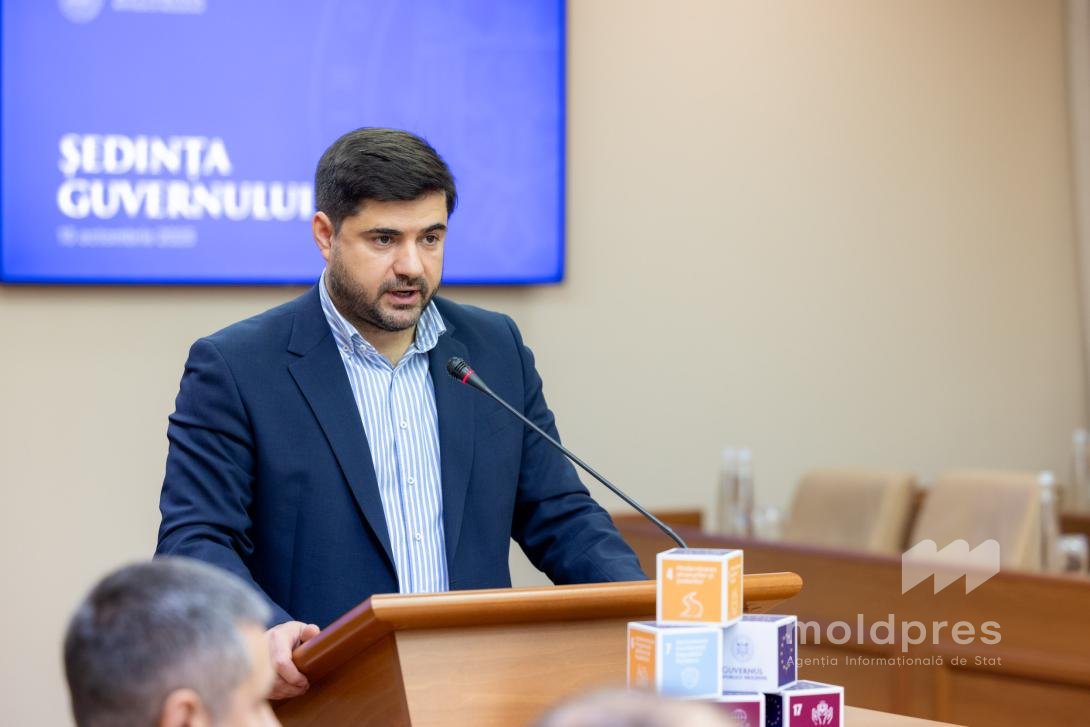
APP head: Separating railway infrastructure from commercial services - necessary step for modernization of CFM
The process of reforming the railway sector in the Republic of Moldova is entering a decisive stage, and the separation of infrastructure from commercial services is one of the most important objectives assumed by the authorities. The statements were made today by Roman Cojuhari, Director General of the Public Property Agency (APP), who explained the reasoning, stages, and impact of this reform on Moldovan Railways (CFM).

According to Roman Cojuhari, in recent years changes have been made that had not occurred for decades.

“Many processes have been made more efficient, and efforts have been focused on those areas that truly bring added value both to the Railways and to the Republic of Moldova. One of the key reforms, expressly provided for by legislation and discussed for some time, is the separation of railway infrastructure from commercial activity,” APP head emphasized.


Two distinct entities with clearly defined roles

Roman Cojuhari explained that the model applied in the railway sector is similar to that used in the road sector: the state is responsible for infrastructure, while commercial activity is carried out separately.

“The State Enterprise ‘Moldovan Railways’ will remain in place and will manage the railway infrastructure. Under the Railway Code and multiannual contracts, the state is obliged to maintain the railway lines, stations, depots, and related land,” he specified.

In parallel, the joint-stock company “Freight and Passenger Railways” will be created, with 100% state-owned capital, and it will have a strictly commercial objective: the transport of freight and passengers.

“The Railway Code also provides for the subsidization of certain passenger transport services, and this mechanism will be easier to apply within the new structure,” Cojuhari noted.


State remains the owner, no privatization

APP Director General stressed that the Railways remain a strategic sector that is not subject to privatization.

“The state will be the founder and will hold 100% of the shares both in the enterprise that manages the infrastructure and in the joint-stock company Freight and Passenger Railways. In this regard, amendments will be made to Law No. 121 to reflect the new legal structure,” stated Roman Cojuhari.

Each of the two entities will be a separate legal person, with its own balance sheet, separate accounts, and its own management. There will also be a clear separation of assets and liabilities: infrastructure will remain with the state enterprise, while locomotives, wagons, buildings used for freight and passenger transport, as well as the debts related to this activity, will be transferred to the new joint-stock company.


A phased process, to be completed by the end of 2026

Roman Cojuhari pointed out that the Government’s decision is only the beginning of the reform.

“The whole separation process will take time. It is planned that by the end of 2026 the asset valuation and the separation of the balance sheet will be completed,” Cojuhari said.

At the same time, the APP head highlighted the progress made regarding the financial situation of CFM.

“Over the last year, wage arrears have been significantly reduced. At present, payments for the month of November are already being made,” said Roman Cojuhari, noting that the efficiency measures taken by the Railways’ management are producing concrete results.


CFM’s debts in decline

According to the data presented, the total debts of Moldovan Railways currently amount to approximately 450 million lei, but they have been reduced by over 14–15% compared to 2024.

“This is very important. For the first time in many years, debts are no longer increasing, but are starting to fall. The financial result for 2025 is better than that for 2024, which confirms that the measures taken were the right ones,” the APP director stressed.


A strategic reform for the future of rail transport

In conclusion, Roman Cojuhari reiterated that the separation of infrastructure from commercial services is an essential reform for the recovery and modernization of Moldovan Railways. “It is a complex but necessary process that will ensure more efficient management, financial transparency, and real preconditions for the sustainable development of rail transport,” he concluded.
 Facebook
 Instagram
 X/Twitter
 Telegram
PHOTO, VIDEO // National Bank of Moldova launches commemorative coin “Ion Pelivan – 150th anniversary of birth”
Daniel Mititelu wins public competition for position of Moldova's National Energy Regulatory Agency
ANRE reduced electricity prices for Premier Energy and FEE Nord consumers
New agrometeorological stations to help farmers in Moldova combat drought and frost
DOC // Giurgiulești Port declared strategic asset
Moldovan energy minister thanks partners from Romania, Ukraine, EU for vital support to Moldova’s power system
Chisinau Airport launches summer season with 70 international routes
Almost 24 thousand tons of gasoline and 3,300 tons of diesel imported into Moldova in last three days
First diesel price cut since outbreak of Middle East conflict
Government to maintain state of emergency as long as situation requires, government spokesperson says
New round of EcoVoucher program: around 3,000 families to be able to replace old household appliances with new, energy-efficient equipment
Faster, greener European rail: Chișinău–Ungheni line enters electrification phase
Electricity consumption decreases by 3 per cent in Moldova on March 26; energy minister describes this as important result of efforts of all country's consumers
VIDEO // Energy minister says solidarity of European partners helps country overcome energy crises
New wave of oil products' slicks detected on Dniester River; authorities convene for emergency meeting
Moldovan PM participates in awards ceremony recognizing rescuers' achievements
Large wind farms with energy storage systems to be built in Moldova: 16 bids submitted in tender
Environmental protection experts from two banks of Dniester hold new working meeting
Moldovan Central Electoral Commission accredits 14 national observers to monitor new local elections, local referendums
New milestone for green energy: Moldova surpassed 1 Gigawatt of installed renewable energy capacity
President met with U.S. Senator
 National Bank of Moldova
Moldovan PM participates in awards ceremony recognizing rescuers' achievements
Environmental protection experts from two banks of Dniester hold new working meeting
Moldovan deputy PM has meeting with Ambassador of Germany
President met with U.S. Senator
Proposals for improving efficiency of ministries discussed at roundtable

VIDEO // Single institution to manage Moldova’s forests
CNMC: Eenergy sector remains fragile, ending state of emergency requires caution
Foreign Ministry: We condemn violation of airspace. Such actions endanger citizens’ security
Support for export promotion: 16 business associations to receive 14.6 million lei through Bridge Export Program
Over 20 media projects to get funding from media subsidy fund
Shahed drone illegally flew over airspace of Moldova
Over 25,000 residents from left bank of Dniester commute daily to right bank, Deputy Prime Minister for Reintegration says
BTA: Bulgarian Literature Has Become Increasingly Visible on International Stage - Deputy Culture Minister Stoyanov
Simple motion on public policies implemented by Ministry of Labour and Social Protection failed
Proposals for improving efficiency of ministries discussed at roundtable
PHOTO GALLERY // Premiere at Mihai Eminescu National Theater: “Intrigue and Love,” directed by Alexandru Cozub
Moldova to sign social security agreements with Quebec (Canada), Albania, Croatia and Ireland
Around 622,000 vulnerable families receive energy compensation
Prime Minister visited agricultural business in Unguri village, Ocnița district
Minister of Labor and Social Protection: Deficit of state social insurance budget decreased to 3.6 billion lei in 2026
Prime Minister visited rescuers and firefighters unit in Ocnița
Receive the latest news directly to your email

Receive the latest news directly to your email