
BUILDING MOLDOVA // Deputy Prime Minister: Ungheni–Chișinău highway to put Moldova on European Union’s map
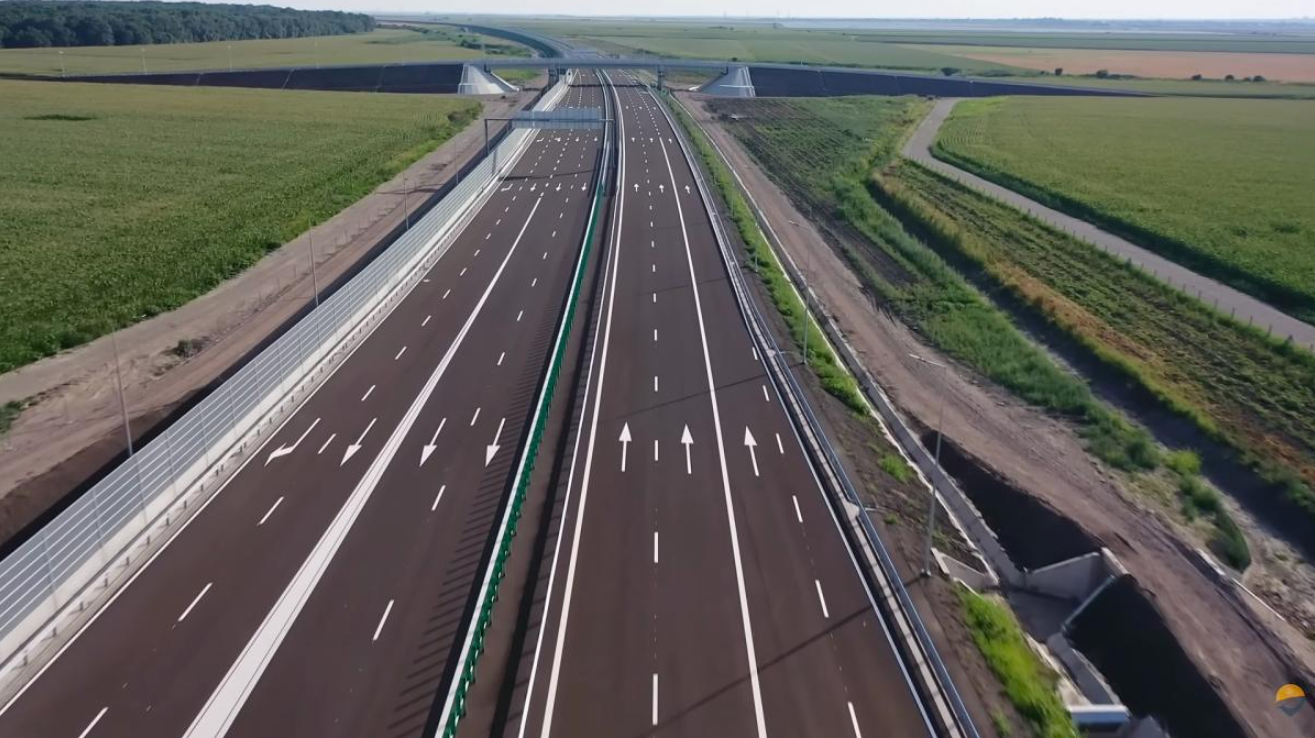
The construction of Ungheni–Chișinău highway will connect the Republic of Moldova to the European network. It will link Chișinău with Iași, providing road connections with Hungary, Slovenia, Austria and other European countries. The project, estimated at approximately 1.2 billion euros, will facilitate the transportation of goods and help attract investment. The message was conveyed by Deputy Prime Minister, Minister of Infrastructure and Regional Development Vladimir Bolea, who presented several strategic projects today at Building Moldova event, dedicated to investments made through Moldova Growth Plan, supported by the European Union.

The official emphasized that infrastructure projects contribute to increasing people’s optimism, while the thousands of projects implemented by the Government demonstrate efforts to develop all 1,682 localities across the country. He also referred to five of the most important projects included in the Growth Plan, involving total investments of 80 billion lei.


“These projects would have been impossible to implement without the support of the European Union, because our national budget amounts to 96 billion lei. Therefore, if we had to invest 80 billion lei from the budget, it would mean that we would need hundreds of years to build these objectives, which are extremely important both for citizens and for the national economy. Thanks to the Growth Plan and the plan we have in place, I firmly believe that these projects can be implemented in the Republic of Moldova over the next five years. These initiatives are not futuristic or distant projects. They are projects that are already being worked on and are currently at different stages of implementation in the Republic of Moldova,” said Vladimir Bolea.


He noted that the project to extend the A8 motorway on the territory of the Republic of Moldova, over a distance of approximately five kilometers, has already entered the implementation phase.


“The first motorway segment, 5.2 kilometers long, has already been contracted. As for the second motorway segment on the territory of the Republic of Moldova, the tender has taken place, while the bridge over the Prut, which forms one end of the motorway, is 56% complete. The continuation of the A8 motorway on the territory of the Republic of Moldova, over a length of approximately five kilometers, is already a project that has entered the implementation phase. The appeals will be examined, after which we will move on to construction. Regarding the segment under the responsibility of the Ministry of Infrastructure, we have launched tenders for the feasibility study for the next 125 kilometers of motorway, which will connect Ungheni with Budești in Chișinău Municipality, specifically the Ungheni road interchange with the Budești road interchange. This is extremely important because the final five kilometers coincide with the fourth segment of the Chișinău ring road. Thus, traffic will be diverted from Chișinău Municipality toward Budești, which is extremely necessary for the capital’s residents,” the Deputy Prime Minister explained.


Vladimir Bolea added that the construction of the motorway is essential for connecting the Republic of Moldova to the European road network and attracting investors. According to the official, the existence of a functioning motorway could encourage major businesses to invest in the country.


“I would like to refer to two cities in Romania that, at the time of accession to the EU, had similar potential—Timișoara and Iași. Today, we see that GDP in Timișoara, a city directly connected to the European Union by motorway, is approximately 22,000 euros. GDP in Iași, a city that does not benefit from this motorway connection, is approximately 17,000 euros. In Chișinău Municipality, GDP is approximately 7,600 euros. It was extremely important for us to have these first five kilometers completed by the end of 2029 and subsequently, by 2030–2031, to connect Chișinău with the entire European Union. This means free movement and reduced travel times. First of all, we must understand that, according to the studies conducted, a motorway allows a significant portion of heavy traffic to be redirected from national roads. According to these studies, 70% of heavy traffic is routinely redirected onto motorways. This means greater safety in localities,” the minister stated.


The Deputy Prime Minister emphasized that the A8 motorway represents a turning point in the economic development of the Republic of Moldova, placing the country on the map of the European Union.


“The Republic of Moldova has designated this motorway as the A8. Thus, if you enter Romania on the A8 motorway, within the European Union and the Schengen Area, you can continue traveling through the territory of the Republic of Moldova on the same A8 motorway. Therefore, we are already connected to the European motorway network. We understand the importance of this project, as well as its costs, which amount to approximately 1.2 billion euros, because it is an extremely expensive project. We are talking about a four-lane motorway and, from an investment perspective, it is clear that without the direct support of the European Union, it will be very difficult for us to build it, even if we obtain part of the financing through loans from the EBRD and the EIB. That is why we are relying heavily on the new financial year, and I firmly believe, following the discussions we are having at the level of the European Union, that we will receive full support to begin construction. If we have the feasibility study by August–September 2027, I believe that we will be able to begin construction of this extremely important motorway in 2028,” Vladimir Bolea explained.


The official also referred to other important national road segments, emphasizing that the inclusion of the Republic of Moldova in the Trans-European Transport Network, TEN-T, facilitates access to European funds for the construction and reconstruction of road infrastructure.


“We are talking about another 132 kilometers of roads that are to be built. We are referring to the R7 road, which will connect the city of Drochia with the town of Costești, where the border crossing point with Romania is located. We have also begun the process of tendering the feasibility study for an extremely important road that is to become an expressway. It will start at the exit from Chișinău, on Grenoble Street, and continue along the Chișinău–Cimișlia–Comrat route. We are referring to the Chișinău–Cimișlia segment, where we have a road built in the 1980s whose service life has already been exceeded. It is to be completely reconstructed. From Porumbeni to Cimișlia, on the other carriageway, where we already have the bridges and other infrastructure elements, the asphalt layer is to be laid so that we have four lanes all the way to Cimișlia. The ring road segment has also already been put out to tender, while the road from Cimișlia to Comrat is to enter the reconstruction process,” he said.


The minister added that, in this way, the economic arteries currently used to transport Moldova’s exports to the two ports will be brought up to the highest standards, benefiting businesses that transport goods.


“This is extremely important because the two ports represent our maritime gateways. Thus, during the first nine months of the current year, 2.7 million tons of goods were imported and exported through these ports. The construction of these roads is vital for reducing travel times,” Vladimir Bolea concluded.


Moldova Growth Plan is a European Union financial support program with a total value of 1.9 billion euros, aimed at accelerating economic development, modernizing infrastructure and supporting the reforms required for the country’s European integration. Funding is conditional on the implementation of the reforms undertaken by the authorities.

It has three main components: providing financial support, facilitating Moldovan companies’ access to the EU single market, and supporting economic and institutional reforms. The package may finance, among other things, the modernization of roads and energy networks, the development of hospitals and schools, as well as support for businesses.
 Facebook
 Instagram
 X/Twitter
 Telegram
CHINA EXPO – Christmas Sale to be held for first time at Moldexpo on December 17
State Secretary for Reintegration: Revenue from taxes imposed in Transnistrian region will return to population through Convergence Fund
Grant to strengthen cybersecurity: Republic of Moldova to receive $1.2 million in U.S. support
PHOTO GALLERY // Moldova to receive $1.2 million U.S. grant to strengthen cybersecurity
Voted in first reading // More enterprises could benefit from SME support programs
Energy Minister at Energy Transition Agenda Conference: Moldova’s energy future is European, and regional integration path through which we can build it more quickly and efficiently
EU market absorbs 69.9 million euros in Moldovan IT exports in first quarter of 2026
United States, Romania, Germany among main markets for Moldovan IT services
Moldova’s IT exports to EU grow by almost 20 per cent in one year
Coal imports into Moldova fall by 19%
Republic of Moldova seeks alternatives for natural gas procurement, including in Ukraine
Prime Minister explains failure of Zarea hotel privatization, announces changes for future auctions
Chisinau Airport to have new air connection with Serbia
Made in Moldova exhibition to take place on 27-31 January 2027
Taras Shevchenko gymnasium's library enriched with Ukrainian children’s literature
BUILDING MOLDOVA // Prime Minister presents strategic projects financed through Moldova Growth Plan
Parliament to hold closed-door hearings on cyberattack and compromise of data of 750,000 citizens
Moldovan Speaker's message on National Greening Day
 National Bank of Moldova

Moldova aligns audiovisual legislation with European standards
Small farms in villages to be able to operate under clearly established conditions
National legislation on electronic evidence adjusted to international standards
Regulatory framework on civil protection and fire safety aligned with European standards
Romanian language courses and integration support for foreigners in Moldova: Parliament passed bill on integration of foreigners

BUILDING MOLDOVA // Prime Minister presents strategic projects financed through Moldova Growth Plan
Parliament to hold closed-door hearings on cyberattack and compromise of data of 750,000 citizens
Moldovan Speaker's message on National Greening Day
LIVE // Building Moldova: Government presents strategic investment projects from Growth Plan
Minister of Economic Development and Digitalization announces broad reform of state enterprises
Irina Rîngaci wins silver at World Wrestling Championships in Astana
New 250 million-euros-worth project in central Moldova settlement; PM: “These are investors who know Moldova, invested here, and are choosing to invest again – on a much larger scale”
Moldovan president highlights risks artificial intelligence to cybersecurity at leaders’ meeting on frontier model control, convenes Moldova's National Security Council
Moldovan PM, IMF's teams discuss economic outlook, fiscal, budgetary policy priorities
VIDEO // Remote medical consultations for village residents; Moldovan Health Ministry launches pilot project
Moldovan parliament's standing bureau approves agenda for plenary meeting due on October 29
Moldovan president offers condolences to families of victims of railway accident in Toledo province: “Moldova stands with Spanish people”
Moldovan Foreign Affairs Ministry extends condolences to families of victims of railway accident in Spain
Train accident in Spain; Moldova's Foreign Affairs Ministry checks whether Moldovan citizens are among victims
Defense Minister on agreement with Ukraine: goal is to protect population and airspace
Moldovan students can get scholarships for high school studies in USA and UK
Receive the latest news directly to your email

Receive the latest news directly to your email