
BUILDING MOLDOVA // Schools and universities at heart of European investment
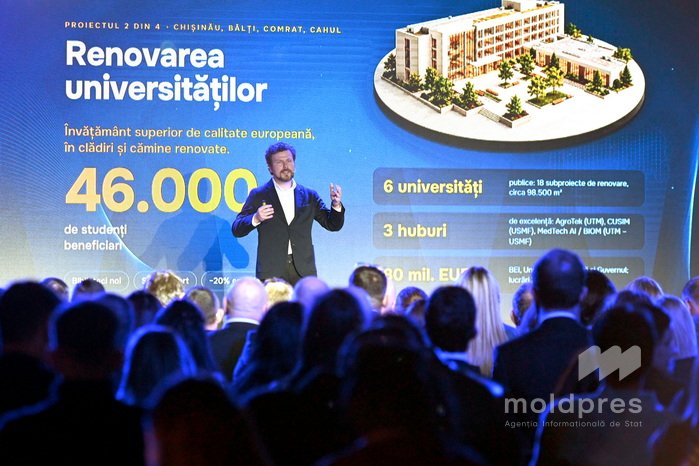
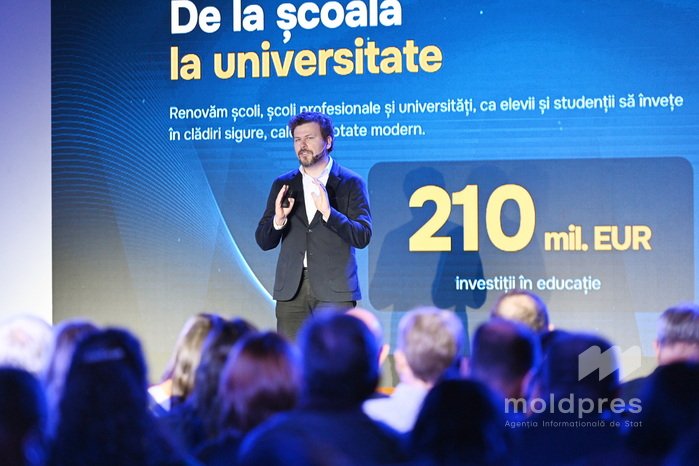
Investments provided for education under the Republic of Moldova’s Growth Plan amount to 210 million euros and target the modernization of schools, the development of universities, and the renovation of vocational and technical education institutions. Minister of Education and Research Dan Perciun presented the projects today at Building Moldova event, emphasizing that the authorities’ objective is to reduce disparities between educational institutions and create better opportunities for pupils and students.


“The Ministry of Education is one of the beneficiaries of the Growth Plan, which means that European resources will also reach pupils, students, those studying in vocational schools, and students at colleges in our country,” Dan Perciun said.


The minister said that the investments must be viewed in the context of a broader vision for the education system, whose fundamental objective is to ensure access to quality education regardless of the locality where a child is born.


“One of the fundamental things we want at the ministry is for every child in our country, regardless of where they were born, to be able to benefit from education of a similar quality. Unfortunately, today we still live in a country where this does not happen,” the official said.


According to Perciun, access to quality education is still influenced by the locality where a child lives and the institution they attend. In this context, the authorities aim to develop a network of schools that provide modern conditions and become educational centers for the surrounding communities.

The minister recalled that the model schools initiative was launched in 2023, based on the Republic of Moldova’s results in the international PISA assessment and statistical data on the education system.

The network includes 90 institutions, 65 of them in the districts and 25 in the municipality of Chișinău. They are expected to become regional centers capable of attracting pupils from several localities.


“The initial idea was that when you enter a model school as a parent, the infrastructure and what happens at the school speak for themselves and are convincing enough for you to want, understand, and accept that it may be worth traveling ten kilometers there every day on a new bus, because your child can benefit from the highest-quality education there,” Dan Perciun explained.


Of the 90 institutions included in the network, 20 will be modernized with resources from the Growth Plan. Approximately 50 million euros have been earmarked for these investments, and around 40,000 children are expected to benefit from improved study conditions.

The selection includes institutions in the municipality of Chișinău and other localities across the country. In the capital, the investments also aim to reduce overcrowding in some schools, where classes are overcrowded while other institutions have unused space.


“In the municipality of Chișinău, there are schools where half of the buildings are empty. Why? Because parents do not want to send their children there. They do not want to send their children there because the conditions are poor,” the minister said.


According to him, modernizing institutions with poor infrastructure should make them more attractive to families and contribute to a more balanced distribution of pupils throughout the school network.


“To also solve the overcrowding problem in Chișinău, we have included institutions with poor infrastructure, which are currently unattractive, where we will invest so that, within three or four years, parents will become interested in sending their children there and we will thus relieve the city’s school network,” Dan Perciun stated.


The minister said that transforming model schools will not be limited to repairs and equipment. The institutions will also benefit from organizational transformation programs targeting school management, the relationship between teachers and pupils, the atmosphere at school, and children’s participation in decision-making.


“We can have the best laboratories. This will contribute to better education, but fundamentally, what happens inside the school must also change: the organizational culture, the way teachers interact with pupils, and the quality of school administration,” the official said.


He noted that the ministry is trying, including with the support of partners from Estonia, to change both study conditions and the way the educational process is conducted.


“We are aware that infrastructure must be accompanied by a transformation in the way things are approached in those schools,” the minister emphasized.


Dan Perciun added that the model schools projects are part of a broader process that includes Restart reform, curriculum modernization, and the procurement of textbooks from Estonia.

Another component of the Growth Plan concerns universities. According to the minister, the authorities aim to increase the number of young people who choose to continue their studies in the Republic of Moldova by modernizing infrastructure and developing training programs adapted to current requirements.


“There is no point in having the best schools if we subsequently fail to convince young people to choose the Republic of Moldova for higher education,” Dan Perciun said.


He noted that in 2023, approximately 5.5 out of every ten high school graduates chose universities in the Republic of Moldova. The minister believes that the country must be able to offer attractive conditions and programs without discouraging young people who want to study abroad.


“There will always be some who choose to go abroad, and we encourage them to do so if they have been admitted to Harvard, Cambridge, or Stanford. It will be difficult for us to compete with these top universities, but I am sure that we can retain more young people here, at home. For that, we must have something to offer them,” the minister said.


Perciun recalled that between 2021 and 2025 and until mid-2026, approximately 600 million lei were invested in universities through a previous project carried out with the support of the World Bank. According to the official, these investments contributed to infrastructure modernization and were accompanied by four consecutive years of growth in undergraduate admissions.


“We have seen a steady trend in recent years, with our young people increasingly choosing to come to our universities. [...] It is a process of infrastructure modernization,” Dan Perciun said.


The minister also mentioned the initiative through which, over the past three years, between 7,000 and 8,000 pupils have been taken on visits to universities to see the laboratories, study facilities, and the results of the investments.

According to him, approximately 6.5 out of every ten graduates currently choose to study in the Republic of Moldova, compared with 5.5 out of ten in 2023. Among the factors contributing to this trend, the minister listed the modernization of universities and growing confidence in the country’s prospects, including in the context of European integration.


“People are gaining confidence in the Republic of Moldova as a state and in what it can offer them in the future,” the official said.


The university component of the Growth Plan includes investments in six universities. These will target both basic infrastructure—academic buildings and laboratories—and innovative projects designed to bring education closer to research and the business community.

One of the projects is the Agrotech Hub, which is to be developed on Mircești campus of the Technical University of Moldova. The center will bring together fields such as engineering, information technology, and agriculture, providing a shared space for researchers, students, and business representatives.


“There, we are going to have an innovation center at the intersection of engineering, IT, and agriculture, for research, students, and the business community, all within the same five-hectare area,” Dan Perciun explained.


According to the minister, an initial investment of five million euros from the World Bank is planned for the campus, while an additional 15 million euros would be allocated through the Growth Plan for the development of the innovation park.

A second project concerns Nicolae Testemițanu State University of Medicine and Pharmacy and provides for the expansion of the medical simulation center. It will allow students to practice various medical procedures and interventions before working with patients in clinical settings.


“It is a simulation center that will allow the university to expand its current capabilities and, essentially, improve the quality of student training by giving students the opportunity to simulate all kinds of operations and medical procedures while still at university,” the minister said.


The third project is related to the development of the park in Stăuceni and involves the construction of a joint building for the University of Medicine and the Technical University of Moldova. Undergraduate, master’s, and doctoral programs would be offered there, particularly in bioengineering, a field at the intersection of medicine and engineering.

Another direction of the Growth Plan concerns vocational schools and colleges. According to Dan Perciun, the project has a budget of 89 million euros and provides for interventions in 24 buildings and 23 dormitories.

The investments are focused on institutions training specialists in areas considered priorities for the economy of the Republic of Moldova: energy, construction, IT, and agriculture.


“This country has potential in four main areas: energy, construction, IT, and agriculture. Therefore, everything we do here must be aligned with the development of these sectors, where there is human potential, a certain level of economic activity, and where investments will yield greater returns,” the minister explained.


He said that the selection of beneficiary institutions is based on the needs of these sectors and the capacity of vocational schools and colleges to train specialists sought on the labor market.

In the minister’s view, vocational and technical education must become an attractive alternative for young people, including those who complete lower secondary school.


“Not everyone necessarily has to attend university. There are enough well-paid occupations in the vocational and technical sector. It is essential to have vocational schools and colleges connected to business, preparing specialists capable of bringing added value to the economy of the Republic of Moldova and being perceived as an equally good alternative to attending high school after the ninth grade,” Dan Perciun stated.


According to the schedule presented by the minister, the project has been approved by the Government and is to be examined by Parliament. Subsequently, the technical design would be carried out in 2027, with construction scheduled to begin in 2028.


“This is the largest investment the state has made in vocational and technical education since independence. It is also the largest investment and one that will represent a fundamental transformation of this sector,” the official said.


The minister noted that investments in vocational infrastructure must be accompanied by stronger connections between educational institutions and employers so that the training provided corresponds to the needs of the economy.

During the presentation, Dan Perciun also referred to the high-tech park project in Stăuceni, carried out in cooperation with the Ministry of Economic Development and Digitalization.

The initiative provides for the development of an approximately 50-hectare area intended for companies in IT, microelectronics, and other high-value-added sectors. The project seeks to create conditions for the development of economic activities based on advanced technologies and bring the academic environment closer to companies.


“The ambition is to create a 50-hectare innovation park, essentially the size of a small city, creating the conditions for technology-driven economic growth, with spaces for IT companies and companies producing goods and services in microelectronics and other high-value-added sectors,” the minister said.


The project also includes the development of activities in bioengineering and advanced medical technologies, including through the building intended for joint programs of the Technical University of Moldova and Nicolae Testemițanu State University of Medicine and Pharmacy.

According to Perciun, the Technical University of Moldova, the State University of Medicine and Pharmacy, Stăuceni City Hall, the Public Property Agency, and the Chișinău Municipal Hall are participating in the initiative.


“It is a complex urban transformation project, if you will, and a contemporary innovation space that will bring all the relevant actors together and create a major economic stimulus. It is a highly complex project from an infrastructure perspective, but it is already being implemented,” the minister stated.


Dan Perciun said that the 210 million euros allocated to the Ministry of Education and Research under the Growth Plan complement investments made together with the World Bank and other partners.


“In addition to the Growth Plan, the Ministry of Education, together with the World Bank and other partners, has a total investment envelope of nearly half a billion euros for the next five years,” the official said.


Overall, the projects presented target three main areas: reducing disparities between schools across the country, modernizing universities to attract and retain more students in the Republic of Moldova, and developing vocational and technical education in line with the requirements of the economy.

The minister emphasized that investments in education must help train the specialists the country needs and create professional prospects for young people in the Republic of Moldova.

Moldova Growth Plan is supported by the European Union and provides funding for the 2025–2027 period, conditional on the implementation of reforms undertaken by the authorities.
 Facebook
 Instagram
 X/Twitter
 Telegram
Online services for submitting, issuing permits restored after cyberattacks in Moldova
PHOTO // Garden of 100 roots inaugurated in Nisporeni on eve of National House centenary
Deputy Prime Minister to visit Cyprus for discussions on European integration and cooperation
Cyberattack on digital public services: authorities block about 11 million access requests
PHOTO // Austria’s National Day marked in Chisinau
Violence can escalate to femicide: How to recognize warning signs and where victims can seek help
PHOTO GALLERY // Romanian Armed Forces Day celebrated in Chișinău with exhibition dedicated to international military missions during interwar period
Two cases of national airspace violations recorded in Moldova in past week; Defence Ministry reiterates need to strengthen air defense capabilities
Drone falls in central Moldova village; police secure area
First at November 1, 2026 elections in Moldova: voters to be able to vote using digital ID from EVO app
Drone illegally entered airspace of Moldova, disappears from radar
PHOTO GALLERY // Two hospitals of Moldova start process of energy modernization
Two members of Judges' Evaluation Commission to end activities on 31 December 2026
Energy consumption in ten hospitals in Moldova expected to drop by 40%; first two hospitals begin renovation
Taras Shevchenko gymnasium's library enriched with Ukrainian children’s literature
BUILDING MOLDOVA // Prime Minister presents strategic projects financed through Moldova Growth Plan
Parliament to hold closed-door hearings on cyberattack and compromise of data of 750,000 citizens
Moldovan Speaker's message on National Greening Day
 National Bank of Moldova

Moldova aligns audiovisual legislation with European standards
Small farms in villages to be able to operate under clearly established conditions
National legislation on electronic evidence adjusted to international standards
Regulatory framework on civil protection and fire safety aligned with European standards
Romanian language courses and integration support for foreigners in Moldova: Parliament passed bill on integration of foreigners

BUILDING MOLDOVA // Prime Minister presents strategic projects financed through Moldova Growth Plan
Parliament to hold closed-door hearings on cyberattack and compromise of data of 750,000 citizens
Moldovan Speaker's message on National Greening Day
LIVE // Building Moldova: Government presents strategic investment projects from Growth Plan
Minister of Economic Development and Digitalization announces broad reform of state enterprises
Irina Rîngaci wins silver at World Wrestling Championships in Astana
New 250 million-euros-worth project in central Moldova settlement; PM: “These are investors who know Moldova, invested here, and are choosing to invest again – on a much larger scale”
Moldovan president highlights risks artificial intelligence to cybersecurity at leaders’ meeting on frontier model control, convenes Moldova's National Security Council
Moldovan PM, IMF's teams discuss economic outlook, fiscal, budgetary policy priorities
VIDEO // Remote medical consultations for village residents; Moldovan Health Ministry launches pilot project
Moldovan parliament's standing bureau approves agenda for plenary meeting due on October 29
Moldovan president offers condolences to families of victims of railway accident in Toledo province: “Moldova stands with Spanish people”
Moldovan Foreign Affairs Ministry extends condolences to families of victims of railway accident in Spain
Train accident in Spain; Moldova's Foreign Affairs Ministry checks whether Moldovan citizens are among victims
Defense Minister on agreement with Ukraine: goal is to protect population and airspace
Moldovan students can get scholarships for high school studies in USA and UK
Receive the latest news directly to your email

Receive the latest news directly to your email