
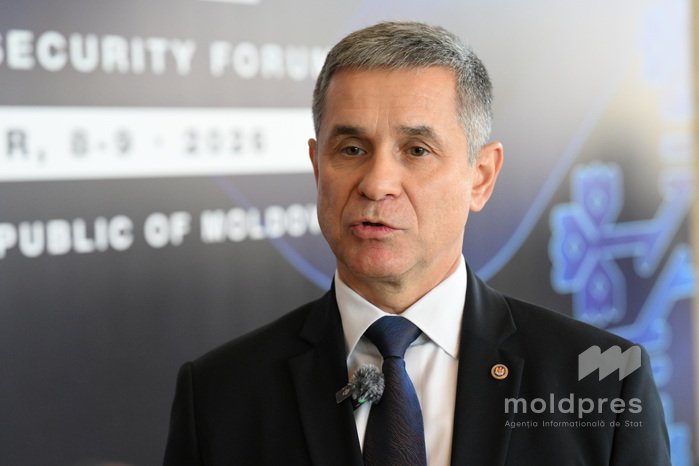
Defense Minister on agreement with Ukraine: goal is to protect population and airspace
The military-technical cooperation agreement between the Republic of Moldova and Ukraine aims to protect the population and airspace from Russian drones and other dangers to national security. Defense Minister Anatolie Nosatîi made the statement today. He explained the provisions of the document and the steps required for it to enter into force.


“I would like to emphasize that the partnership’s sole purpose is to protect the population and airspace from Russian drones and other dangers and threats to national security,” Anatolie Nosatîi said after today’s government meeting.


The minister said that the document would be sent to the Ministry of Foreign Affairs, after which the Ministry of Defense would promote its ratification by Parliament. Following its presentation to the legislature, the full text of the agreement will be available for public consultation and will be published on Parliament’s website.


“At that point, the full text will be available to the entire society, including those who spread misinformation by claiming that this treaty is secret. The agreement will be published on Parliament’s website,” the official said.


According to Nosatîi, after ratification, the agreement will enter into force in accordance with the provisions of the 1969 Vienna Convention on the Law of Treaties.

The minister rejected the opposition’s criticism of military cooperation with Ukraine, stating that such initiatives contribute to strengthening the security of the Republic of Moldova.


“I would like to point out that the opposition is against everything that is done well for the Republic of Moldova, in order to promote the agenda of the Russian Federation and to ensure that the Republic of Moldova remains a state unable to meet security requirements in the interests of its citizens,” Nosatîi said.


The official noted that the Ministry of Defense currently has more than 120 military agreements concluded with various partner states. These cover areas such as training, logistics, military medicine, cybersecurity and the strengthening of defense capabilities.

The new agreement with Ukraine provides for cooperation in areas such as the modernization and operation of military equipment, communications systems, specialist training, the protection of critical infrastructure, the exchange of knowledge and technologies, research and development of military production, as well as strengthening cyber-defense capabilities.

Anatolie Nosatîi emphasized that the document does not provide for the direct granting of military assistance to a state involved in an armed conflict. According to his explanations, the cooperation will be consultative in nature and will include the exchange of technical and scientific information, specialized documentation, best practices and professional experience.
 Facebook
 Instagram
 X/Twitter
 Telegram
Moldova and Ukraine accelerate Bălți–Dnestrovsk power line project to increase energy exchanges between two countries
Prime Minister in Kyiv: Moldova to remain reliable neighbor and partner of Ukraine
Moldova's European path and regional security discussed by Foreign Ministers of Moldova and Cyprus
Romania’s Prime Minister to visit Chișinău on Tuesday
Republic of Moldova and Cyprus seek to deepen interparliamentary cooperation
Foreign affairs minister of Moldova, President of Cyprus discuss strengthening Moldovan-Cypriot relations, Moldova’s European agenda
VIDEO // Moldovan PM in Kyiv says Moldova reconfirms firm support for Ukraine
PM: Commissioning Chișinău power substation to reduce risk of blackout
Tofan Government’s 100-day report to be presented on 5 November
President holds meetings with Hungary’s leaders in Budapest
PHOTO // President honors courage of Hungarian people, 70 years after 1956 anti-communist Revolution
Ukraine condemns violation of Moldova’s airspace
Moldovan president condemns incident in Telenesti district: “Russia’s war continues to endanger citizens’ lives”
Staff member of Russia's Embassy in Moldova to be declared persona non grata after explosive-laden drone crashed in Telenesti district
Train accident in Spain; Moldova's Foreign Affairs Ministry checks whether Moldovan citizens are among victims
Defense Minister on agreement with Ukraine: goal is to protect population and airspace
Moldovan students can get scholarships for high school studies in USA and UK
Economy Minister announces simplified rules for small entrepreneurs and cybersecurity measures
200,000-lei allowances for Romanian language teachers going to teach in Gagauzia and Taraclia
Government simplifies business rules and reduces administrative costs
International parcels valued under €150 to be subject to VAT starting 1 November
 National Bank of Moldova

200,000-lei allowances for Romanian language teachers going to teach in Gagauzia and Taraclia
Government updates privatization rules and list of state-owned assets
Government simplifies business rules and reduces administrative costs
Government approves 2026 National Prize laureates' list
Enhanced protection against bank card fraud and other cashless payment instruments

Enhanced protection against bank card fraud and other cashless payment instruments
ARMENPRESS: Slovenia firmly supports Armenia’s efforts to deepen EU ties, says FM
EcoContact presents Moldova’s experience in biodiversity conservation at regional event in Armenia
Moldelectrica gets required documents for design of 400 kV Bălți–Suceava power line
APP head announces measures to facilitate privatization and reorganize state-owned enterprises
Prime Minister on cyberattack targeting public digital services: Authorities investigating possible involvement of foreign actors
CEC: Electoral information systems and voter data not affected by cybersecurity incident
Government announces changes in leadership of e-Governance Agency and Agency for Geodesy, Cartography and Cadastre
Five European champions and six medals for Moldova at European Muaythai Championships in Paris
Deputy Prime Minister on working visit to Kingdom of the Netherlands
Ministry of Agriculture proposes extending licensing of grain and oilseed imports by late year
Moldovan, Romanian Prime Ministers visit Chisinau Electrical Substation
VIDEO // Moldovan president has meeting with Romanian PM
PHOTO // Romanian PM visits Chisinau Electrical Substation, which entered works acceptance procedure
Moldovan government launches new round of public consultations on legislative package for local public administration reform
PHOTO // Moldovan parliament speaker, Romanian PM discuss energy independence, connectivity between Romania and Moldova
Receive the latest news directly to your email

Receive the latest news directly to your email