
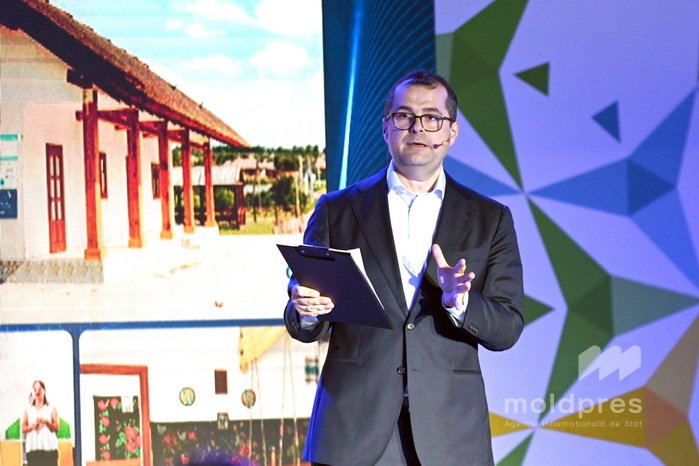
BUILDING MOLDOVA // Prime Minister presents strategic projects financed through Moldova Growth Plan
The Republic of Moldova has 912 priority investment projects in areas such as energy, road infrastructure, education, healthcare, irrigation and the digital economy, while the authorities intend to accelerate their implementation through a more efficient coordination and monitoring mechanism. Prime Minister Vasile Tofan presented several of the strategic projects today at Building Moldova event, dedicated to investments carried out through the Republic of Moldova’s Growth Plan, supported by the European Union.


“European integration does not mean only laws, it does not mean only negotiations; it also means concrete investments and concrete projects that make our lives better. A European country is not declared, a European country is built, and that is what we want to do,” Vasile Tofan said at the opening of the event.


The prime minister explained that the authorities chose to organize the presentation outside the Government headquarters in order to showcase the investments and their results in concrete terms, rather than merely discuss development plans.


“When we are in a European state, many things seem natural to us. A good road, a competitive company, electricity that is available and never goes out, efficient heating and other things. These are ordinary things that have been built over decades. We do not have decades at our disposal. We want to close this gap in a few years, and that is why we have this historic opportunity called the Growth Plan,” the prime minister stated.


According to Tofan, the Growth Plan is the main source of funding for some of the country’s priority investments. European funding is conditional on the implementation of the reforms undertaken by the authorities, while the projects are at different stages of implementation, ranging from feasibility studies to works in progress or completed projects.

The prime minister said that approximately 425 projects have already been implemented or are currently underway, of which 374 are local investments and 177 have been completed. The Republic of Moldova has already received approximately €500 million from the European Union, including a €157 million tranche granted on the basis of the reforms implemented, the official noted.

To illustrate how the funds are being used, the prime minister listed several projects carried out in localities across the country. These include wastewater treatment plants in Zăbriceni, Edineț District, with a processing capacity of 200 cubic meters of water per day and investments of approximately 8 million lei, as well as water supply and infrastructure works in Hâjdieni and Vlădeni.

Vasile Tofan also mentioned the repair of a road in Nisporeni District that had not been renovated for approximately 20 years, the modernization of the Licurici kindergarten, the first daycare center for children under three in Hâncești, and the renovation of four kindergartens in Chișinău. He also referred to roads modernized to provide access to educational institutions and public services in several localities, as well as vouchers granted for the modernization of electrical appliances.


“This is how Moldova is built; this is where the money from the Growth Plan goes,” the prime minister said.


At the same time, the head of government emphasized that securing funding is not enough if projects are not completed on time and within the established budgets.


“We must be able to deliver on time and within budget. Quickly, well and cost-effectively. The Growth Plan provides the funding, but it is our responsibility to ensure that we can deliver these projects on time,” Vasile Tofan stated.


To reduce delays caused by approval procedures, tenders, appeals and a lack of coordination among implementing units, the Government intends to strengthen project management capabilities within a more powerful structure that can accelerate the implementation of investments.


“A single objective: for projects to be completed, not merely announced,” the prime minister emphasized.


The authorities also intend to ensure implementation transparency. According to Tofan, citizens and journalists will be able to consult information about the status of each project and request explanations whenever delays occur.

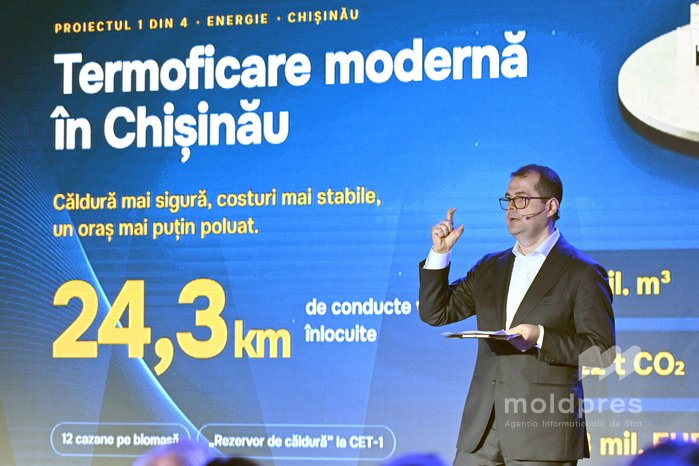
In his speech, the prime minister presented four priority investment directions in the energy sector: modernizing the district heating networks in Chișinău, increasing the energy efficiency of buildings, developing electricity interconnections with neighboring states and modernizing the National Electrification Network.

Tofan noted that although the private sector has contributed to the development of renewable energy capacity, the modernization of energy transmission and distribution infrastructure, as well as the improvement of energy efficiency in public buildings, requires state intervention.


“We cannot control the national energy price, but we can control the quality of our infrastructure and its efficiency,” the prime minister stated.


Regarding the capital’s district heating system, the official said that approximately 20% of thermal energy is lost in the network because of outdated pipes. The plan presented provides for the modernization of approximately 24 kilometers of network, the construction of a thermal energy storage reservoir and the installation of 12 decentralized heating plants, with a total capacity of approximately 11 megawatts. Some of these plants are expected to use biomass produced from agricultural waste.

According to the estimates presented by the prime minister, the district heating system modernization projects could enable annual savings of approximately 4–5 million cubic meters of natural gas.

Another priority concerns the energy efficiency of buildings. Vasile Tofan said that these buildings consume approximately twice as much energy per square meter for heating as buildings in Europe, while the modernization program aims to reduce energy consumption.


“Compensation payments can help us through one winter, but compensation payments will not repair structural problems. Projects like these will address the structural problems we have,” the prime minister stated.


The third strategic project presented is the Bălți–Dnestrovsk electricity line, with an estimated length of approximately 90 kilometers and a transmission capacity of 500 megawatts. According to Tofan, the interconnection would enable electricity imports from Ukraine when electricity is cheaper and create opportunities for exports to the Ukrainian market.

The fourth area concerns the modernization of the National Electrification Network. The prime minister explained that the development of renewable energy generation capacity, the expanding use of electric vehicles and the installation of storage systems will increase demand on the network. In this context, works are proposed to modernize at least 14 sections and install new transformers to improve the efficiency of electricity transmission.


“A European country is not declared. A European country is built. And today we want to show you our plans for accelerating this construction,” Vasile Tofan concluded.


During the continuation of Building Moldova event, Cabinet members presented priority projects in the fields of infrastructure, education, healthcare and other sectors included in the Republic of Moldova’s Growth Plan.

The Republic of Moldova’s Growth Plan is a European Union financial support program worth a total of €1.9 billion, intended to accelerate economic development, modernize infrastructure and support the reforms necessary for the country’s European integration. The funding is planned for the 2025–2027 period and is conditional on the implementation of the reforms undertaken by the authorities.

The plan aims to mobilize investments in areas such as energy, transport, education, healthcare, agriculture, digitalization and the development of local communities. The funds are intended both for infrastructure projects and the modernization of public services, as well as for strengthening the competitiveness of the economy and improving living conditions. The plan has three main components: providing financial support, facilitating Moldovan companies’ access to the EU single market, and supporting economic and institutional reforms. The package can finance, among other things, the modernization of roads and energy networks, the development of hospitals and schools, and support for businesses.

According to the European Commission, the €1.9 billion includes up to €1.5 billion in loans and €520 million in non-reimbursable support. Disbursements are conditional on the fulfillment of the reform milestones agreed upon by the Republic of Moldova and the European Union.
 Facebook
 Instagram
 X/Twitter
 Telegram
CHINA EXPO – Christmas Sale to be held for first time at Moldexpo on December 17
State Secretary for Reintegration: Revenue from taxes imposed in Transnistrian region will return to population through Convergence Fund
Grant to strengthen cybersecurity: Republic of Moldova to receive $1.2 million in U.S. support
PHOTO GALLERY // Moldova to receive $1.2 million U.S. grant to strengthen cybersecurity
Voted in first reading // More enterprises could benefit from SME support programs
Energy Minister at Energy Transition Agenda Conference: Moldova’s energy future is European, and regional integration path through which we can build it more quickly and efficiently
EU market absorbs 69.9 million euros in Moldovan IT exports in first quarter of 2026
United States, Romania, Germany among main markets for Moldovan IT services
Moldova’s IT exports to EU grow by almost 20 per cent in one year
Coal imports into Moldova fall by 19%
Republic of Moldova seeks alternatives for natural gas procurement, including in Ukraine
Prime Minister explains failure of Zarea hotel privatization, announces changes for future auctions
Chisinau Airport to have new air connection with Serbia
Made in Moldova exhibition to take place on 27-31 January 2027
BUILDING MOLDOVA // Schools and universities at heart of European investment
BUILDING MOLDOVA // Deputy Prime Minister: Ungheni–Chișinău highway to put Moldova on European Union’s map
BUILDING MOLDOVA // Agriculture to be based on science and smart solutions
Taras Shevchenko gymnasium's library enriched with Ukrainian children’s literature
BUILDING MOLDOVA // Prime Minister presents strategic projects financed through Moldova Growth Plan
Parliament to hold closed-door hearings on cyberattack and compromise of data of 750,000 citizens
Moldovan Speaker's message on National Greening Day
 National Bank of Moldova

Moldova aligns audiovisual legislation with European standards
Small farms in villages to be able to operate under clearly established conditions
National legislation on electronic evidence adjusted to international standards
Regulatory framework on civil protection and fire safety aligned with European standards
Romanian language courses and integration support for foreigners in Moldova: Parliament passed bill on integration of foreigners

BUILDING MOLDOVA // Prime Minister presents strategic projects financed through Moldova Growth Plan
Parliament to hold closed-door hearings on cyberattack and compromise of data of 750,000 citizens
Moldovan Speaker's message on National Greening Day
LIVE // Building Moldova: Government presents strategic investment projects from Growth Plan
Minister of Economic Development and Digitalization announces broad reform of state enterprises
Irina Rîngaci wins silver at World Wrestling Championships in Astana
New 250 million-euros-worth project in central Moldova settlement; PM: “These are investors who know Moldova, invested here, and are choosing to invest again – on a much larger scale”
Moldovan president highlights risks artificial intelligence to cybersecurity at leaders’ meeting on frontier model control, convenes Moldova's National Security Council
Moldovan PM, IMF's teams discuss economic outlook, fiscal, budgetary policy priorities
VIDEO // Remote medical consultations for village residents; Moldovan Health Ministry launches pilot project
Moldovan parliament's standing bureau approves agenda for plenary meeting due on October 29
Moldovan president offers condolences to families of victims of railway accident in Toledo province: “Moldova stands with Spanish people”
Moldovan Foreign Affairs Ministry extends condolences to families of victims of railway accident in Spain
Train accident in Spain; Moldova's Foreign Affairs Ministry checks whether Moldovan citizens are among victims
Defense Minister on agreement with Ukraine: goal is to protect population and airspace
Moldovan students can get scholarships for high school studies in USA and UK
Receive the latest news directly to your email

Receive the latest news directly to your email