
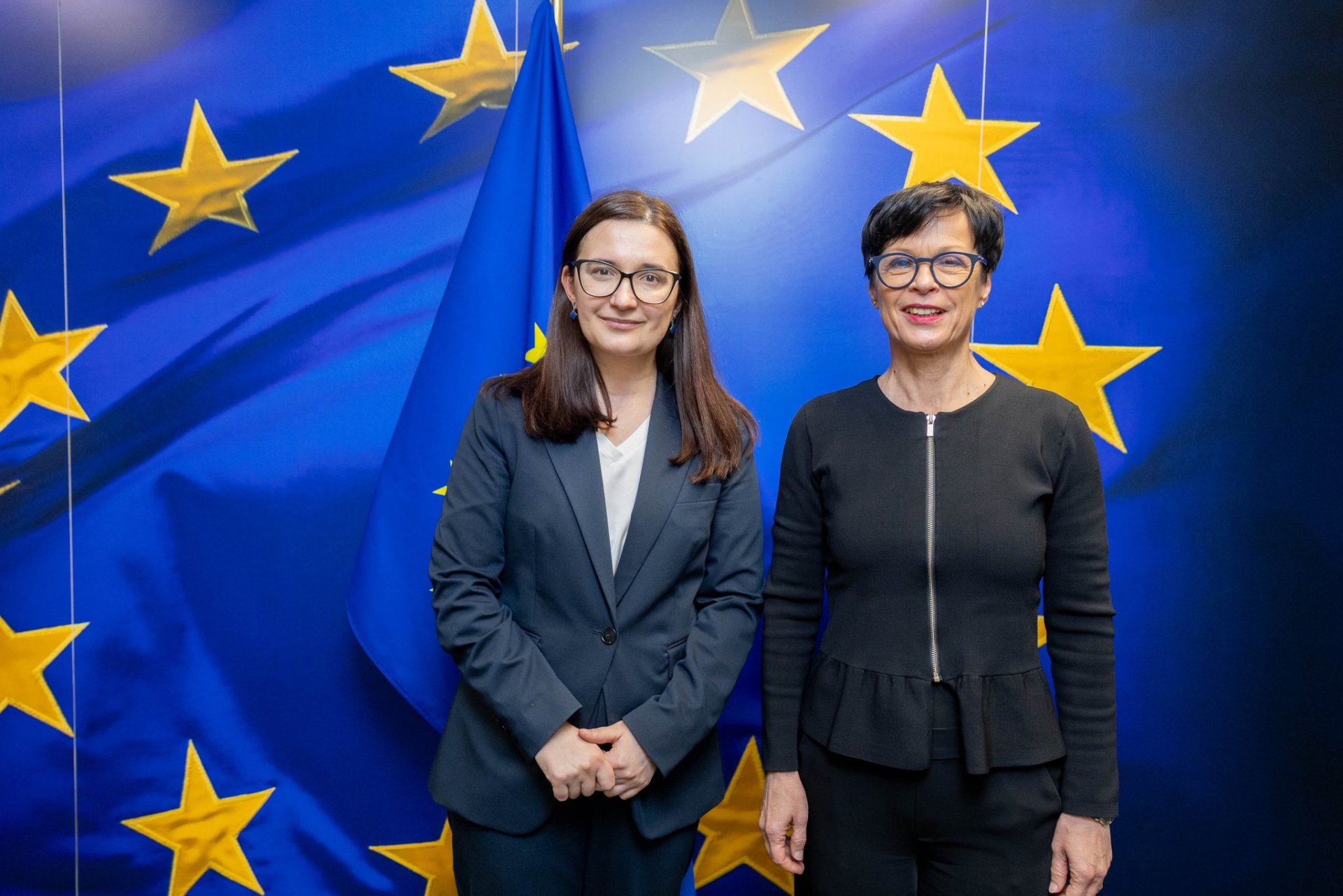
VIDEO // Moldovan deputy PM for European integration says Moldova might conclude EU accession negotiations in early 2028
Moldova is among the most advanced candidate countries for European Union membership and, together with three other candidate states, will receive an individualized roadmap for the accession process. The document is expected to be presented at the end of October, together with the EU’s annual enlargement package. The statements were made by Deputy Prime Minister for European Integration Cristina Gherasimov and European Commissioner for Enlargement Marta Kos have made statements to this effect, who joined online during the “In Context” programme broadcast by the public television channel Moldova 1.
Cristina Gherasimov described as “the best news” the European Commission’s decision to include Moldova among the candidate states with an advanced level of preparedness for accession.
“The best news in Commissioner Kos’s statement in Strasbourg today afternoon is that we have been identified as a country with an advanced level of preparedness for accession, together with three other candidate states, and, as a result, we will receive a roadmap that will clearly anchor us on a path toward the next stage or toward the final destination of joining the European Union,” Gherasimov said.
According to the deputy prime minister, the new approach must be viewed in a broader context, as it is not only the candidate countries that are preparing for accession; the European Union is also adjusting its own policies and institutions for future enlargement.
“Candidate countries, such as ours, are preparing for accession, but at the same time the member states and the European Union have also begun preparing for enlargement. We have been talking about this for many years, but until now we had not seen any concrete document containing specific proposals,” Cristina Gherasimov said.
She noted that the European Commission’s proposals would be discussed and approved by the member states and that the roadmap for Moldova would not contain an exact accession date, but rather an estimated timetable for concluding the negotiations.
“Our deadlines are very well known in Brussels: we want to be ready to conclude the negotiations by the beginning of 2028, which would subsequently allow us to prepare for accession by 2030,” the official explained.
Individualized roadmap
Marta Kos, for her part, confirmed that Moldova would benefit from an individualized roadmap and praised the progress made by the country in recent years.
“Today we decided to select four countries for which we will draw up the roadmap. This is a major recognition for Moldova,” the European commissioner said.
According to her, details regarding the roadmap will be presented at the end of October, together with the European Commission’s enlargement report.
“I know that your government and your president want to finalize the negotiations at the end of 2028, and we support you in this decision,” Marta Kos said.
The European commissioner praised the reforms carried out by Moldova in recent years and said that, if the pace is maintained, she sees no impediment to the country joining the EU around 2030.
“What you have done over the past two or three years is unimaginable. You are delivering under very difficult conditions, with Russia trying to obstruct you, but you have demonstrated determination on the path to accession. If you continue delivering at the same level in the future, I see no impediment to Moldova becoming an EU member in 2030,” Kos said.
Possible protection mechanisms after accession
An important element of the new enlargement policy is represented by the protection mechanisms that the European Union intends to introduce for future member states.
Marta Kos explained that these mechanisms would not affect a state that respects democracy and the rule of law, but could be applied in the event of possible backsliding after accession.
“We must ensure that, when new countries join, they comply with the principles of the rule of law and democracy. These protection measures will apply only if the newly acceding state violates these principles,” the European commissioner explained.
Thus, if a new member state were to experience regression in the areas of justice, the prosecution service or the rule of law, the EU could apply certain safeguard measures. These could include suspending European funds or taking other measures meant to protect the Union’s decision-making process.
Gherasimov noted that some of these mechanisms had also been applied in previous enlargements, but that the current proposal contains new elements as well.
Opening chapters could be decided without unanimity
Another important proposal concerns the way member states will make certain decisions during the enlargement process. The European Commission proposes that, for some intermediate stages of the negotiations, a qualified majority could be used instead of unanimity.
“If a decision is reached that all intermediate stages between the opening and closing of the negotiating chapters should be decided by a qualified majority, meaning two-thirds of the member states, it would be highly advantageous for us,” Cristina Gherasimov said.
At present, Moldova depends on the unanimity of the member states for certain decisions concerning the accession process.
The deputy prime minister emphasized that the new mechanism would be particularly important for the stage involving the closing of the negotiating chapters.
“We have a very ambitious timetable and aim to open all the remaining chapter groups no later than the end of this year,” she said.
According to Cristina Gherasimov, Moldova aims to conclude the negotiations at the beginning of 2028, and a possible transition to qualified-majority voting could take place by then.
Chisinau awaits the opening of the next two clusters
Moldova is awaiting the opening of the next two negotiating clusters in the near future, and Chisinau says that all European capitals support this step.
“We should see the results next week. There is support from all European capitals for the opening of the next two clusters,” Gherasimov said.
These are the clusters covering “The Internal Market” and “Competitiveness and Inclusive Growth.”
The deputy prime minister noted that their opening also depended on certain legislative developments in Ukraine, particularly in the area of minority education.
“We have also heard very positive signals from Budapest, which has likewise given the green light to the draft laws that are to be approved by the Verkhovna Rada in Kyiv. We are now waiting for our colleagues in Kyiv to make progress on these legislative projects, in the hope that next week we will already be able to hold the next intergovernmental conferences, where we will open negotiating chapter groups 2 and 3,” Cristina Gherasimov said.
Moldova wants to close two chapters by the end of the year
As for the chapters on external relations and foreign and security policy, the government says that the work is at an advanced stage and that Moldova could be ready to close them by the end of the year.
“We have been working on these two chapters since the beginning of this year, when we opened the technical negotiations in December 2025. I want to tell you that we are at a very advanced stage. If we could already reach discussions on closing these chapters, we would be ready, by the end of this year, to close these two negotiating chapters,” the deputy prime minister said.
Gradual integration could be expanded
Marta Kos also announced that, as part of the enlargement package to be presented at the end of October, the European Commission intends to propose the possibility of deeper gradual integration of candidate countries into EU structures and policies before formal accession.
“At the end of October, as part of the enlargement package, we will introduce not only the roadmaps, but also the possibility of gradual integration,” Kos said.
She explained that gradual integration would be possible for countries that deliver the necessary reforms and are strategically aligned with the European Union, as well as in areas where there is a common interest.
Marta Kos said that Moldova could gain broader access to certain European areas before accession.
“This means that you will be able to have greater access to Europe before accession,” the commissioner said.
Areas that could benefit from deeper integration include security, defense, artificial intelligence and access to the European market.
Government to consult civil society, business community and Diaspora
Cristina Gherasimov said that, over the next two weeks, the authorities would hold consultations with civil society, the private sector and the Diaspora to identify the areas in which Moldova wants more advanced gradual integration.
“Over the next two weeks, we intend to invite civil society, the private sector and the Diaspora to discussions, so that together we can identify the additional sectors in which Moldova would like to see gradual integration before joining the European Union,” she said.
The deputy prime minister noted Moldova’s recent integration into the SEPA area and the expansion of roaming benefits as examples, while indicating European programmes, such as Creative Europe and DiscoverEU for the coming period.
Chisinau is also examining ways to deepen cooperation in defense, security and artificial intelligence, as well as to facilitate Moldovan companies’ access to the European market.
Moldova could participate in European security initiatives
During the programme, Marta Kos said that Moldova was already an important EU partner in the field of security and that the country contributes to European security.
The statement comes amid discussions about a possible European Security Council and the involvement of partners from outside the EU in future security mechanisms.
“You are already contributing to European security. We have a defense and security partnership, and we conclude it only with countries that are genuinely relevant to us,” Kos said.
She cited the parliamentary elections in Moldova and the way the authorities and society dealt with pressure and Russian propaganda.
Cristina Gherasimov, for her part, said that Moldova was interested in deepening cooperation with the EU in this area.
“I believe we can do much more here and, since this is an important priority for the European Union, as I also heard in President von der Leyen’s annual address in September, we believe we can make further progress with the cooperation already in place with the European Union,” the official said.
More than 600 million euros received through the Growth Plan
Cristina Gherasimov also provided data on the implementation of the Growth Plan for Moldova, as the country has recently received a new tranche of 157 million euros.
According to the deputy prime minister, Moldova has so far received more than 600 million euros through this mechanism, with the payments conditional on the implementation of reforms.
“Each financial disbursement from the European Union is based on specific reforms carried out by the government. So far, from the signing of the Growth Plan until June 2026, Moldova had 46 reforms to implement. Of these 46, we managed to implement 44, which represents 95 per cent of all the reforms,” Gherasimov said.
According to her, the next stage involves more difficult and structural reforms.
“What lies ahead are much more difficult reforms, structural reforms, such as the reorganization of the railway, for example, which our colleagues at the Ministry of Infrastructure and Regional Development are already working on. This is just one example of a reform, but it is a reform that takes time. Accordingly, over the next year or so, which is the time remaining under the Growth Plan, we will have to implement these reforms,” the deputy prime minister for European Integration said.
In this context, European officials and the Moldovan authorities say that the new approach to enlargement policy could offer Moldova a more predictable path toward EU accession, without setting an exact legal accession date for the time being.

 Facebook
 Instagram
 X/Twitter
 Telegram
PHOTO GALLERY // EU & My Grandparents contest 2026
Grandparents and grandchildren discover Europe together at contest
Moldova aims to open all EU negotiation chapters in next six months
Concluding EU accession negotiations, preparing signing of Accession Treaty by 2028 among goals of Moldova's Tofan Government
Message of Prime Minister-designate Vasile Tofan after opening of negotiations on Cluster 6
Irish Minister for European Affairs and Defence: Moldova made significant progress and demonstrated strategic alignment with EU values
Moldova maintains EU accession timeline
EU Commissioner after opening negotiations on Cluster 6: Moldova - best performing student in my class
Accession talks advance: Republic of Moldova opens second cluster with EU
VIDEO // Moldova opens negotiations on EU accession Cluster 6: Historic day for EU enlargement
VIDEO // Acting Prime Minister: Opening of negotiations for Cluster 6 marks new stage in accession process and reflects progress made by our country
Republic of Moldova and EU open accession negotiations today for Cluster 6
EU grants Moldova additional 120 million euros to strengthen defense
Republic of Moldova opens accession negotiations with EU for External Relations Cluster
VIDEO // Moldovan deputy PM for European integration says Moldova might conclude EU accession negotiations in early 2028
VIDEO // Moldovan government welcomes European Commission's analysis on EU's preparedness for enlargement
VIDEO // European Commissioner for Enlargement says Moldova to receive a roadmap for EU accession on October 28
Moldovan president discusses, leadership of NATO Parliamentary Assembly discuss security of Moldova
National Wine Day 2026, record edition in Moldova: 114 wineries, more than 116,000 tastings
Officials, parliamentarians from 22 countries discuss regional security in Chisinau
Moldovan parliament hosts 109th Rose-Roth Seminar
 National Bank of Moldova
Moldovan president discusses, leadership of NATO Parliamentary Assembly discuss security of Moldova
Officials, parliamentarians from 22 countries discuss regional security in Chisinau
Moldovan deputy PM for reintegration has meeting with Ambassador of France
International financing for modernization of technical vocational education, agricultural sector of Moldova
Moldovan parliament's foreign policy commission endorses candidacies of four new ambassadors

Moldovan parliament speaker says Ukraine's security most important investment in security of Moldova
Moldovan parliament's foreign policy commission endorses candidacies of four new ambassadors
Moldova to have new ambassadors to Greece, Lithuania, Belgium, State of Qatar
PHOTO // Foreign Ministers of Moldova and Estonia launched IMPACT North project in Bălți
Energocom purchased electricity at average price of EUR 157.42/MWh in September
PHOTO // Moldova, United Arab Emirates sign Memorandum of Understanding on cooperation between diplomatic institutes
StratCom: Norway's military support attacked by manipulation on anonymous Telegram channels
VIDEO // Defense Minister ahead of Moldova Security Forum: Security means more than defense
PM: Increasingly frequent drone incidents show that Moldova’s security no longer abstract issue
One year since Moldova connected to SEPA
DOC // Mihaela Fedoseev appointed Head of Office of President of the Republic of Moldova
Over 100,000 tastings at National Wine Day in Moldova: which wines were most popular
Embassy of Estonia officially opens in Chisinau
Smart agriculture, priority for Moldova; agriculture minister says agriculture should be based on science
Moldovan president meets Estonia’s foreign affairs minister, on visit to Chisinau for inauguration of Embassy
BTA: Leading Copper Producer in Bulgaria Receives Up to EUR 55 Mln Loan for Green Investments
Receive the latest news directly to your email

Receive the latest news directly to your email