
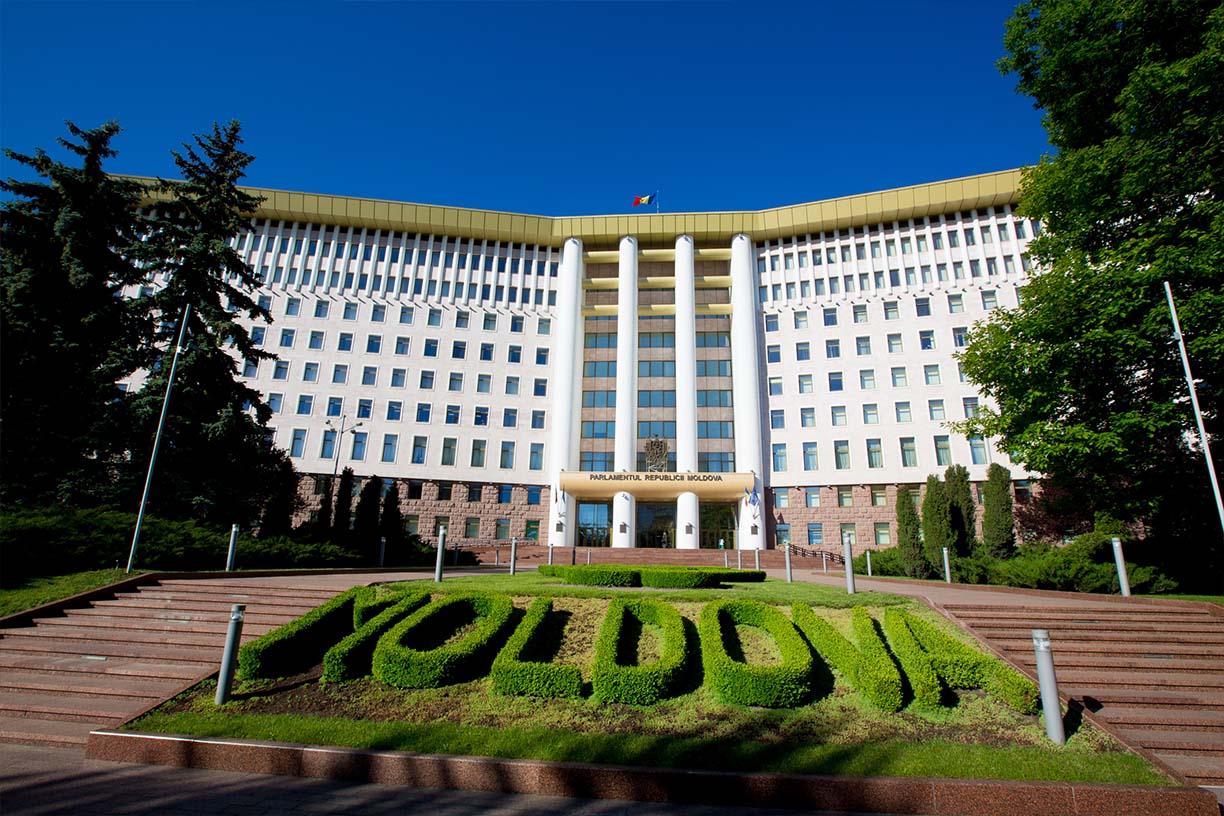
Moldovan parliament hosts 109th Rose-Roth Seminar
The parliament of Moldova on October 6-8 is hosting the 109th Rose-Roth Seminar of the NATO Parliamentary Assembly, an event dedicated to security challenges in the Black Sea region and strengthening democratic resilience. President of the NATO Parliamentary Assembly Marcos Perestrello has said that Moldova’s experience was providing important lessons for the organization’s allies and partners.

At the opening of the seminar, Marcos Perestrello said that all partner countries had much to learn from Moldova’s commitment to democratic resilience and its determination to defend all democratic values and its European future.

The official underscored the importance of holding the meeting at a time when Moldova was on the front line of more security challenges.

“Moldova is on the front line of many of the security challenges facing both our allies and partners: from violations of airspace by drones and the war spreading across the region to disinformation campaigns and attacks on critical infrastructure,” Perestrello said.

The president of the NATO Parliamentary Assembly noted that Moldova had faced attempts to destabilize and undermine democratic institutions and social cohesion, while the way the authorities and society responded to these challenges offered valuable experience to international partners.

“This seminar provides an opportunity to exchange ideas, experiences and best practices and to strengthen our collective ability to respond to this increasingly complex threat environment,” Marcos Perestrello said.

For his part, Lilian Carp, the heads of the parliament’s commission for national security, defense and public order, said that holding the seminar in Chisinau had special significance, given the profound changes in the regional security environment.

“For us, it is a privilege to host this important parliamentary meeting, which over the years has become a valuable forum for open debate, the exchange of opinions and the identification of common responses to security challenges,” Lilian Carp said.

He noted that Moldova had previously hosted Rose-Roth seminars in 2006 and 2015, while the concerns of that time—related to strengthening democratic institutions, regional security and relations with Euro-Atlantic partners—had since acquired new dimensions.

“Looking back at these two moments today, we can see how much the region has changed and, at the same time, how many of the concerns of that period remain relevant,” Carp said.

According to the parliamentarian, Moldova has strengthened its institutions and deepened its relations with European and international partners, but security is not a finished process.

“Today’s reality shows us that security is not a finished process and that problems must be constantly reassessed,” Lilian Carp stressed.

He drew attention to the expanding range of threats facing Moldova, mentioning hybrid threats, disinformation, foreign interference, cyberattacks, the protection of critical infrastructure and incidents affecting the country’s airspace.

“In 2006, we spoke about strengthening institutions and democratic control over the security sector. Today, these goals remain important, but new challenges have been added: hybrid threats, disinformation, foreign interference, cyberattacks, the protection of critical infrastructure and incidents affecting the airspace of Moldova,” Carp said.

Parliament Speaker Igor Grosu delivered a similar message. In his opinion, the experience of recent years has demonstrated how important it is to identify and address vulnerabilities before they are exploited.

The speaker presented three lessons that, in his opinion, Moldova had learned in the context of interference and hybrid threats: prevention, exposing threats and the constant defense of democracy.

He also emphasized the role of the independent press in identifying and exposing attempts to manipulate elections.

“That is why, defending the independent press is part of national security,” he added.

Another lesson, according to Grosu, is the need for the permanent defense of democracy.

In the context of the war in Ukraine, the speaker stressed the importance of strengthening Moldova’s defense capabilities and supporting Ukraine.

“The most important investment in the security of Moldova today is Ukraine’s security. As long as Ukraine holds out, the war remains far from our cities and villages. Support for Ukraine is also a direct investment in the security of Moldova and of Europe as a whole,” the official said.

Parliament Speaker Igor Grosu said that Moldova was forced to reform its institutions while simultaneously preparing them for rapidly evolving threats.

“A few hundred kilometers from this hall, the largest war Europe has seen since the Second World War is taking place. For almost five years, Ukraine has been resisting Russian aggression. The effects of this war are reaching us more and more frequently,” Igor Grosu said.

He noted that, in addition to the conventional war in Ukraine, Moldova was facing a hybrid war characterized by disinformation, energy blackmail, cyberattacks and attempts to influence electoral processes.

Defense Minister Anatolie Nosatii addressed the seminar participants on Moldova’s defense and security priorities, stressing that resilience had become a national necessity.

“Russia’s aggression against Ukraine has directly affected the security environment, and Moldova is directly exposed to these regional consequences. They include incidents involving violations of airspace, cyberattacks, information threats, risks to critical infrastructure and pressure,” the minister said.

According to Nosatii, “in this environment, resilience is not an abstract concept for Moldova, but a necessity and a national priority.”

Among the priorities of the National Army, Nosatii listed air surveillance and defense, the protection of critical infrastructure and cyber defense.

The minister stressed that the development of defense capabilities must be accompanied by the interconnection of systems, information sharing and increased response capacity.

“We must not merely receive new capabilities; we must also develop and interconnect them,” Anatolie Nosatii said.

He noted that Moldova also contributed to international security through the participation of Moldovan military personnel in international missions.

Nosatii emphasized that resilience should not be viewed exclusively through the lens of military capabilities.

“Resilience is not something we build just once. It is something to which we must contribute and which we must continuously develop,” Anatolie Nosatii concluded.

The seminar will include more discussion sessions. They will address regional security and the security of Moldova, in the context of the Russian Federation’s war of aggression against Ukraine; energy security from the Black Sea to the Persian Gulf; resilience and the NATO Parliamentary Assembly–Moldova partnership in a changing Euro-Atlantic security environment. Another topic discussed by the seminar participants will be the situation in the Black Sea region during wartime and its implications for regional and Euro-Atlantic security.

The participants in the seminar also intend to examine the evolution of the NATO Parliamentary Assembly–Moldova partnership, identify priorities for future cooperation and explore areas in which parliamentary engagement and international partnerships can help strengthen the resilience of Moldova and advance its European integration agenda. They will also assess how Russia’s war against Ukraine has deepened regional security interdependence and analyze the role of Moldova both as a frontline state and as a contributor to regional stability.

The NATO Parliamentary Assembly is an interparliamentary organization bringing together 281 parliamentarians from the 32 member states of the North Atlantic Alliance, as well as from associated countries. Since October 2025, Moldova has held the status of a comprehensive security partner of the NATO Parliamentary Assembly.
 Facebook
 Instagram
 X/Twitter
 Telegram
Moldovan president in Helsinki says country's response to become stronger
VIDEO // Moldovan president in Helsinki says war reaching territory of Moldova; Finnish head of state: ''Moldova’s place is in the EU”
Moldova does not rule out expelling Russia’s Ambassador after drone incidents; Moldovan parliament speaker says everything possible
Speaker: Administrative-territorial reform must ensure predictable transfer of powers and resources
Foreign Minister receives new U.S. Ambassador: We want to further strengthen and develop partnership
Foreign Minister at opening of Honorary Consuls’ Meeting: Moldova made clear and irreversible choice to join European Union
VIDEO // Moldovan president to attend Security Forum
Moldova’s candidate re-elected as member of United Nations Subcommittee on Prevention of Torture
Russia’s Ambassador-Designate summoned to Moldova’s Foreign Affairs Ministry; Oleg Ozerov receives protest note, after three drones violated Moldova’s airspace in a single day
MOLDPRES INTERVIEW // Ambassador Zhihua Dong: Moldova's European integration opens up new opportunities for cooperation. China promoting direct freight route
Foreign Ministry summons Russia’s Ambassador after several drones violated Moldova’s airspace
CEC: 15 candidates enter race for mayoral positions in November local elections
European Commissioner begins visit to Moldova with meeting with President
Speaker after drone explosion in Ivancea: We categorically condemn and will continue to condemn every illegal overflight of our airspace
Moldova to have new ambassadors to Greece, Lithuania, Belgium, State of Qatar
PHOTO // Foreign Ministers of Moldova and Estonia launched IMPACT North project in Bălți
Energocom purchased electricity at average price of EUR 157.42/MWh in September
StratCom: Norway's military support attacked by manipulation on anonymous Telegram channels
 National Bank of Moldova
Officials, parliamentarians from 22 countries discuss regional security in Chisinau
Moldovan deputy PM for reintegration has meeting with Ambassador of France
International financing for modernization of technical vocational education, agricultural sector of Moldova
Moldovan parliament's foreign policy commission endorses candidacies of four new ambassadors
Moldovan president meets Estonia’s foreign affairs minister, on visit to Chisinau for inauguration of Embassy

PHOTO // Moldova, United Arab Emirates sign Memorandum of Understanding on cooperation between diplomatic institutes
StratCom: Norway's military support attacked by manipulation on anonymous Telegram channels
VIDEO // Defense Minister ahead of Moldova Security Forum: Security means more than defense
PM: Increasingly frequent drone incidents show that Moldova’s security no longer abstract issue
One year since Moldova connected to SEPA
DOC // Mihaela Fedoseev appointed Head of Office of President of the Republic of Moldova
Over 100,000 tastings at National Wine Day in Moldova: which wines were most popular
Embassy of Estonia officially opens in Chisinau
Smart agriculture, priority for Moldova; agriculture minister says agriculture should be based on science
Moldovan president meets Estonia’s foreign affairs minister, on visit to Chisinau for inauguration of Embassy
BTA: Leading Copper Producer in Bulgaria Receives Up to EUR 55 Mln Loan for Green Investments
Moldovan General Police Inspectorate receives new batch of equipment from EU Partnership Mission
Moldovan PM, European commissioners discuss energy, security, economic reforms to accelerate Moldova’s European path
IMF's technical mission at Moldova's State Tax Service to reform, modernize tax administration
ARMENPRESS: Armenia, Iran discuss cooperation in energy, transport, infrastructure development
Moldovan PM has talks with Belgian counterpart
Receive the latest news directly to your email

Receive the latest news directly to your email