
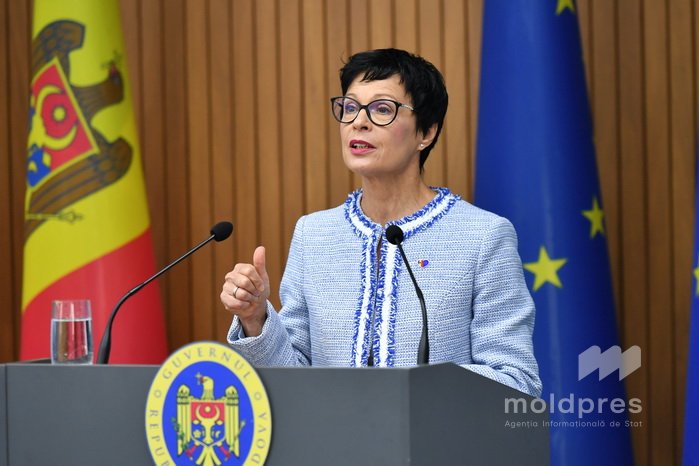
VIDEO // European Commissioner for Enlargement says Moldova to receive a roadmap for EU accession on October 28
Moldova on October 28 will receive a roadmap outlining the next steps on its path toward accession to the European Union. The document will be presented by the European Commission together with the EU enlargement reports and will include indicative stages, deadlines and concrete objectives for the most advanced candidate countries. European Commissioner for Enlargement Marta Kos has made statements to this effect after a meeting of the College of Commissioners on assessments of pre-accession policy.
Marta Kos noted that Moldova was among the four candidate countries considered to be “frontrunners” in the accession preparation process, alongside Montenegro, Albania and Ukraine. According to the commissioner, these states have made significant progress in recent years in terms of their level of preparedness for accession.
“We have identified four frontrunners: Montenegro, Albania, Moldova and Ukraine. These countries have demonstrated significant progress in terms of their level of preparedness in recent years,” Marta Kos said.
According to her, the roadmaps are to be presented at the end of October and will help maintain the pace of reforms and make the path toward accession more predictable.
“We want to help them maintain the progress of reforms, and these roadmaps will set out the next steps. They will contain indicative deadlines and clear objectives. This will give us greater predictability on the path to accession,” the European commissioner said.
Marta Kos stressed, however, that the existence of a roadmap did not mean a shortcut in the accession process. The European path will continue to be determined by the results achieved by each candidate country individually.
“It is important that this process will continue to be based on the individual achievements of the candidates. There will be no shortcuts,” the European official said.
Moldova praised for consistency on its European path
Responding to a question about the risk that differentiation among candidate countries could create frustration, Marta Kos said that identifying the four “frontrunners” represented, in her opinion, an incentive for the other candidate states.
In the case of Moldova, the European commissioner particularly highlighted the results of the elections and the referendum, which she presented as confirmation of the country’s European orientation.
“We have another country, Moldova, which has demonstrated, through five elections and a referendum, that it is firmly on the European path, even though Russia has invested hundreds of millions of euros to push it away from this path,” Marta Kos said.
She explained that the roadmaps were not an instrument meant exclusively for the four countries at the forefront of the process, but that they make the most sense for states that have advanced sufficiently for the next steps to be defined concretely.
“When I speak about the roadmaps, they are, in fact, for everyone. But it makes sense to prepare a roadmap for those who are so advanced that it is relevant,” the commissioner said.
Marta Kos used an analogy to explain the importance of reforms in the accession process.
“I would compare this to a car. If the car does not run, there is no point in pushing it from behind while the engine is not working. The engine can work only if there is fuel, and the fuel is represented by reforms in the country,” she said.
According to the commissioner, the progress demonstrated by the candidate states must show that accession is possible when countries fulfill the commitments they undertook upon getting candidate country status.
Gradual integration presented as an accelerator of enlargement
As part of its assessment of pre-accession policy, the European Commission is also proposing a more ambitious approach to the gradual integration of candidate states into certain EU policies and sectors before full accession.
Marta Kos noted that gradual integration should not be viewed as an alternative to full membership.
“Gradual integration is not a substitute for full accession. It is the accelerator of enlargement,” she said.
According to the European Commission, candidate states that meet the necessary standards could participate, before accession, in certain strategic sectors where there are mutual benefits for current and future member states. The areas mentioned include energy, transport, artificial intelligence, security and defense.
“Once candidates meet the standards, they should be able to participate in strategic sectors where there are clear advantages for current and future member states, such as energy, transport, artificial intelligence, security or defense,” Marta Kos specified.
She stressed that participation in EU policies before full accession would be conditional on reforms and respect for the Union’s values and strategic interests.
European Commission proposes stronger rule-of-law safeguards
Another element of the new approach is strengthening safeguards for future member states. Marta Kos stressed that all countries joining the EU would enjoy equal rights and that there is no intention to create a “two-tier Union.”
“All member states—and I strongly emphasize this—including the new members, will enjoy equal rights. We do not want two-tier membership,” the commissioner said.
At the same time, the European Commission deems it necessary to have mechanisms allowing it to respond in the event of serious violations of commitments undertaken during accession negotiations, particularly in the areas of the rule of law, democracy and fundamental rights.
According to Marta Kos, the proposed instruments include the possibility of reducing financial support or restricting voting rights in the event of serious violations.
“We want it to be easier to reduce financial support or restrict voting rights. This is an insurance policy, so that we can react, if necessary,” she said.
The commissioner specified that such measures would be applied only in the event of serious violations.
“These safeguards will be implemented only if violations occur,” Marta Kos said.
EU enlargement considered possible
The assessment presented by the European Commission shows that, in most policy areas, the European Union is capable of integrating new members, although adjustments are needed in certain sectors.
“Our assessment is clear. Enlargement is possible today,” Marta Kos said.
She emphasized the need for more efficient and flexible European institutions, as well as decision-making mechanisms adapted to a larger Union.
As for agriculture, the European Commission considers it necessary to examine specific arrangements for certain sensitive agricultural products from Ukraine, taking into account the size and productivity of Ukraine’s agricultural sector. According to Marta Kos, the goal is to ensure that Ukraine’s accession does not negatively affect European farmers, while also supporting Ukraine’s return to its traditional export markets.
European Commission preparing the next steps
According to Marta Kos, the European Commission’s work following the assessment of pre-accession policy will focus on four main areas.
The first is presenting the roadmaps for the most advanced candidate countries together with the enlargement reports at the end of October. The second concerns preparing a new approach to gradual integration. The Commission will take stock of the existing instruments and propose a more ambitious approach.
The third area is developing a detailed common framework for safeguards applicable to future member states, while the fourth concerns using the assessment of Ukraine’s agricultural sector in discussions on opening Cluster 5 for Ukraine.
Marta Kos reiterated that the enlargement process must remain merit-based and depend on the implementation of reforms.
“Enlargement is possible today. But there are areas where we see challenges that we need to address. One of them is the need for more streamlined institutions and a more flexible and efficient decision-making process,” the European commissioner said.
In the case Moldova, the presentation of the roadmap on October 28 will provide an indicative framework for the next stages of its European path, but the pace and progress will continue to depend on the implementation of reforms and the commitments undertaken by the Moldovan authorities.

 Facebook
 Instagram
 X/Twitter
 Telegram
Grandparents and grandchildren discover Europe together at contest
Moldova aims to open all EU negotiation chapters in next six months
Concluding EU accession negotiations, preparing signing of Accession Treaty by 2028 among goals of Moldova's Tofan Government
Message of Prime Minister-designate Vasile Tofan after opening of negotiations on Cluster 6
Irish Minister for European Affairs and Defence: Moldova made significant progress and demonstrated strategic alignment with EU values
Moldova maintains EU accession timeline
EU Commissioner after opening negotiations on Cluster 6: Moldova - best performing student in my class
Accession talks advance: Republic of Moldova opens second cluster with EU
VIDEO // Moldova opens negotiations on EU accession Cluster 6: Historic day for EU enlargement
VIDEO // Acting Prime Minister: Opening of negotiations for Cluster 6 marks new stage in accession process and reflects progress made by our country
Republic of Moldova and EU open accession negotiations today for Cluster 6
EU grants Moldova additional 120 million euros to strengthen defense
Republic of Moldova opens accession negotiations with EU for External Relations Cluster
Acting Prime Minister welcomes European Parliament report on Moldova
VIDEO // Moldovan government welcomes European Commission's analysis on EU's preparedness for enlargement
VIDEO // European Commissioner for Enlargement says Moldova to receive a roadmap for EU accession on October 28
Moldovan president discusses, leadership of NATO Parliamentary Assembly discuss security of Moldova
National Wine Day 2026, record edition in Moldova: 114 wineries, more than 116,000 tastings
Officials, parliamentarians from 22 countries discuss regional security in Chisinau
Moldovan parliament hosts 109th Rose-Roth Seminar
Moldovan parliament speaker says Ukraine's security most important investment in security of Moldova
 National Bank of Moldova
Moldovan president discusses, leadership of NATO Parliamentary Assembly discuss security of Moldova
Officials, parliamentarians from 22 countries discuss regional security in Chisinau
Moldovan deputy PM for reintegration has meeting with Ambassador of France
International financing for modernization of technical vocational education, agricultural sector of Moldova
Moldovan parliament's foreign policy commission endorses candidacies of four new ambassadors

Moldovan parliament's foreign policy commission endorses candidacies of four new ambassadors
Moldova to have new ambassadors to Greece, Lithuania, Belgium, State of Qatar
PHOTO // Foreign Ministers of Moldova and Estonia launched IMPACT North project in Bălți
Energocom purchased electricity at average price of EUR 157.42/MWh in September
PHOTO // Moldova, United Arab Emirates sign Memorandum of Understanding on cooperation between diplomatic institutes
StratCom: Norway's military support attacked by manipulation on anonymous Telegram channels
VIDEO // Defense Minister ahead of Moldova Security Forum: Security means more than defense
PM: Increasingly frequent drone incidents show that Moldova’s security no longer abstract issue
One year since Moldova connected to SEPA
DOC // Mihaela Fedoseev appointed Head of Office of President of the Republic of Moldova
Over 100,000 tastings at National Wine Day in Moldova: which wines were most popular
Embassy of Estonia officially opens in Chisinau
Smart agriculture, priority for Moldova; agriculture minister says agriculture should be based on science
Moldovan president meets Estonia’s foreign affairs minister, on visit to Chisinau for inauguration of Embassy
BTA: Leading Copper Producer in Bulgaria Receives Up to EUR 55 Mln Loan for Green Investments
Moldovan General Police Inspectorate receives new batch of equipment from EU Partnership Mission
Receive the latest news directly to your email

Receive the latest news directly to your email