
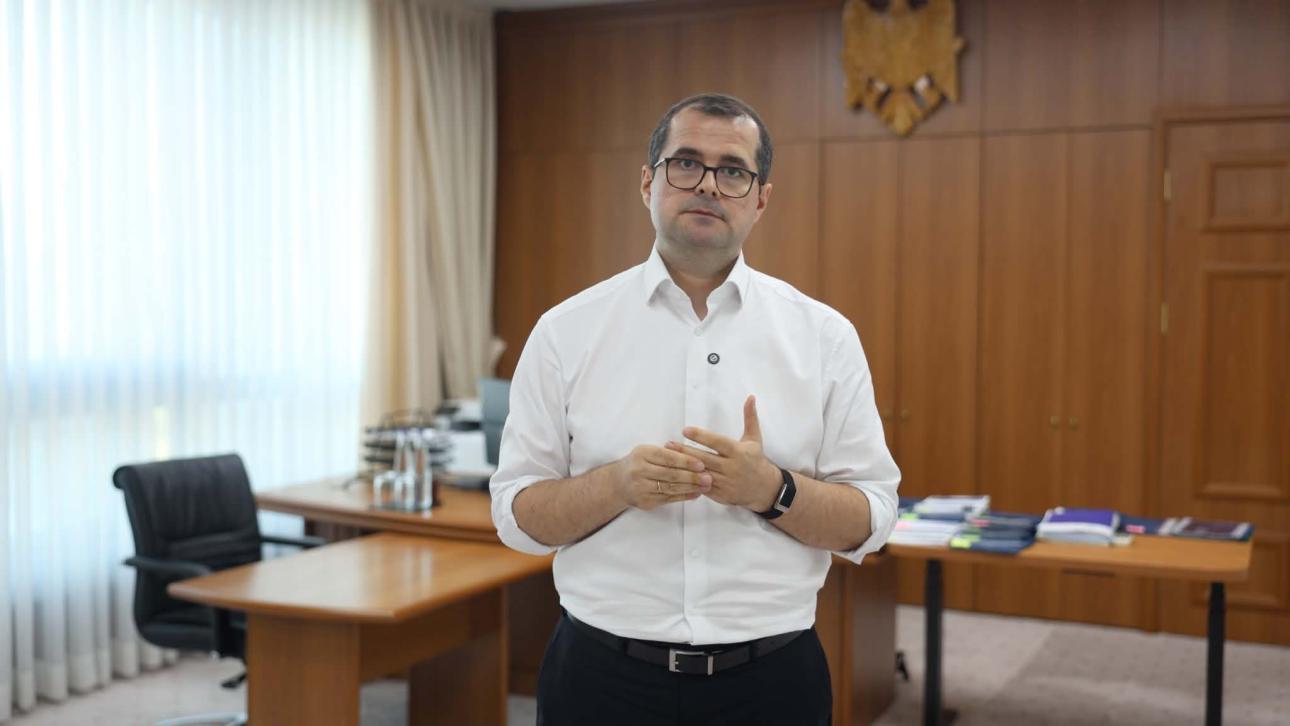
Moldovan PM announces concept for deregulation, simplification of inspections
Prime Minister Vasile Tofan today presented a deregulation concept that will be translated into draft laws and draft government decisions. On July 22, at the first government meeting, the PM asked the Economic Development and Digitalization Ministry to submit, by September 9, concrete proposals in two areas: reducing rules and procedures that are no longer necessary and changing the way the state conducts inspections in the private sector. The deregulation packages are in the final approval stage at Justice Ministry and the National Anticorruption Center (CNA) and will be submitted for approval as soon as possible.

The analysis of these areas identified two problems: a large number of requirements and authorizing documents that need to be simplified, and a punitive and disproportionate approach to inspections, which often overlap and are divided among more institutions and different regulatory regimes. The proposals announced by the prime minister include the following:

Amendments are proposed to approximately 100 regulatory acts, which are being analyzed in two packages currently undergoing final approval: one package proposing amendments to or repeal of government decisions, and one package concerning legislative amendments.

Approximately 80 authorizing documents are being reviewed, in order to determine which can be eliminated or transformed into notifications or voluntary compliance documents.

A total of 172 permissive procedures have been identified outside the Nomenclature of Permissive Acts established by law. They must either be justified and included in the Nomenclature or transformed into notification procedures.

At present, there are 19 inspection bodies, 36 authorities with powers to establish administrative offenses, and 5 investigative bodies that may intervene in economic activity.

More than 300 articles concerning administrative offenses and more than 80 articles of the Criminal Code may apply to economic activity.

In tax inspections, planned inspections currently account for approximately 4 per cent of the annual total. This means a lack of predictability and a risk of harassment.

Proposed measures concerning deregulation

The proposals do not eliminate health, safety, environmental, or consumer protection standards. They target repetitive procedures, documents, and approvals that duplicate one another. Prime Minister Tofan gave more examples:

For small agricultural and energy investments outside built-up areas, a simplified urban planning procedure is proposed, without eliminating technical, environmental or heritage requirements. For example, getting a planning certificate for the design of a basic agricultural construction, such as a refrigeration facility, warehouse, or storage building, located outside the built-up area of a locality without an approved General Urban Plan requires at least 26 successive administrative steps, taking a minimum of 7–12 months in total, or 10–15 months if an environmental impact assessment is also required.

The veterinary-sanitary authorization and the food safety registration certificate will no longer have to be renewed solely because a lease agreement has been extended. The proposal is for them to be issued for an unlimited period, provided that the activity and relevant conditions do not change.

Staffing tables will no longer be mandatory. A company will be able to use them, if they are useful to it, without this internal formality being imposed on all employers.

Another problem concerns situations in which the law allows an activity to begin based on a notification, but the company is practically required to wait for a certificate that merely confirms that the notification has been submitted. This approach turns a simplified procedure into a disguised authorization.

Occupational health and safety documents and training may be completed electronically, including online training with an electronic signature. Today, a significant part of the records is still kept on paper, with handwritten signatures.

Small businesses with a low fire risk will not be required to organize the same procedures as high-risk activities.

In construction, investors will no longer have to collect approvals from other institutions themselves. For example, when required, heritage approval should be obtained through the process between the authorities. For a Detailed Urban Plan, institutional responsibility will remain with the local authority, without requiring the investor to move between institutions.

The building and the networks serving it may be authorized through a single procedure. At present, they may undergo separate and successive authorization procedures, even though they are part of the same investment.

Before detailed design starts, investors may optionally request a preliminary review of the urban planning concept. The purpose is to determine at an early stage whether there is a fundamental obstacle, before spending money on the complete design.

If an authority fails to process an application within the statutory deadline for a planning certificate or building permit, or refuses it manifestly without justification, we propose establishing an administrative mechanism to unblock the situation before the investor is required to go to court.

Vine-growing and winemaking registers may be kept directly in the existing information system, without the obligation to reproduce the format of paper registers with numbered, stitched and signed pages.

Another example concerns medical laboratories. If a laboratory is accredited by a body recognized within the European accreditation system, there is no justification for requiring it to show again, through a similar procedure, that it meets the same standards. Through this package, we recognize relevant European accreditations and eliminate repeated checks. We are not lowering quality standards. On the contrary, we are using a rigorous European system and avoiding the costs of duplicate accreditation. For the laboratory, this means fewer procedures and lower expenses. For the patient, it means maintaining the same quality requirements.

Another example is the yellow license plates used by vehicles providing public passenger transportation. These plates entail additional procedures and costs for carriers, without improving passenger safety and without replacing licensing, technical inspections, or transport oversight. We propose eliminating this requirement and switching to regular license plates. Carriers will continue to comply with all safety, authorization, and service quality rules, but they will no longer pay for a separate administrative element that provides no clear benefit.

Forms concerning cash register and control equipment will be simplified. Fields that are not relevant in every situation will no longer have to be completed formally merely for the document to be accepted. The information necessary to identify and record the equipment will be required, rather than data entered mechanically without value for the authority or the company.

When certain tourism subsidies are granted, a classification certificate will not be required where the law does not actually require the facility to be classified.

These examples illustrate the logic of the entire package. If a contract already produces the necessary legal effects, an authorization that duplicates it should not also be required. If a European accreditation already confirms compliance with the standards, the same procedure should not be repeated. If the law provides for notification, it should not be turned into a wait for a certificate. If a record can be safely kept in electronic form, people should not be required to maintain paper registers.

Proposed measures concerning the simplification of inspections

The second package of changes concerns the way the state verifies compliance with the rules. A low-risk company with a good track record should not be inspected in the same way as a high-risk activity or a company with repeated violations.

From July 22, when the controale@gov.md address was launched, until September 6, 213 reports from entrepreneurs were received. Sixty three of them directly concerned regulatory barriers, bureaucratic procedures, or sector-specific fees, while 38 concerned state inspections. Almost 74 per cent of the reports concerning inspections referred to two institutions—the State Tax Service and the National Food Safety Agency. The most frequently reported problems include unannounced or repeated tax inspections, assessments and penalties considered disproportionate, excessive requirements for small producers, obstacles in obtaining environmental, sanitary and construction approvals, duplicate reporting, and unnecessary requests for documents or data. A report does not automatically mean that the authority was wrong and the company was right, but these figures clearly show where most problems arise.

Unannounced inspections stay necessary when there is a real risk, evidence of fraud, or a danger to people. The prime minister announced more proposals:

More planned, risk-based inspections. For tax inspections, we propose a clear annual plan, a public risk-classification methodology, and the integration of the plan into the State Register of Inspections. Additional plans and unannounced inspections should be justified exceptions.

Clearer limits on the duration and frequency of inspections. The number and duration of visits must be proportionate to the taxpayer’s risk and the potential damage, rather than left without sufficiently clear limits.

Checklists for tax inspections as well. Businesses must know what the inspector is checking, what documents may be requested and how serious each instance of non-compliance is.

Fewer documents during inspections. For tax inspections, the concept proposes reducing procedural documents and integrating them into the Register of Inspections, so that the inspection process can be monitored.

Violations that can be quickly remedied and do not create an immediate risk should, as a rule, be corrected before automatically leading to disproportionate penalties. At the same time, vague provisions, overlaps and cases in which the same action may result in significantly different penalties will be reviewed.

The State Register of Inspections must become an instrument for monitoring inspectors as well. It will be expanded to enable data exchange, identify repeated inspections and automatically flag certain procedural violations.

Institutional performance should not be measured by the money collected through inspections. The indicators should track reduced risk, compliance with procedures and increased voluntary compliance. Inspections should serve prevention and compliance, not punishment.

Comparable indicators for authorities will be published: planned and unannounced inspections, companies inspected, penalties, suspension of activity, appeals and compliance with procedures.

Companies’ complaints concerning unjustified inspections or interventions must be monitored at the system level, rather than resolved only in isolation. Serious cases may be analyzed and escalated to correct practices that are repeated.

The deregulation packages are at the final expert review stage. Subsequently, measures requiring government decisions will be submitted to the government for approval, while legislative amendments will be approved by the government and sent to parliament. During this process, some solutions may be adjusted or removed.

“This process does not end with today’s package. We will continue to review rules and authorizing documents, eliminate duplication and digitize procedures wherever possible. I encourage you to comment and report other suggestions for simplification. Requirements that protect health, safety, the environment and consumers will remain. But procedures that are no longer useful must disappear,” Prime Minister Vasile Tofan said.
 Facebook
 Instagram
 X/Twitter
 Telegram
President meets with Ambassador of Turkey at end of term
Prime Minister and Denmark’s Ambassador approach new opportunities for investment and economic cooperation
Head of state, at 35th anniversary of National Army's establishment, says peaceful Moldova needs Moldova capable of defending its peace
Moldovan president’s speech at event on online safety, digital determinants of children’s, adolescents’ mental health, emotional well-being
Deputy PM for reintegration has meeting with new Head of OSCE Mission to Moldova
As many as 561 mayor's offices adopt final decisions on voluntary amalgamation; government's secretary-general says real stake of reform to provide citizens with decent living conditions
Government approves amendment to state social insurance budget for 2026
More medical services for population: mandatory health insurance funds to be increased by 167.4 million lei
Government approves 2026 state budget revision: Funds allocated for compensation, completion of local infrastructure projects, one-off payments for public sector and road fund
Moldovan PM has meeting with Ambassador of Greece
Moldovan deputy PM participates in solemn ceremony dedicated to starting of new school year at Evrica Theoretical Lyceum from Rabnita
Moldovan deputy PM for reintegration pays working visit to Rezina district
Moldovan deputy PM for reintegration attends solemn ceremony marking beginning of new school year at Evrika Theoretical Lyceum from in Rabnita
Great National Dictation brought together 3,500 people from across country on Romanian Language Day
VIDEO // Premierul Vasile Tofan anunță simplificarea procedurilor pentru antreprenori și reformarea controalelor. Circa 80 de acte permisive ar putea fi eliminate sau simplificate
Moldovan PM announces concept for deregulation, simplification of inspections
Moldovan MPs to convene at plenary meeting on September 10; agenda includes budget, energy security, EU legislation
New ways to advance Moldova-Bulgaria relations on agenda of discussions between Moldovan foreign affairs minister and Bulgarian MPs
Moldova, Israel strengthen cooperation in tourism
European Commissioner for Equality to pay first official visit to Moldova
Moldovan PM has phone conversation with Dutch counterpart
 National Bank of Moldova
New ways to advance Moldova-Bulgaria relations on agenda of discussions between Moldovan foreign affairs minister and Bulgarian MPs
Moldovan PM has phone conversation with Dutch counterpart
Moldovan PM visits Superior Council of Magistracy
Speaker: Moldova must become relevant security provider in Europe
Government approves plan on preparing for 2026–2027 heating season

Cross-border partnership for children: 177 specialists of Moldova, Romania join professional network
Moldovan authorities announce special measures at border amid transit of Hasidic pilgrims
Moldova withdraws Commonwealth of Independent States Agreement on combating human trafficking
ARMENPRESS: Economy Minister, Emirati logistics company discuss Armenia’s role as regional logistics hub
Moldovan PM visits Superior Council of Magistracy
Meeting of Romanian National Theaters opens in Moldovan capital today
Moldova, Bulgaria strengthen cooperation in economy, energy, security
Tudora–Starokazacie Moldovan-Ukrainian border crossing point resumes operations; traffic through crossing point proceeds as normal
PHOTO GALLERY // ''We are what we love'': Romanian National Theatres meet in Chisinau
Truck traffic redirected through Palanca customs checkpoint; Moldova's Customs Service increases number of officers
VIDEO // Tour of Romania starts from Moldova; more than 130 cyclists start in Chisinau
Assigning young specialists in healthcare system to be optimized
Speaker: Moldova must become relevant security provider in Europe
Government approves plan on preparing for 2026–2027 heating season
President attends state funeral of King Harald V of Norway
Strengthening transparency in public procurement – new measures approved by Government
Receive the latest news directly to your email

Receive the latest news directly to your email