
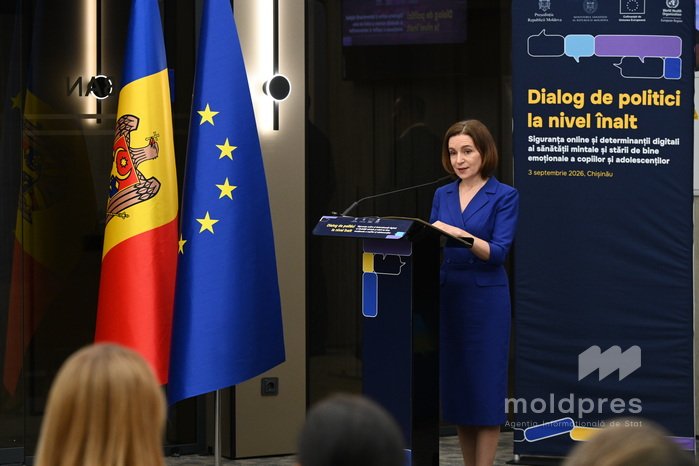
Moldovan president’s speech at event on online safety, digital determinants of children’s, adolescents’ mental health, emotional well-being
Dear Ms. Gradinaru,

Dear Director Azzopardi Muscat,

Dear Ambassador Piorko,

Dear Minister Gasnas,

Distinguished partners and guests,

Dear young people,

At the beginning of this year, I announced children’s safety and their mental health in the digital age as a priority topic. I did so based on a simple observation: a large part of children’s lives now takes place online. This is where they learn, communicate, make friends, discover the world and express themselves. The digital environment opens up extraordinary opportunities for them, but it also influences their attention, emotions, relationships and the way they see themselves.

In his book, The Anxious Generation, Jonathan Haidt concludes that the sudden transition from a childhood based on play in the real world to one based on phones and screens has caused a huge increase in anxiety and depression among young people. Screens deprive young people of sleep, attention and real social connection. The lack of physical activity and interaction with the physical environment limits the development of bodily resilience and self-confidence. As a result, in more and more countries, excessive use of screens and social media is being treated as a major public health crisis.

In Moldova, before discussing solutions, we wanted to listen to young people and adults. In recent months, we spoke with students, teachers, parents and specialists in Chisinau, Cahul, Ungheni, Balti and Nisporeni. We listened to children’s experiences, parents’ concerns and the difficulties faced by teachers. Young people spoke openly about the risks they encounter in the digital space and about the need for clear rules, while teachers spoke about the support they need to use new technologies in education.

These meetings showed that we need measures that are both ambitious and realistic. We can no longer return to the times when parents’ concern was for their children to come home before dark, while teachers’ concern was that students would not copy their homework during recess from their more diligent classmates.

Today, children can be at home or at school and, at the same time, be completely absorbed in the online world. And parents and teachers, no matter how hard they try, do not always know whom children are communicating with, what content they are accessing or what situations they are experiencing.

I know that many parents wonder what the right age is for giving their children their own phone or access to screens. How many hours are too many? How much freedom should they offer, and where should they draw the line? The answers are not always simple. That is precisely why parents must not be left alone to face such difficult decisions.

Ladies and gentlemen,

We already see, in the adult world, how powerful manipulation and disinformation can be in the cognitive warfare we are facing. If adults sometimes find it difficult to distinguish truth from falsehood, we cannot expect a child to navigate safely on their own through a space designed to constantly capture their attention.

The problem is not technology itself. The problem arises when the digital environment does not take into account the best interests of the child or adolescent. Bullying, harmful content and mechanisms that encourage compulsive use affect health and long-term development. Therefore, we adults have a duty to create protection mechanisms.

I do not use the term “protection” by chance. The solution cannot consist of a succession of simple bans. The discussions we held across the country showed us that some adolescents understand the risks and want to be heard. But they also showed us that they expect answers from us, the adults. They expect clear rules, support when they encounter a problem and an environment in which they can ask for help without fear and without being judged.

We are at the beginning of the school year, and we all know that today’s school is facing an entire spectrum of major transformations. Artificial intelligence and digitalization are changing the way new generations acquire knowledge. We must prepare children for occupations that will undergo profound changes and for professions that do not even exist today.

We cannot do this by isolating them from technology. We must teach them to use it intelligently, in a balanced and responsible way, to think critically and to use new tools without becoming captive to them.

That is why, we need a joint effort from families, schools, the healthcare system, public authorities, civil society and the companies that operate digital platforms.

We need practical support for parents and teachers, clear procedures for preventing and reporting incidents and rapid and confidential access to help for children in difficulty.

At the same time, protection must be integrated into the very way platforms operate.

Last but not least, we must listen to the voices of children and adolescents, in order to understand their needs, fears and aspirations.

The debate on these issues is taking place today throughout the world. It is important to maintain a constant dialogue with our partners, to discuss openly evidence-based solutions and policies, what works and what does not, and to learn from the experience gained.

At the same time, we must understand that there are no definitive solutions established once and for all. We will have to calibrate measures as we go, through continuous learning and adaptation, as technologies and the risks associated with them evolve.

I hope that today’s discussions will move us from identifying problems to developing concrete ideas regarding measures, responsibilities and results that we can evaluate. I thank the Health Ministry, the World Health Organization Regional Office for Europe, the European Union, United Nations Children’s Fund (UNICEF), UN Population Fund (UNFPA) and everyone contributing to this effort.

Our goal is simple: every child of Moldova should be able to grow up healthy, free and safe in a world where physical and digital reality intersect.

Thank you!
 Facebook
 Instagram
 X/Twitter
 Telegram
Moldova celebrates 35 years since proclamation of Independence
Moldovan parliament speaker, new Head of Council of Europe Office in Chisinau discuss democratic reforms, European path of Moldova
Moldovan parliament speaker meets Ambassador of Turkey to Moldova, at end of mandate in Chisinau
Moldovan parliament speaker has farewell meeting with Ambassador of Lithuania
Lithuanian Ambassador to Moldova awarded Order of Honour
Moldovan president has meeting with members of NATO’s Political Committee
Moldovan PM, president of Council of International Civil Aviation Organization discuss developing relevant sector in Moldova
Fifty nine young people of Moldova complete paid internship programme in public service
State of alert in energy sector, hydrological domain extended by 30 days in Moldova
Government backs licensing of grain and oilseed imports by 31 October 2026
Government to support social inclusion of people with disabilities under National Program 2026–2030
29 new regional development projects included in 2025-2027 Single Programming Document
Government gradually standardizing tax regime applied to goods imported by economic operators from Transnistrian region
Head of the Reintegration Policy Bureau has meeting with Ambassador of Belgium to Moldova
Moldovan president, at international online safety conference, says each child must grow up healthy, free, safe in world where physical, digital realities intersect
Searches conducted in more settlements of Moldova in case concerning illegal financing of parties through cryptocurrencies
Electronic monitoring of domestic abusers to be strengthened: Moldova's National Probation Inspectorate to receive 200 new bracelets, 2027 budget to be doubled
Moldovan parliament speaker, on National Army Day, says National Army symbol of defending peace
MPs stand silent for one minute in memory of victim of tragedy in central Moldova village, femicide victims
PHOTO // Well-known Romanian actor, three memorable roles to be screened at Romanian Film Days
VIDEO // PM announces urgent measures following tragic case in central Moldova village
 National Bank of Moldova
Deputy PM for reintegration has meeting with new Head of OSCE Mission to Moldova
As many as 561 mayor's offices adopt final decisions on voluntary amalgamation; government's secretary-general says real stake of reform to provide citizens with decent living conditions
Government approves amendment to state social insurance budget for 2026
More medical services for population: mandatory health insurance funds to be increased by 167.4 million lei
Government approves 2026 state budget revision: Funds allocated for compensation, completion of local infrastructure projects, one-off payments for public sector and road fund

VIDEO // Moldova's National Army marks 35 years since establishment; Defence minister: “Our mission stays the same – to protect peace”
How can we protect children in digital environment? Moldovan president, Romania’s First Lady attend international conference in Chisinau
Moldovan foreign affairs minister has meeting with regional director of United Nations Population Fund
Moldovan deputy PM for reintegration says harmonization of tax regime to continue, despite Tiraspol's reaction
BTA: Bulgarian Funding to Improve Kindergarten Yard in Moldova's Cairaclia
Moldovan Central Electoral Commission approves electoral calendar for organizing elections for office of Gagauzia's governor
Deputy PM for reintegration has meeting with new Head of OSCE Mission to Moldova
Railway of Moldova state enterprise transports over 46,000 tons of export, transit goods in last August
Moldovan foreign affairs minister rejects claims by Russia’s Ambassador-Designate
Energocom company of Moldova says natural gas price continue to rise on European exchange
ARMENPRESS: EU Council backs temporary trade-liberalization measures for Armenian products
Moldova to send Russia protest note over unauthorized opening of polling stations for elections; Moldovan foreign affairs minister says it represents unfriendly act
Director of National Probation Inspectorate resigns after tragedy in central Moldova settlement; electronic monitoring system to be reformed
As many as 561 mayor's offices adopt final decisions on voluntary amalgamation; government's secretary-general says real stake of reform to provide citizens with decent living conditions
Local Public Administration Reform // Moldovan government prepares normative amalgamation phase for 254 mayoralties
Bookfest Chisinau opens its 2026 edition; readers invited to celebrate books for five days
Receive the latest news directly to your email

Receive the latest news directly to your email