
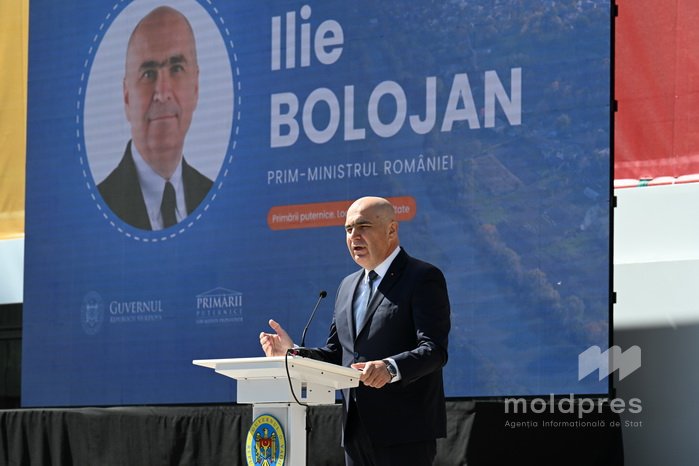
Romanian PM in Chisinau: “We can no longer manage localities as we did 40 years ago. Without strategic decisions, you cannot create conditions for development”
Acting Prime Minister of Romania Ilie Bolojan, who participated in an event dedicated to the process of amalgamating municipalities in Chisinau, urged local elected officials of Moldova to support the reform of local public administration, emphasizing that making local structures more efficient is essential for community development and reducing administrative costs. The Romanian official spoke about the need to adapt administrations to current demographic realities and to use public resources more efficiently.

“Today we are discussing a priority, namely creating the conditions for the prosperity of the citizens we represent. To create prosperity, there are more very important aspects. First, we must create conditions for economic development. Without strategic decisions on belonging to large economic blocs, such as the European Union, you cannot create conditions for development. This means access to markets, technology transfer and jobs. If Romania has developed in recent years, it is also as a result of access to EU markets and the support received to recover delays. And the right path chosen by Moldova is this European path. I congratulate the leadership of Moldova on these strategic decisions and your citizens on voting for this direction, which creates the basic conditions for prosperity. But the second condition for prosperity is what happens in each local community. And, whether we like it or not, local elected officials have an essential role. You are hearing this from a former mayor for three terms, that is 12 years, and a former president of a County Council. Prosperity means investments for citizens: water and sewerage networks, asphalt up to people’s homes, better-looking schools, clinics where people receive better treatment and many other things,” said Ilie Bolojan.

The acting prime minister explained that the financing of local infrastructure was based on government transfers and on taxes collected from citizens, underlining the need for these funds to be used efficiently.

“We must acknowledge that governments no longer have unlimited capacity to make transfers and precisely for this reason money must be used as efficiently as possible, for projects that bring real value to communities. In such a way that, when funds are directed, they go to projects that bring added value to the respective community. But the second source for carrying out these investments is the taxes we collect from citizens. The value of an administration is given by the share it returns to citizens from these taxes. If administrations spend almost all collected money on operating expenses and the amount that goes back to citizens is very small, it means that the administration no longer exists for citizens, but citizens for the administration. Dear colleagues, please reflect on what has happened in these years, on things we could not avoid. Rural localities have been depopulated to some extent due to declining birth rates. Because of the lack of jobs, young people have migrated either to Western Europe or to major cities in search of better opportunities. In the context, this depopulation means that some administrations can no longer function as they did 40 years ago, because they no longer correspond to current realities and consume too many resources. When we openly analyze administrative costs per citizen, we find that as a locality has fewer inhabitants, costs are much higher. Moldova has a favorable context, which I believe should be used. I once again congratulate the government for supporting this process. On the one hand, there is a stable majority for these measures, even if they are not always popular and not always supported by local elected officials,” he said.

Ilie Bolojan called on local elected officials of Moldova to support administrative reforms, even if they may be difficult.

“My request to all local elected officials is to support these changes, even if at first they may seem uncomfortable. Even if from two mayoral positions only one will remain, or the number of councilors will decrease, what matters is that we do good things for the citizens. Thank you for what you are doing, thank you for your friendship. May God watch over Romania and Moldova,” Ilie Bolojan concluded.

Acting Prime Minister of Romania Ilie Bolojan is in Chișinău today to participate in the event, Strong Mayoralties – Developed Settlements, organized on the Great National Assembly Square (PMAN).

The event brought together over 400 mayors from localities that have initiated the voluntary amalgamation process, district presidents, members of specialized organizations, as well as external partners and was dedicated to the reform of local public administration and the strengthening of administrative capacities.

The event was attended by the President Maia Sandu, Parliament Speaker Igor Grosu and Prime Minister Alexandru Munteanu.

In late last January, the government officially announced the launch of the process of preparing the local public administration reform, as part of efforts to modernize administration and improve the quality of public services provided to the population. Subsequently, broad consultations on the reform were held with all interested parties, after which the government presented the reform concept.

According to the latest data presented by the authorities, 663 decisions to initiate the amalgamation process have been approved so far, targeting 767 mayoralties and covering about 86 per cent of all mayoralties of Moldova.
 Facebook
 Instagram
 X/Twitter
 Telegram
Euractiv: Moldova might start negotiations on first EU accession cluster in next June
Foreign affairs minister says Moldovan citizens on both banks of Dniester understand very well international circumstances country is in, risks of Russian citizenship
Foreign affairs minister meets Austria’s Ambassador to Moldova
Moldovan Central Electoral Commission imposes sanctions on officials from electoral bureaus set up for May 17 new local elections
Government simplifies voluntary amalgamation process
Deputy Prime Minister meets with Austrian Parliamentarians
New State Secretary appointed at Ministry of Labour and Social Protection
Romania’s Interim Prime Minister to visit Chișinău
Austrian MPs reaffirm support for Moldova
Romania accelerates strategic Vulcanesti–Chisinau project: “A pillar of Moldova’s energy security and European future”
Traian Băsescu thanked President for granting Moldovan citizenship: I remain devoted to cause of country’s integration into EU
DOC // Former President of Romania granted Moldovan citizenship
Moldovan Ambassador to Japan presented copies of letters of credence
Chair of National Defence Committee of Estonia visits Chisinau
PM's emotional message at end of school year
30 MW Photovoltaic park with battery storage to be built in Vadul lui Vodă
Romania’s acting PM in Chisinau speaks about proposal for sanctions against Russian diplomats in Bucharest
Moldovan PM says many things are to be done, Romania stays Moldova's strategic partner
 National Bank of Moldova
President received Romania’s Prime Minister in Chișinău
Last Bell rings in Romanian-language schools on left bank of Dniester
Moldovan president says reform of local public administration communal effort between villages
Moldovan president's speech at Strong Mayoralties - Developed Settlements event
Strong Mayoralties – Developed Settlements: about 400 mayors from localities that initiated voluntary amalgamation process gather at Moldovan government

Romania’s acting PM cuts short visit to Moldova
Moldovan parliament speaker says only large localities to be able to provide quality services
Mayors of Moldova voice support for local public administration reform
Moldovan president's speech at Strong Mayoralties - Developed Settlements event
Romanian PM in Chisinau: “We can no longer manage localities as we did 40 years ago. Without strategic decisions, you cannot create conditions for development”
Strong Mayoralties – Developed Settlements: about 400 mayors from localities that initiated voluntary amalgamation process gather at Moldovan government
Moldovan president says reform of local public administration modern community work: more villages joining their mayoralties to make life better for everybody
Moldovan Central Electoral Commission starts printing ballot papers for second round of new local elections
Romanian acting PM in Chisinau: “On these days, Romania is signing all its contracts to equip the army with new technology”
Moldovan PM welcomes Romanian prime minister in Chisinau: joint projects, regional resilience, priorities of bilateral cooperation
LIVE // Over 400 mayors gather in Chisinau for Strong Mayoralties – Developed Settlements event
Moldovan Central Electoral Commission: May 29 last day of electoral campaigning before second round of new local elections
Moldovan government's secretary general says country's localities can become stronger, only if we unite our efforts, resources, administrative capacities
Moldovan National Road Transport Agency launches nationwide inspections of heavy trucks
Moldovan PM says attack in Galati shows threats of war real for entire region
Moldovan parliament speaker says drone attack on Galati serious, unacceptable act
Receive the latest news directly to your email

Receive the latest news directly to your email