
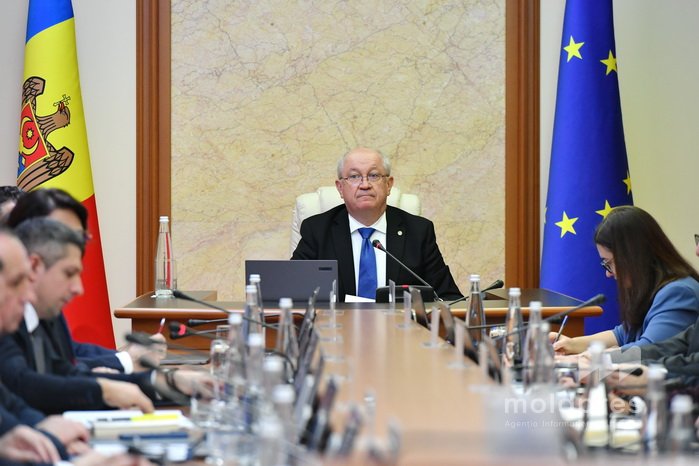
Moldovan PM says first Stalinist deportations from Bessarabia painful history that citizens must know
Prime Minister Alexandru Munteanu has invited citizens to visit the exhibition titled, State Terror in Soviet Moldova: Scope, Victims and Perpetrators, which will be inaugurated on the Great National Assembly Square on June 12. The event will  mark 85 years since the first Stalinist deportations from Bessarabia.

On the night of June 12–13, 1941, thousands of people were taken from their homes and deported to Siberia and Kazakhstan in cattle cars, as part of one of the most tragic repressive operations of the totalitarian Soviet regime.

“For many citizens of Moldova, the deportations are part of their family stories. Thus, we remember tens of thousands of people who were taken from their own homes and separated from their families. In my own family, my grandfather was deported and I never even got to know him, because he returned from the Murmansk region sick and died very young. This is the history of our family,” said Alexandru Munteanu.

The exhibition, State Terror in Soviet Moldova: Scope, Victims and Perpetrators, reconstructs, through documents, photographs, period artifacts and testimonies, the suffering of deported families and the memory of those who went through Stalinist repressions.

“I urge all my colleagues from the government and all citizens to visit the exhibition, because this is our history, a painful history that we must know. Memory means understanding how precious freedom, dignity, rights and the protection of democracy are,” emphasized Alexandru Munteanu.

The exhibition will be open as of June 12 till July 6, between 09:00 and 21:00. The schedule also includes more special events. On June 21, topic-related films from the reserves of the National Archives about Soviet repressions will be screened, and on June 28, a theater performance will be staged. On July 6, a special event dedicated to the deportations of the night of July 6–7, 1949, will be held. A novelty of this year’s edition is the organization of a similar exhibition in Balti.

Visitors will be able to see railcars similar to those in which people were transported, as well as documentary materials reflecting the scale of the tragedy and its impact on society. The exhibition is an exercise in collective memory and a tribute to all those who were deported, persecuted, dispossessed of their property and torn from their families.

It is organized by the Culture Ministry and the National Archives Agency, with the support of the Association of Former Deportees and Political Prisoners, the Railway of Moldova, the State Chancellery, the Blue Frame project, regional museums and other state institutions.

The mass deportation operation in the Moldavian Soviet Socialist Republic (MSSR) on the night of June 12–13, 1941, included 18,392 people and was part of a broader action to “cleanse” the new territories occupied by the USSR in 1939–1940, following the Ribbentrop–Molotov Pact. The mass deportation of July 6–9, 1949, was the largest on the current territory of Moldova. The operation affected more than 11,000 families; the contingent of those forcibly transported in cattle cars numbered 35,796 people, including 11,889 children, 14,033 women and 9,864 men.
 Facebook
 Instagram
 X/Twitter
 Telegram
VIDEO // Moldovan labour minister presents transformations in social protection system
Moldovan president attends National Forum of Social Protection Professionals
VIDEO, PHOTO // Social protection professionals gather in Chisinau for first National Forum dedicated to competent field
Police investigate reports of flying object, possible explosion in two central Moldovan districts
PHOTO // Moldovan PM, mayors from Gagauz autonomy discuss water crisis, political deadlock in Comrat, attracting Turkish investment
Moldovan Border Police monitor situation after explosion nearby border with Ukraine; no fragments found in Moldova
Moldova to host International Competition for Search and Rescue Dogs for the first time
PHOTO // Fragments that may have come from drone found on land near Colonița
PHOTO // Ștefan cel Mare Academy inaugurates drone operator training laboratory
Five youth centers to receive €500,000 for equipment and technical support
PHOTO // Fire Shield 2026 exercise concludes
DOC // New rules for recognition of professional qualifications obtained abroad
Palanca border crossing point temporarily suspended due to communication network failure
Unidentified drone briefly crossed airspace of Moldova
Judicial reform, rule of law in focus of discussions between Moldovan president, new Head of Council of Europe Office
Moldovan parliament's standing bureau approves agenda for September 24 plenary meeting
Energocom company of Moldova requests gas prices' adjustment after 42-per cent rise in European quotations
Moldova, Mongolia abolish visa requirements for holders of diplomatic, service passports
Vulcănești–Chișinău Power Line: defective equipment at Chișinău substation repaired
DOC // Moldova has new media law
DOC // Decision on declaring state of emergency in energy and hydrological sectors published in Official Journal
 National Bank of Moldova
Judicial reform, rule of law in focus of discussions between Moldovan president, new Head of Council of Europe Office
Moldovan parliament's standing bureau approves agenda for September 24 plenary meeting
Topics considered at meetings of Moldovan parliament's standing commissions on September 23, 2026
New opportunities for professional development, salary supplements for employees in Moldova's social assistance system
Parliament to ratify new agreement between Moldova and Romania on strategic transport infrastructure

Civil protection and fire protection to be regulated by rules aligned with European standards
Clearer, more visible health warnings on tobacco products' packaging in Moldova
Vulcănești–Chișinău Power Line: defective equipment at Chișinău substation repaired
DOC // Moldova has new media law
DOC // Decision on declaring state of emergency in energy and hydrological sectors published in Official Journal
Legal framework for integration of foreigners in Moldova to be strengthened
National legislation on electronic evidence to be aligned with international standards
Energy communities: clearer rules for establishment and registration
VIDEO // Officials and international experts present opportunities for Moldova’s organic agriculture in Chisinau at Southeast European Conference
Modernization works for district heating systems in Chișinău and Bălți to be declared matter of national public utility
Obtaining permits and approvals for renewable energy production to be simplified
StratCom analyzes main vulnerabilities of regional information environment ahead of elections in Gagauzia
Parliament to examine legislative measures to strengthen NBM independence in line with European standards
PHOTO GALLERY // Journey through Northern Moldova through MOLDPRES lens
Prime Minister visits New York: bilateral meetings and address to plenary of UN General Assembly
Moldova and Kazakhstan strengthen cooperation
Receive the latest news directly to your email

Receive the latest news directly to your email