
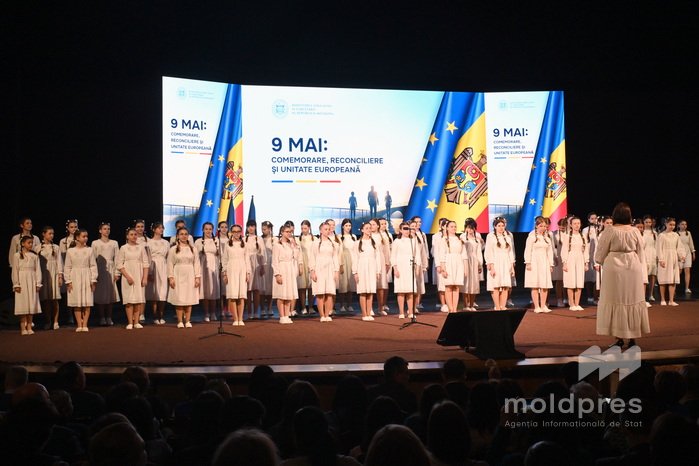
Scientific conference “9 MAY: Remembrance, Reconciliation and European Unity.” held in Moldova; head of state says European future of Moldova means assuming the past, choosing truth over propaganda
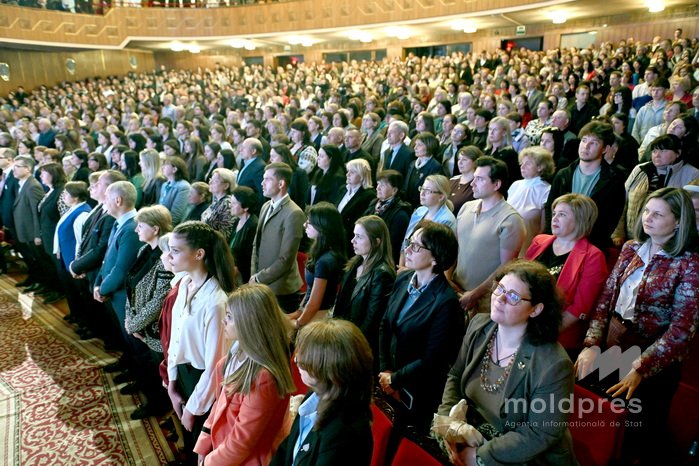
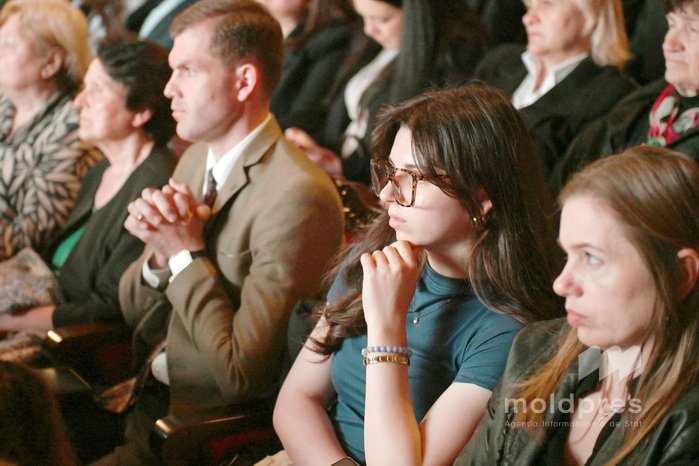
Over 1,200 history teachers from across the country, ambassadors and the top leadership of the state have taken part in the national scientific conference, 9 May – Remembrance, Reconciliation and European Unity. President Moldova Maia Sandu addressed the participants and reiterated that the European future of Moldova means assuming the past, just as it means choosing truth over propaganda.

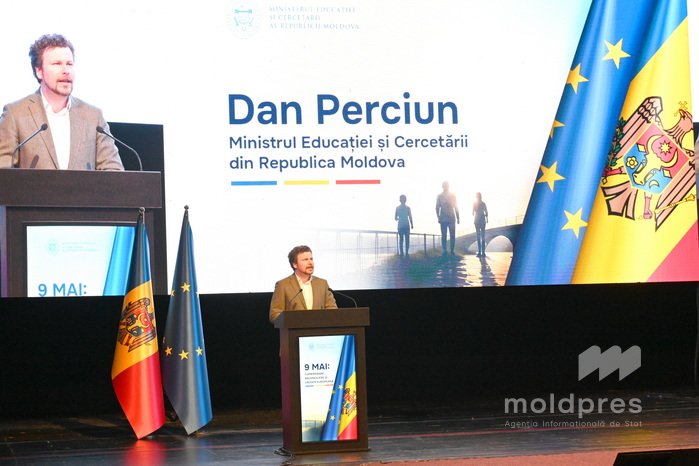
The event was opened by the Education and Research Minister Dan Perciun, who emphasized that, after independence, history teachers and researchers had had a fundamental mission in shaping the civic and national consciousness of young people.

“The role of those who teach history and civic education is essential for our democratic resilience and for defending fundamental human values,” Perciun said.

The minister highlighted the contribution of teachers in explaining the difference between history and propaganda, between patriotism and hatred, as well as in protecting historical memory in a context marked by disinformation.

He pointed out that patriotic education must be understood as the formation of responsible citizens, not as the promotion of slogans.

“Healthy patriotism is a patriotism of responsibility, based on respect for the country, language, culture and on openness towards a shared European future,” the minister said.

In his speech, Dan Perciun underlined that European integration is, in essence, a choice of values.

“European integration is not just an economic or security project, but a fundamental choice between freedom, democracy and respect for each citizen,” he said.

The official described the European Union as a project of peace and reconciliation, built on the tragic lessons of the 20th century. He said that the European path of Moldova is “a natural return to a space of values.”

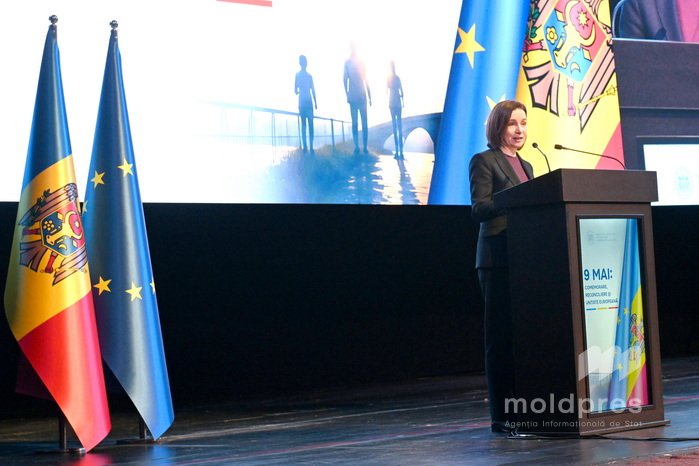
President Maia Sandu stressed the importance of assuming the past and historical truth in building the country’s European future.

“The European future of Moldova means assuming the past, just as it means choosing truth over propaganda. Only in this way will we be able to build a society that does not allow fear, lies and division to decide the fate of its citizens,” the head of state stressed.

Maia Sandu emphasized that society cannot move forward without an honest relationship with history and without rejecting the manipulation of the past:

“We cannot build a mature democratic society without a culture of memory based on facts.”

The head of state also spoke about the significance of 9 May, noting that it must be viewed through the lens of reconciliation and historical responsibility:

“We cannot tolerate the overlapping of remembrance of the victims of war with the glorification of totalitarian regimes. Yes, 9 May is Victory Day, and the sacrifice of those who fought and died in the Second World War must be respected and commemorated with dignity. But history did not stop in 1945. For us, it was followed by the establishment of a regime that brought deportations, organized famine, repression, fear and the systematic attempt to suppress our national identity. Therefore, we cannot tolerate the overlapping of remembrance of the victims of war with the glorification of the Soviet regime. At the same time, it is important to understand that there is no contradiction between the idea of honoring Victory Day and celebrating Europe. On the contrary, the European project was born precisely from the devastating lesson of war and totalitarianism, from the conviction that peace and freedom must replace hatred and imperialism. A united Europe is the result of a reconstruction that was first and foremost moral, based on respect for human dignity. Yet, we all know: when we asserted our desire to live according to the same principles, when we claimed our right to decide our own future, we were forced, in 1992, to defend our country with weapons in hand. Even if weapons are silent today on the territory of Moldova, we are facing another form of aggression — cognitive warfare, which also targets the past and seeks, by manipulating it, to control our present and future. Those who insist on an exclusively Moscow-centered interpretation of 9 May are trying to falsify not only what happened in 1945, but everything that followed. Just as Russian propaganda today seeks to justify the war of aggression against Ukraine by denying the identity of a people and by the abusive use of history. Reconciliation cannot be built on moral and historical ambiguity. We cannot mix truth with lies; we cannot equate victims and aggressors. Authentic reconciliation is built on truthfulness, on the recognition of suffering, on clear-sightedness about the past and on turning memory into a warning for the future.”

At the same time, the president highlighted the role of education in defending democracy and in passing on historical memory to new generations, stressing that the truth about the past is essential for the resilience of society.

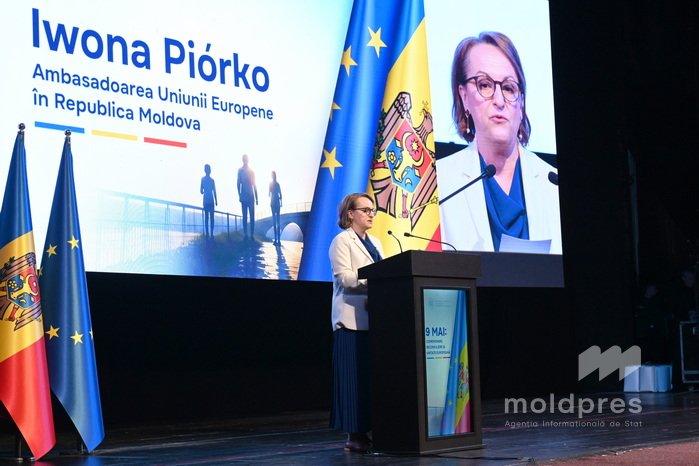
The event was also attended by Ambassador of the European Union Iwona Piorko.

“Europe Day is not just a symbolic celebration. It is the expression of a fundamental choice made by European states after two devastating wars: the choice of peace, unity and freedom. It is the result of a painful historical lesson, from which Europe understood that only cooperation and solidarity can prevent the repetition of the tragedies of the past.”

She reiterated that Europe Day is not only about the past, but above all about responsibility for the future:

“Moldova has chosen a European path — a future anchored in peace, opportunities and democratic freedoms, as part of the European Union. Let us use this day not only for remembrance, but also for reaffirming the principles that define us. Let us honor memory without allowing it to be manipulated. Let us reject propaganda without giving up dialogue. And let us continue, together, to build a European future for our country.”

The ambassadors of Romania and Ukraine also delivered speeches at the event.

According to the Education and Research Ministry, the scientific conference, 9 MAY: Remembrance, Reconciliation and European Unity, brings to the forefront a reflection on memory, historical truth, reconciliation and the belonging of Moldova to the space of European values.
 Facebook
 Instagram
 X/Twitter
 Telegram
Corruption case at district hospital in Florești
Moldova could have unified system of environmental payments and fees
Judge passes re-evaluation in Moldova; Superior Council of Magistracy accepts Commission’s report
PHOTO // First deck of “Bridge of Flowers” from Ungheni brought to construction site of Moldova
Prime Minister on International Nurses Day: Thank you for work you do every day, with patience and care
Authorities encourage voluntary amalgamation: 87% of town halls in Moldova have fewer than 3,000 inhabitants
Prime Minister’s message of support before Eurovision
Law enforcement bodies dismantles darknet platform involved in illegal hacking services, sale of stolen databases and drug trafficking
PHOTO // “Nicolae Testemițanu” USMF students win first place at EuRoPhyz Quiz 2026 competition
Voluntary amalgamation in central district of Moldova: 32 mayoralties join forces for better standard of living
Moldovan parliament speaker comments on case of minor who died at Cahul military unit
Moldovan judges, prosecutors enhance knowledge in green justice field
PHOTO GALLERY // European Town inaugurated in heart of Moldovan capital on Europe Day
European Town inaugurated on Great National Assembly Square of Chisinau on Europe Day – celebration of peace, unity, diversity
President’s blunt message at Council of Europe ministerial session: Russia - greatest danger to continent
LIVE VIDEO, TEXT // Ministerial Session of Committee of Ministers of Council of Europe opened in Chișinău
UK Foreign Secretary in Chișinău: Crimes against Ukraine cannot go unpunished
President at Ministerial Session of Council of Europe’s Committee of Ministers
Former deputy mayor challenges Chisinau mayor to public debate
Deputy Prime Minister for European Integration discusses European agenda and progress in EU accession negotiations with Czech Foreign Minister
VIDEO // Bucharest supports accelerating European Integration of the Republic of Moldova
 National Bank of Moldova
Moldovan president has discussions with foreign affairs ministers of Switzerland, Norway, Delegate Minister for European Affairs of France
Moldovan PM, France’s Minister Delegate for European Affairs discuss new investment projects
Free movement, access of journalists to Security Zone discussed within Joint Control Commission
Moldovan deputy PM for reintegration has meeting with Foreign Affairs Minister of Norway
Working groups on behalf of Chisinau, Tiraspol discuss up-to-date topics on civil status documents, population's registration

Munteanu Government will not resign
Ukrainian Foreign Minister in Bălți: We ready to cooperate with Moldova in defence and security
Deputy Prime Minister explains political conditions for European integration
Official opening of EU accession negotiations expected next week; Moldovan president: ''We hope the decision will be taken”
Moldovan president has discussions with foreign affairs ministers of Switzerland, Norway, Delegate Minister for European Affairs of France
Moldovan PM, France’s Minister Delegate for European Affairs discuss new investment projects
Moldova might have another 50-meter Olympic pool: talks held in Chisinau with president of European Aquatics Federation
PHOTO // Moldova to receive 60 million euros to modernize irrigation systems
Moldovan Judges' Evaluation Commission completes evaluation of all judges with leadership positions
PHOTO // Norwegian Embassy to be opened in Moldovan capital
PHOTO GALLERY // Volume ''Talent Has No Days Off," signed by Aurelian Silvestru, launched at Moldova's National Library
National Bank of Moldova: annual inflation rate to follow upward trend in 2026, afterwards to decline
Free movement, access of journalists to Security Zone discussed within Joint Control Commission
Energy minister Athens says Moldova undergoing major transformation of its energy system
VIDEO // Moldovan parliament speaker says country must strengthen defense capabilities, continue investments
Moldovan parliamentary commission for national security and defense to consider case of minor dead in military unit in Cahul
Receive the latest news directly to your email

Receive the latest news directly to your email