
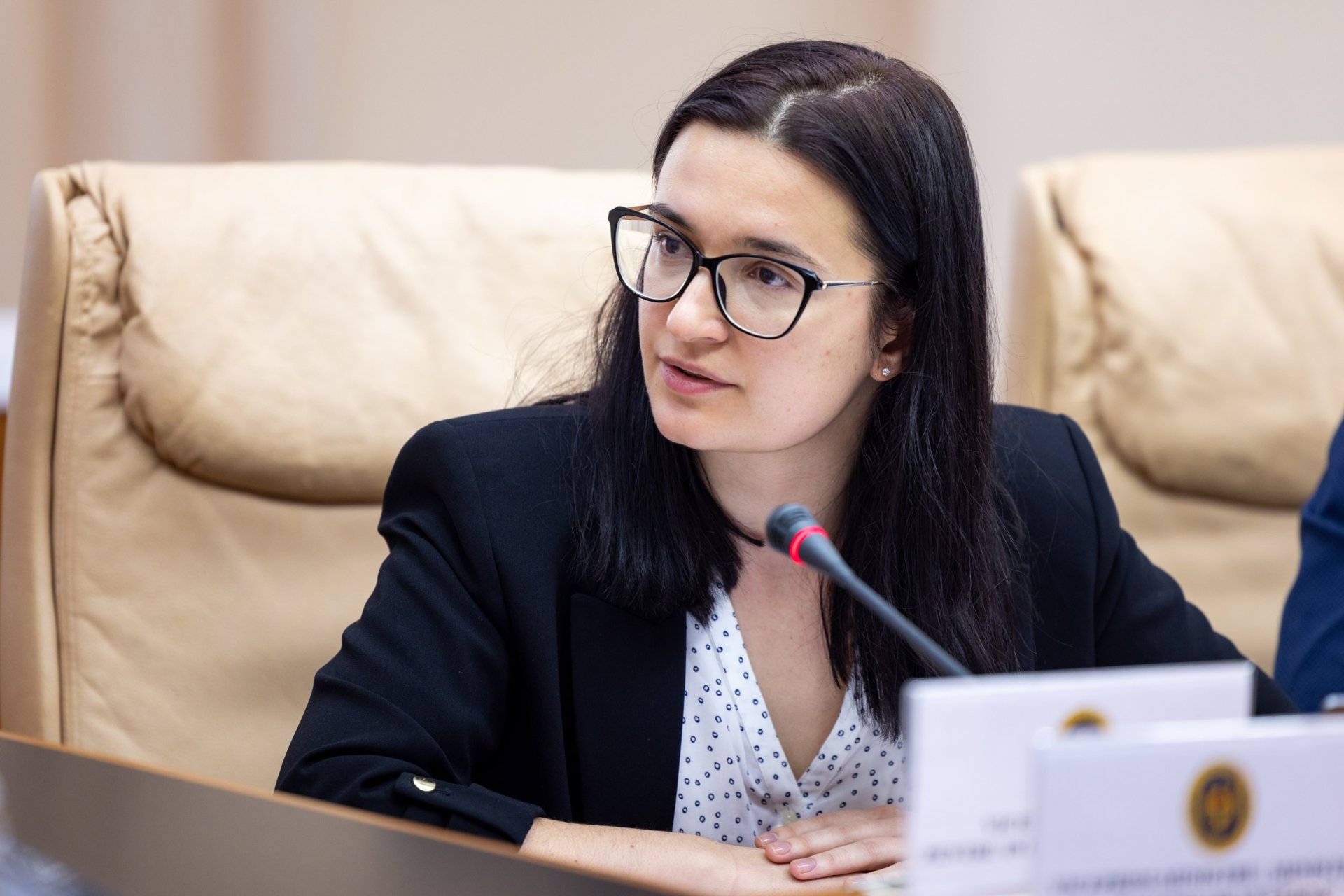
Deputy Prime Minister explains political conditions for European integration
There are encouraging political signals at European level, and the decisions expected in the coming weeks could directly influence the enlargement process. Deputy Prime Minister Cristina Gherasimov explained the conditions under which accession negotiations between the Republic of Moldova and the European Union could be officially opened, the stages that will follow this moment, and the estimated timeline for signing the accession treaty.

“We have seen the elections in Hungary that took place and we have the first signs that the situation for Ukraine could be unblocked. We still need to see that first meeting between the Prime Minister of Hungary and President Zelensky to see what the conditions will be, whether there will be conditions for Ukraine to open the first cluster of chapters related to fundamental values and then the rest. We very much hope that this decision will be taken, because only last week the Hungarian government was, in a way, installed. Now we will see what the first diplomatic steps will be regarding this dimension of EU enlargement. We remain in a package with Ukraine,” Cristina Gherasimov said on Jurnal TV.

The official stressed that the Republic of Moldova and Ukraine have long been ready for the opening of negotiations, and the first group of chapters is to be launched simultaneously for both states, even if afterwards each country will follow an individual negotiation path.

“The truth is that both Ukraine and our country have been ready for a long time to open negotiations, and it is absolutely natural that the first cluster should be opened for both countries at the same time. But, as I have been told many times, what follows is an individual path for each candidate state, because the reforms we have to implement differ from the reforms in other candidate states, such as Ukraine. Accordingly, we hope that the first group of chapters will be opened together, because that would be fair. But from then on, each goes on its own way,” Gherasimov explained.

The Deputy Prime Minister underlined that political developments in EU member states play an important role in advancing the enlargement file, noting that elections are due in several European countries and that domestic debates may temporarily slow down discussions on enlargement.

“We have elections in France, we have elections in Italy, we have elections in Poland, in Germany. Many of these states have an electorate segment that opposes enlargement. Accordingly, no political party is willing to commit to discussing enlargement next year. Exactly as we saw in the period before the European Parliament elections. Discussions on enlargement were rarer, so to speak. From this perspective, this year is very important, while we have this window of opportunity, where we have 27 member states that support the Republic of Moldova and, most likely, also Ukraine with regard to our European path. It is important to unblock certain processes,” the official explained.

Regarding the next stages, Cristina Gherasimov mentioned that the negotiation process first requires meeting a number of benchmarks and implementing a set of priority reforms, especially in the areas of justice, security and freedom. She stressed that the strategic objective of the Republic of Moldova is to join the European Union by 2030, which implies closing negotiations by the end of 2027 or the beginning of 2028 and signing the accession treaty no later than the end of 2028.

“There are two states that could organize a referendum to decide whether to accept us or not: France and, sometimes, the Netherlands is also mentioned. But again, they can decide whether to put this decision to a referendum. In France, it is less flexible, because after Croatia’s accession it was decided that all subsequent states wishing to join should be subject to a referendum. Accordingly, we must have this period of at least two years to allow member states to go through the ratification process. In order to sign the accession treaty by the end of 2028, it is important to close the negotiations and we need a period of time during which this treaty will be drafted,” the official explained.

At the same time, the official drew attention to the fact that the country still has a significant amount of technical work to do, including the transposition and implementation of European legislation, stressing that the process is different from that of other candidate states in the Western Balkans.

Chisinau authorities expect that the decision to officially open accession negotiations between the Republic of Moldova and the European Union will be taken as soon as possible. “We hope that next week there will be an official decision,” President Maia Sandu said.
 Facebook
 Instagram
 X/Twitter
 Telegram
Moldovan deputy PM has discussions with high EU official in Brussels
Moldovan president in Strasbourg says Moldova ready for opening of negotiations with EU on all clusters
Deputy Prime Minister for European Integration discusses European agenda and progress in EU accession negotiations with Czech Foreign Minister
European MP says elections in EU can influence Moldova’s path, European support stays strong
First in EU accession process: European Parliament, parliament of Moldova launch joint working groups on negotiation chapters
Moldova and Italy launch cooperation project to align national agricultural sector with European Union requirements
VIDEO, PHOTO // Young Moldovan lawyers preparing to implement European environmental standards in context of EU accession
Chișinău hopes for unblocking EU enlargement after change of power in Hungary
Moldova has roadmap for protection of species and habitats in line with EU standards
VIDEO // Romanian president says there is European-wide consensus to support Moldova, Ukraine, despite nuances on pace of accession to EU
DOC // Government of Romania accelerates Suceava-Balti power line project, by declaring it object of national importance
MOLDPRES REPORT // Europe reaches Cantemir by rail: Railway of hope relaunched under banner of shared values on both banks of Prut
Deputy Prime Minister pays working visit to Brussels
Moldovan experts learn about European experience on biodiversity conservation during study visit to Greece
Minister of Energy: Works on Vulcănești–Chișinău line completed
President met with former Prime Minister of Finland
Moldova and Romania expand cooperation for development of infrastructure projects
Approved by Government: electronic signatures to be available from age of 14
 National Bank of Moldova
Prime Minister met with EU Representative for Transnistrian settlement
Prime Minister and Strategic Counsellor at Tony Blair Institute discuss support for European reforms in Moldova
President met with former Prime Minister of Finland
20 model schools to undergo major modernization: Government approves ratification of Financing Contract between Moldova and EIB
President announced measures following abuses at MoldATSA

Moldova and Romania expand cooperation for development of infrastructure projects
Parliament to tighten rules for convicts trying to flee country
Military sappers neutralized 21 explosive devices remaining from World War II
Record on electricity exchange: 542 MWh traded in single day, equivalent to about 4% of consumption
Approved by Government: electronic signatures to be available from age of 14
Moldova continues withdrawal from CIS treaties
State Chancellery to launch comprehensive review of consultancy contracts
20 model schools to undergo major modernization: Government approves ratification of Financing Contract between Moldova and EIB
President announced measures following abuses at MoldATSA
President’s statements on measures announced following abuses at MoldATSA
Energy Minister in Montreal: Energy efficiency - best investment to reduce citizens’ bills
116 projects, including for opening new nursery groups included in Single Programming Document for 2025–2027
More road safety: Government sets clearer rules for market surveillance of motor vehicles
Investments for local development
Victims of human trafficking to benefit from greater protection and faster assistance
Better conditions for businesses in northern Moldova, at Multifunctional Industrial Park in Ocnița
Receive the latest news directly to your email

Receive the latest news directly to your email