
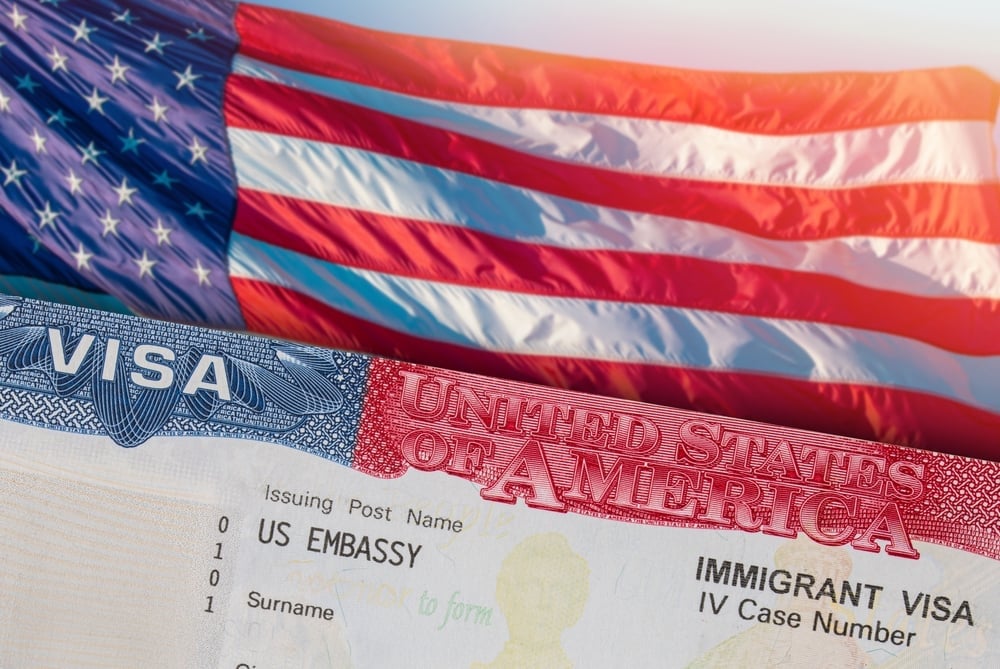
USA temporarily suspends issuing of immigrant visas for citizens of more states, including Moldova; Foreign Affairs Ministry says impact of measure limited
The United States has temporarily suspended the issuance of immigrant visas for citizens of more countries, including Moldova, starting from January 21, 2026. The measure is administrative in nature, as part of a review of the criteria regarding the use of public assistance (“public charge”), and does not represent a general ban on travel or entry to the U.S.

According to the Foreign Affairs Ministry (MAE), applications for immigrant visas can still be submitted and applicants can be interviewed, but the actual issuance of visas has been temporarily suspended.

“Immigrant visas that have already been issued remain valid and are not revoked. At the same time, nonimmigrant visas—tourist, study, work, and business visas—are not affected and continue to be processed and issued as usual. Immigrant visas are official documents that allow a person to settle permanently in the United States of America. They are different from nonimmigrant visas, which are issued for temporary stays, such as tourism, studies, or work for a limited period,” the MAE said

The institution also specified that “the impact of this measure on citizens of  Moldova is limited, given that the number of immigrant visas issued annually in Chisinau has been constantly low.”

“For official and up-to-date information, citizens are encouraged to consult the website of the U.S. Embassy in Chisinau and the platform travel.state.gov,” the MAE noted.

Following the US decision, WatchDog expert Andrei Curararu emphasized that the measure did not target Moldova specifically. Instead, a general rule called “public charge” is being applied.

“The USA has not closed its borders, Moldova is not banned, and visas are not stopped. The affected visas are those for family reunification, those won in the green card lottery and some work visas that lead to permanent residence. Tourist visas (B1/B2), study and exchange visas and those who already have a visa or green card are not affected. If the visa is valid, it is not canceled,” Andrei Curararu pointed out.

The expert added that the reason invoked by the US was an internal analysis of how many recent immigrants had ended up living on social assistance.

“The decision does not target Moldova in particular. The list includes many countries wealthier than Moldova: Uruguay, the Bahamas, Barbados, Kazakhstan, Thailand, Armenia, and Azerbaijan. So, it is not a list of ‘poor countries’,” Andrei Curararu stated.

As for the number of citizens hit by the new measure, the expert said that it is relatively small.

“A recent public report shows that, in May 2025, 23 family-based immigrant visas were issued in Chisinau. This indicates that, in a year, we are talking about dozens or a few hundred people—our fellow citizens who need to be protected. Thus, for the persons concerned, the files may be put on hold, while for everyone else, nothing changes,” Andrei Curararu added.

The United States on January 14 announced a freeze of all visa procedures for 75 countries. President Donald Trump stressed that “immigrants must be financially independent and not become a financial burden on Americans.”

In this context, the Department of State is conducting a comprehensive review of all policies, regulations and guidelines, in order to ensure that immigrants do not use social assistance in the United States.

White House Press Secretary Karoline Leavitt announced that the measure targeted applications from citizens of such countries as Somalia, Russia, Afghanistan, Brazil, Iran, Iraq, Egypt, Nigeria, Thailand, and Yemen. The list also includes Moldova and other European countries, such as Albania, Bosnia, North Macedonia and Montenegro.

Applicants for immigrant visas who are citizens of the affected countries can still submit visa applications and the Department will continue to schedule them for interviews; however, no immigrant visas will be issued to these citizens during the suspension. At the same time, people with dual citizenship who apply using a valid passport from a country not included on the list are exempt from this suspension.

The Department of State on January 12 announced that it had revoked more than 100,000 visas since Donald Trump’s return to the White House, a record number within a single year.
 Facebook
 Instagram
 X/Twitter
 Telegram
PAS MP conveys message on Dniester Day
Deputy Speaker urges graduates to continue studies in Moldova: Moldovan universities becoming increasingly competitive at European level
DOC // Greenhouse gas emissions data to be verified by independent experts
Moldova, Greece seek to develop joint projects in tourism, culture
Moldovan government endorses draft of new media law; Culture minister describes step as necessary for modernizing legal framework in sector
Moldova aims to become regional hub for medical tourism; authorities preparing strategy
Around 70 households affected by floods caused by heavy rains in Moldova; damages to be assessed
Moldova expands diplomatic presence in United Kingdom: first Honorary Consulate opened in Manchester
Yellow Code for atmospheric instability in Moldova: showers with thunderstorms, hail expected
Moldovans working in Slovakia to receive pensions
Defense Minister denounces smear campaign
Process of recognizing diplomas obtained in foreign institutions to be optimized
Moldovan citizens who worked legally in Canada to be eligible for social benefits
Prime Minister calls for continuous mobilization and support for communities affected by heavy rains
President: Dniester - essential for people’s health and safety of our communities
Moldova continues on path to EU even without formal decision on clusters, says head of state
New local elections: over 2 percent of voters cast ballots by 09:00
Prime Minister at Great Children’s Choir: We want every child to know they have seat at grown‑ups’ table, their voice matters
 National Bank of Moldova
Prime Minister at Great Children’s Choir: We want every child to know they have seat at grown‑ups’ table, their voice matters
President received Romania’s Prime Minister in Chișinău
Last Bell rings in Romanian-language schools on left bank of Dniester
Moldovan president says reform of local public administration communal effort between villages
Moldovan president's speech at Strong Mayoralties - Developed Settlements event

President: Negative emotions prevailed after Eurovision
PHOTO GALLERY // Best local entrepreneurs awarded at Moldovan Business Gala
President urges citizens to double-check before transferring money to scammers
PHOTO GALLERY // Largest exhibition dedicated to children opened at Moldexpo
MOLDPRES REPORT // Solar energy, batteries and electric transport: green technologies developed in China that could be of interest to Moldova
Attention, travelers! Heavy traffic at Leușeni border crossing point on exit from Moldova
Moldova ready to open first negotiation cluster with European Union, says Moldovan foreign minister
Deputy Prime Minister: Moldova increasingly respected internationally
CEC announces silence day ahead of second round of new local mayoral elections
Moldova hosts annual conference of banking supervisors from Central and South-Eastern Europe
PHOTO GALLERY // About 400 mayors gathered in PMAN for event - Strong city halls. Developed Communities. Romania’s acting prime minister special guest
Larisa Miculeț to assume role of acting head of Embassy of the Republic of Moldova in Ireland
ARMENPRESS: Armenia reaffirms constructive engagement in EAEU
ARBOM signs sponsorship agreement with Levski Trakia football team
Moldova’s walnut exports exceed 40 million dollars annually
President received Romania’s Prime Minister in Chișinău
Receive the latest news directly to your email

Receive the latest news directly to your email