

DOC // Currency operations to be simplified
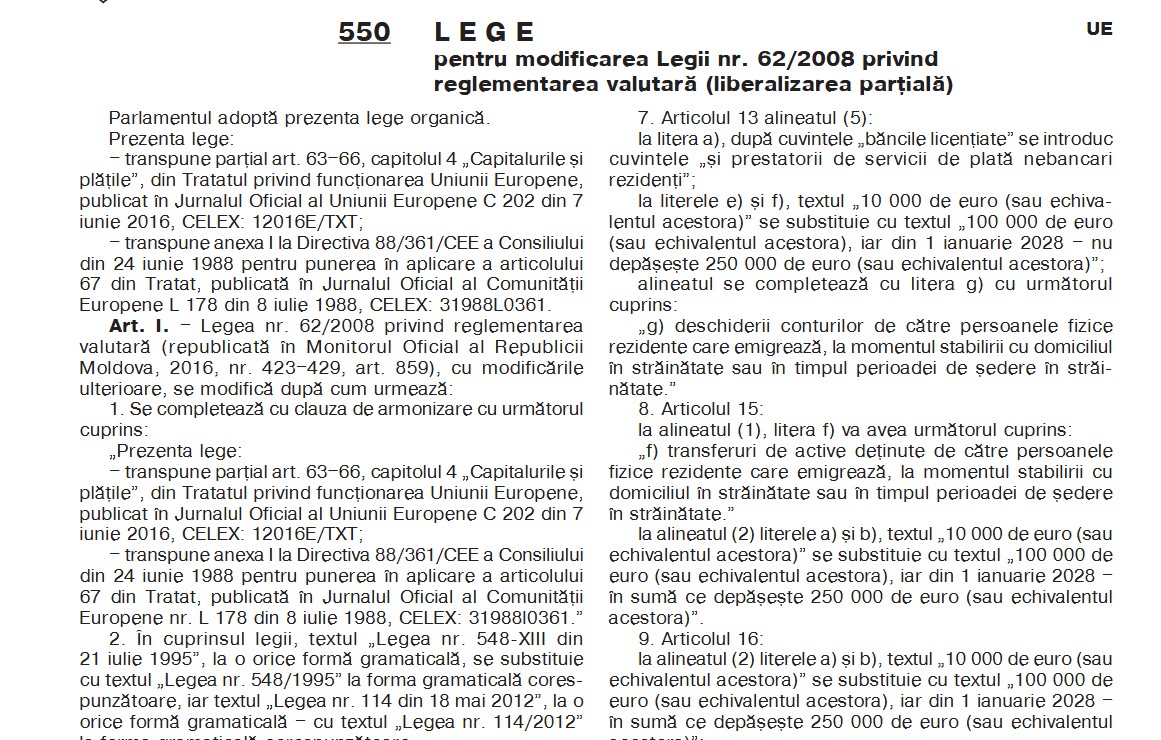
The value thresholds for carrying out certain foreign exchange operations without authorization from the National Bank of Moldova (NBM) will be gradually increased from EUR 10,000 to EUR 100,000, and from January 1, 2028, to EUR 250,000. The provisions are included in Law No. 226 of September 24, 2026, amending the Law on Foreign Exchange Regulation, published in the Official Journal.

The document aims to gradually liberalize foreign exchange operations and adapt the financial sector to European requirements. The process will take place in two stages, before the full liberalization planned for the time when the Republic of Moldova joins the European Union.

The law eliminates the authorization requirement for residents purchasing foreign financial instruments as part of their admission to the capital and money markets in the Republic of Moldova. It also expands the list of operations that may be carried out without authorization, including certain credits and loans granted to non-residents by investment companies, non-bank lending organizations, and insurance and reinsurance companies.

Starting October 1, 2027, the notification and registration requirements with the NBM will be eliminated for certain external loans and credits received by residents.

The new provisions will allow resident individuals who emigrate to open accounts abroad and transfer assets when establishing their residence or during their stay outside the country. The use of foreign currency will also be permitted in commercial establishments at airports, on board aircraft, and at international border-crossing points.

The amendments also concern the operations of foreign exchange offices. They will be able to provide payment services and distribute or redeem electronic money if they are registered as agents of licensed payment companies or electronic money institutions.

At the same time, the law strengthens the NBM's powers in the areas of authorization, supervision, and sanctions. The institution will be able to refuse authorization for an operation that poses risks related to the implementation of international sanctions or the termination of correspondent banking relationships.

Foreign exchange offices will also be required to submit information on their annual financial statements to the NBM.
 Facebook
 Instagram
 X/Twitter
 Telegram
PHOTO GALLERY // Farmer from Briceni modernizes farm and prepares new investments in fruit growing
VIDEO // Moldova could import natural gas from Ukraine
EcoVoucher Programme: More than 3,300 families replaced old appliances with energy-efficient equipment
Railway of Moldova enterprise to increase freight transport tariffs by 15 per cent as of November 1
Moldova must accelerate investments under Growth Plan; EU Ambassador explains conditions for funding
EU seeks solutions to support Moldova in energy crisis, to mobilize other donors
Two internal customs posts from Chisinau to operate on weekends
Eugen Doga Chisinau International Airport serves over 761,000 passengers in last September
PHOTOS // Austria’s experience in protected areas' management, habitats' restoration studied by specialists of Moldova
PM invites European companies to invest in Moldova
Moldovan companies promote fruit at Fruit Attraction 2026 in Madrid
Moldova has nearly 243 MWh of energy storage capacity
National Wine Day 2026, record edition in Moldova: 114 wineries, more than 116,000 tastings
Energocom purchased electricity at average price of EUR 157.42/MWh in September
Four state-owned enterprises to be put up for privatization again after failing to attract investors
Energy compensation could reach 670,000 families this winter
StratCom: False claim about drone factory coordinated and amplified on Telegram, feeding Russian narrative about “militarization of country”
National Army reservists strengthen military skills during training exercise
 National Bank of Moldova

Meeting between Deputy Prime Minister for Reintegration and delegation of ambassadors of Weimar format member states to OSCE
PM visits factories in two settlements of Moldova
Moldovan president attends National Forum of Ethnic Minorities
Moldovan PM visits Chisinau Electrical Substation, in final preparation stage
Moldovan PM, Ambassador of State of Qatar discuss investments, expanding bilateral economic cooperation

Moldovan MP says Foreign Affairs Ministry sends protest note to Ukraine, after Ukrainian border guards illegally crossed Dniester River
Moldova's National Police to benefit from new cooperation project with Germany; initiative aims to strengthen operational, investigative capacities
PHOTOS // Week of Italian Language in the World opens in Chisinau; Italy’s Ambassador: “There is a connection between us based on cultural sensitivity”
Moldova's General Police Inspectorate, Czech Republic sign agreement to strengthen digital expertise; project provides modern equipment, training for police officers
Moldovan interior minister meets new U.S. Ambassador to Moldova
PHOTO // Chisinau-based Nicolae Testemitanu State University of Medicine and Pharmacy hosts exhibition – project offering glimpse into world of people with down syndrome
Electricity consumption falls by 6.5 per cent in Moldova in one week; fuel stocks remain stable
ARMENPRESS: Armenia assumes COP17 presidency for two-year term
IMF mission to visit Chisinau on October 21–28 for discussions with authorities
Moldovan Finance Ministry launches new subscription session for government securities with interest rates of up to 8.05 per cent
About 50 schools from Moldovan capital benefit from investments worth over 1.1 billion lei for modernization
Moldova's foreign affairs minister, Ambassador of Slovakia discuss bilateral cooperation
Deputy Prime Minister meets ambassadors of countries in Weimar format
4.8-magnitude earthquake strikes Vrancea seismic zone
Meeting between Deputy Prime Minister for Reintegration and delegation of ambassadors of Weimar format member states to OSCE
Ministry of Environment announces slight improvement in situation on Dniester river following recent rains
Receive the latest news directly to your email

Receive the latest news directly to your email