
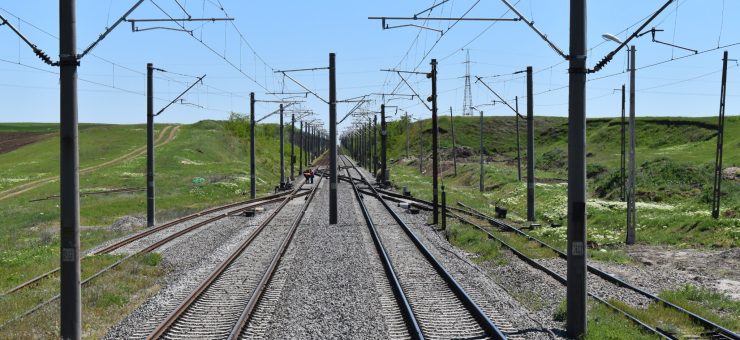
First electrified railway with European gauge on Chisinau–Ungheni segment: feasibility study to be completed in 2026
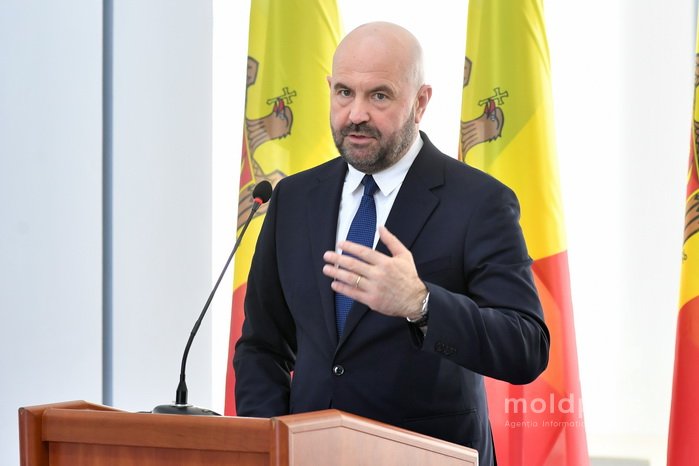
A feasibility study targeting the construction of the first electrified railway line with European gauge, on the Chisinau–Ungheni segment, will be completed in 2026. This will allow trains to run at a speed of 140 kilometers per hour. Deputy Prime Minister, Minister of Infrastructure and Regional Development Vladimir Bolea has made statements to this effect.

In Chisinau, the electrified railway line will extend to the vicinity of the Airport. It will be a continuation of the electrified railway section that will start in Iasi and reach Ungheni.

“In 2026, the feasibility study for the construction of the railway segment from Ungheni to Chisinau will be completed. In Chisinau, the line will reach right in front of the airport. We are talking about a railway built from scratch, in line with European requirements and designs, fully electrified, with European gauge and high-speed trains of at least 140 km per hour,” said Vladimir Bolea at the show, In context, broadcast on the public television station Moldova 1.

The project will ensure a direct connection to the modern network of European railways.

“This will be the train that will initially connect Moldova to Bucharest, but later, when the Romanian side completes the construction project from Iasi to Pascani, and from Pascani northwards, towards the European Union, we will be able to reach, via Ungheni, any city in the European Union by high-speed train traveling at 140–160 km/h. It is an extraordinary opportunity,” emphasized Vladimir Bolea.

The new Chisinau–Ungheni line will represent not only a technical innovation for the national railway infrastructure, but also a strategic project that aligns Moldova with European transport standards.

The Ministry of Infrastructure and Regional Development has earlier announced that the project’s pre-feasibility study was being carried out with the support of the Eastern Partnership Investment in Connectivity (EPIC) Facility, an initiative that contributes to the development of sustainable infrastructure and the expansion of the European transport network.
 Facebook
 Instagram
 X/Twitter
 Telegram
Moldova strengthens public finances in line with European standards with Slovenia’s support
Mircea Esanu leaves Public Services Agency to lead Moldova Project
VIDEO // Moldova to have single structure for implementing strategic projects
EBRD lends €344 million to upgrade Moldova’s strategic road corridors
Giant grapevine to be set up in PMAN for National Wine Day
VIDEO // This year’s National Wine Day to bring together more than 110 producers in central Chișinău
DOC // Law on crypto-asset market published in Official Journal and enters into force
Natural gas prices on European exchange continue to rise; energy minister says international energy crises directly affect Moldova
Government approves ratification of agreement on construction of bridge over Prut River and first highway section in Moldova
Modernization works for district heating systems of Chisinau, Balti cities to be declared projects of national public utility
Companies from both banks of Dniester explore Romanian market to identify new opportunities for business expansion
VIDEO // Consumers to be able to compare natural gas and electricity suppliers’ offers in one place
Implementation of Growth Plan advances; Moldovan government prepares new package of projects to attract investments worth 2 billion euros
Grants worth over one million euros to develop Moldova’s innovation ecosystem with EU support
VIDEO // Message in Romanian delivered by Prime Minister from UN rostrum
PHOTO // U.S. Ambassador-designate to Moldova arrives in Chisinau
Moldovan Prime Minister holds talks with Croatian and Slovenian counterparts
VIDEO // Prime Minister for Fox News Podcasts: Moldova can be export and trade hub for entire region
 National Bank of Moldova
Prime Minister at UN: Moldova may never become great power, but it can certainly become great country
Speech by Prime Minister at 81st Session of United Nations General Assembly
Prime Minister discusses European integration and strengthening economic cooperation with Croatian and Slovenian counterparts in New York
“A Night Written in Red” - documentary performance about courage, resistance and freedom staged in Parliament square
Strengthening Moldova’s cooperation with UNDP, UNOPS discussed in New York

Strengthening Moldova’s cooperation with UNDP, UNOPS discussed in New York
PHOTO // PM in New York tells Diaspora government willing to turn experience of Moldovans from United States into projects for country
Moldovan foreign affairs minister at UN says Moldova strengthening capacity to respond to health threats
Moldova under emergency state in energy, hydrological sectors as of September 26; what measures take effect
Moldova's National Crisis Management Commission approves new measures to ensure energy security, protect water resources
PHOTO // PM promotes Moldova's investment opportunities in New York
Balti Clinical Hospital to receive ultrasound machine through grant provided by government of Japan
Moldovan PM, U.S. investors, companies discuss potential projects in Moldova
Japan supports modernization of Balti Clinical Hospital with grant worth over 95,000 dollars
Moldovan parliament speaker urges students not to be afraid to express their ideas, wishes
Moldova's Border Police receive six special vehicles on behalf of FRONTEX
Head of state says Moldovans must build economy where well-educated people can find opportunities at home
Moldovan president attends events dedicated to 35th anniversary of foundation of Academy of Economic Studies
New charges brought against former Moldovan president Igor Dodon in “Kuliok” case; prosecutors seek harsher sentence
Moldova represented at Interparliamentary Conference on Stability, Economic Coordination and Governance in European Union
ARMENPRESS: EU Commissioner Kos promotes Armenian products after trade measures adopted
Receive the latest news directly to your email

Receive the latest news directly to your email