
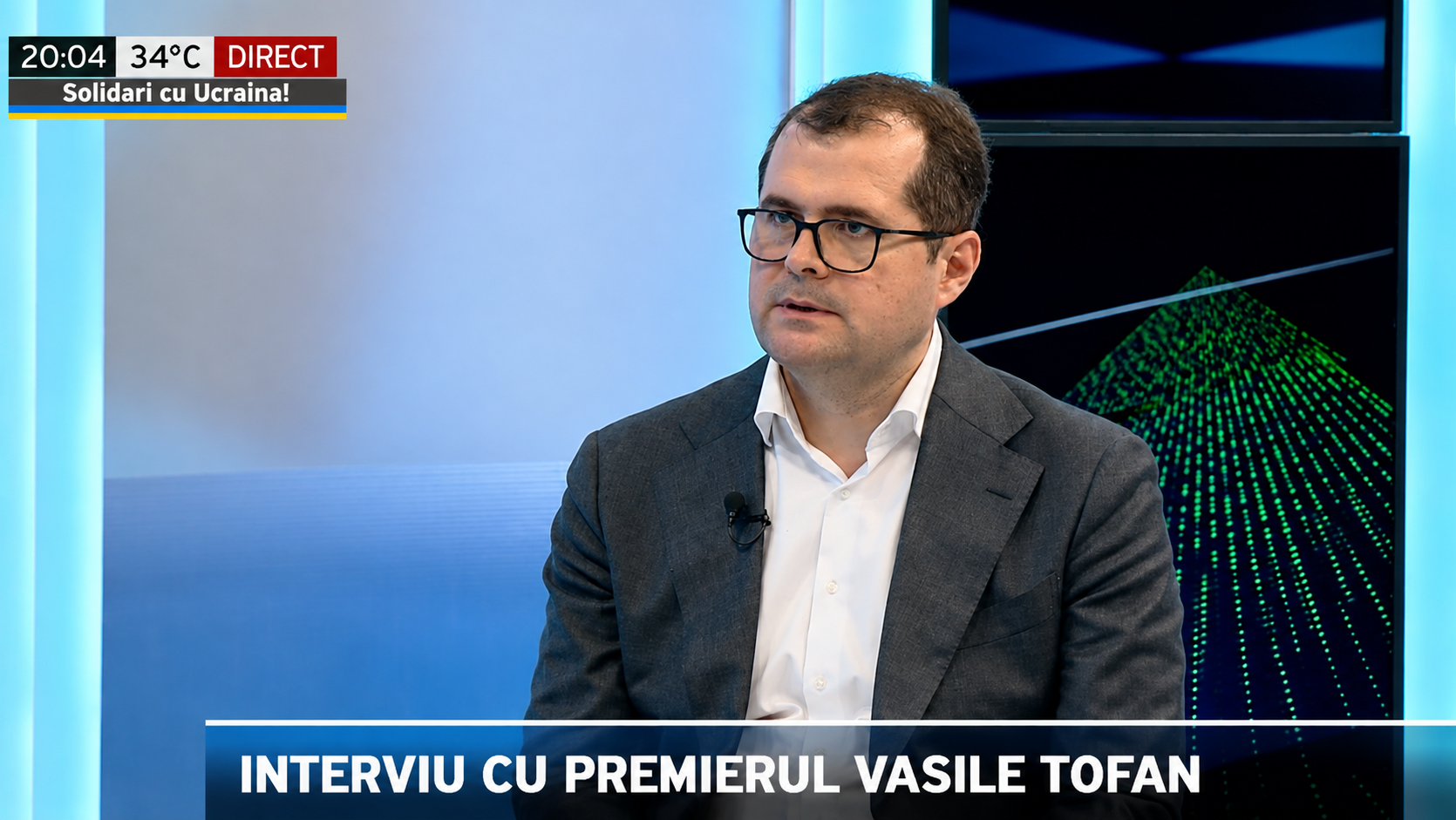
VIDEO // Prime Minister announces sweeping tax reform: lower labor taxes, higher levies for banks, tobacco and gambling
The Government will present tomorrow a new fiscal policy based on rebalancing the tax system, which provides for lowering taxes on labor and investments, maintaining incentives for basic consumption, and increasing taxes on banks, tobacco, alcohol and gambling. The announcement was made this evening by Prime Minister Vasile Tofan during a TV show.

The Prime Minister stressed that the reform should not be seen as a simple tax increase, but as a redistribution of the tax burden.

"The gist of this fiscal policy – it is not about tax hikes. First and foremost, we are moving toward rebalancing taxes. The state can largely tax four things: labor, investments, consumption and vices. We want to tax labor less," Vasile Tofan said on TV show.

He explained that one of the main measures aims to reduce the tax burden on employees, especially those with low incomes. According to him, lowering labor taxation would also help combat the shadow economy.

"We will reduce taxes on labor, especially in the lower wage brackets, by increasing the personal allowance. This also allows us to reduce tax evasion, because it is very hard to catch those who receive salaries in envelopes," the Prime Minister said.

At the same time, the Government intends to increase the tax on dividends in order to limit practices by which some companies avoid paying payroll taxes.

"Many entrepreneurs acting in bad faith pay themselves dividends, withdraw the money in cash and pay workers off the books to avoid taxes. That is why we will increase the dividend tax a bit," Tofan explained.

The Prime Minister also announced an expansion of the tax break on reinvested profit.

"We will raise the ceiling from 100 million to 200 million lei in annual turnover, so that more enterprises, including exporters, can benefit from a zero rate on reinvested profit," he said.

According to the Prime Minister, the measure aims to stimulate investment in assets and business development, while profits withdrawn from companies will continue to be taxed. With regard to VAT, the Prime Minister specified that the Executive has given up some of the increases initially discussed.

"For medicines the VAT will remain 8%. For most staple foods, such as potatoes, carrots, vegetables, fruit, bread and milk, VAT will also remain at 8%. We have listened to people and understood that this is a sensitive issue," Vasile Tofan said.

The Prime Minister gave assurances that the tax changes regarding natural gas and electricity will not affect the upcoming cold season.

"For energy and gas, the changes will come into force starting April 1. We want this cold season to remain as it is. It is already hard enough for people," he declared.

He explained that, for natural gas, the reduced VAT of 8% will be maintained for basic consumption. "For the first 150 cubic meters of gas, VAT will remain at 8%. Approximately 86% of households consume less than this threshold. For every cubic meter consumed above this limit, the standard rate of 20% will apply," Tofan specified.

The same approach will be applied to electricity. "We will keep a zero tax for the first 100 kilowatt-hours, and starting from the 101st kilowatt, the 20% tax will be applied," the Prime Minister said.

The Executive is also preparing to increase excise duties on products considered harmful. "We will raise tobacco taxes quite significantly. I am sorry for smokers, but we will increase the excise duty by 20%. We will also raise excise duties on alcohol and taxes on gambling," Tofan declared.

The Prime Minister argued that the volume of spending on gambling justifies a fiscal intervention. "Ten billion lei, or 2.5% of GDP, is spent on gambling. We want to tax this sector carefully, without pushing the activity into the black market," he said.

One of the most important measures announced by the Prime Minister targets the banking sector.

"We will increase taxes on banks and financial institutions by 50%. We will raise the profit tax from 12% to 18%. This is about almost 600 million lei that will go to the budget," Vasile Tofan said.

The Prime Minister acknowledged that the measure may have effects on lending, but believes that the advantages are more significant.

"We ran the numbers and I have assumed responsibility for this tax. It also has risks, because one leu taken out of banks’ capital reduces lending by six lei. Still, for the 2027 fiscal year I believe this tax is justified and that the fiscal benefits are greater than the risks," Tofan explained.

The Prime Minister confirmed that the HoReCa sector will also be subject to tax changes, but the VAT increase will be lower than initially discussed. "We will raise the tax on HoReCa a bit. It will be much closer to 8% than to 20%. We have heard the feedback and I think this is a reasonable compromise," he said.

He argued that most of the revenues in this sector come from large hotels and that the new VAT level will seek a balance between the need to collect revenue and the need to support the tourism industry.

The Government is to present tomorrow the new fiscal policy concept, which will underpin the tax changes for 2027. According to the Prime Minister, the reform aims to reduce the tax burden on labor and stimulate investments, while increasing taxation in areas considered less productive or with a negative impact on society, such as tobacco, alcohol, gambling and the banking sector.
 Facebook
 Instagram
 X/Twitter
 Telegram
Moldovan PM requests de-bureaucratization measures for entrepreneurs
Around 300 public institutions from Chisinau to benefit from modernization of district heating infrastructure
Moldovan Economic Development and Digitalization Ministry prepares two new deregulation packages: 100 laws, government decisions to be amended
Moldovan PM announces new measures to supply market with diesel, protect consumers from price increases
Parliament speaker says Moldova does not risk running out of fuel
What state of alert in energy, hydrological sectors involves: Moldova's government prioritizes actions to protect population, ensure uninterrupted operation of vital services
PM says Moldova has lowest fuel prices in region, country must make sure it has necessary volumes
Moldova enters hydrological alert
Moldovan government declares state of alert in energy sector
Moldovan Energy Ministry consults business community to set priorities in energy sector
Natural gas prices on European exchange fall by over 7 per cent
Moldovan Finance Ministry launches new subscription round for government bonds for population
New guarantees for investors: Moldova to conclude bilateral agreements with Sweden, Kazakhstan
Moldovan government announces measures to reduce diesel deficit: stocks to be replenished with 12,000 tons of fuel
I Will Serve My Term Until 2029 and Replace Ministers Who Do Not Deliver Results, Prime Minister says
Prime Minister warns of critical situation in energy sector
VIDEO // Prime Minister announces sweeping tax reform: lower labor taxes, higher levies for banks, tobacco and gambling
Gheorghe Hajder: Reducing Dniester’s flow to 30 cubic meters per second would mean natural disaster
Foreign Ministry condemns airspace violation after discovery of drone fragments near Văleni
Drone fragments discovered in Văleni
President about Tofan Government: Development plans are big and ambitious. A lot of energy and stability are needed to succeed
 National Bank of Moldova
Confiscated assets and money to be used for social and public interest purposes
30 MW photovoltaic park with 60 MWh storage system to be built in Vadul lui Vodă
Moldova’s defence system to be modernized under implementation Program of National Defence Strategy
Head of State appoints Liliana Vițu as Director of Center for Strategic Communication and Countering Disinformation
President met with participants of APEX Maths Chișinău

VIDEO // President about energy and hydrological crises: Government will do everything possible to mitigate consequences
PHOTO // Authorities in Moldova and Ukraine assess situation on Dniester and prepare measures to reduce risks
Energy-saving measures in Parliament
Deputy Prime Minister: Moldova does not recognize alleged privatization acts carried out by Tiraspol authorities in eastern districts
Localities that initiated voluntary amalgamation are to finalize necessary procedures during August
Prime Minister calls on Moldovans in diaspora to support Moldova’s development projects
Deputy Prime Minister on visit of Afghan delegation: Visa issuance procedures fully respected. No violations of legal provisions found
Confiscated assets and money to be used for social and public interest purposes
30 MW photovoltaic park with 60 MWh storage system to be built in Vadul lui Vodă
Prime Minister urges citizens to use energy rationally: To avoid paying higher costs, we must save
30 MW photovoltaic power plant to be built in Vadul lui Vodă
Water deficit in Dniester persists
Moldova’s defence system to be modernized under implementation Program of National Defence Strategy
Foreigners legally residing in Moldova to benefit from expanded access to social and financial inclusion mechanisms
Moldova strengthens national security risk analysis and management capacities
Fiscal policy concept to be presented on 6 August
Receive the latest news directly to your email

Receive the latest news directly to your email