
Ministry of Agriculture proposes extending licensing of grain and oilseed imports by late year
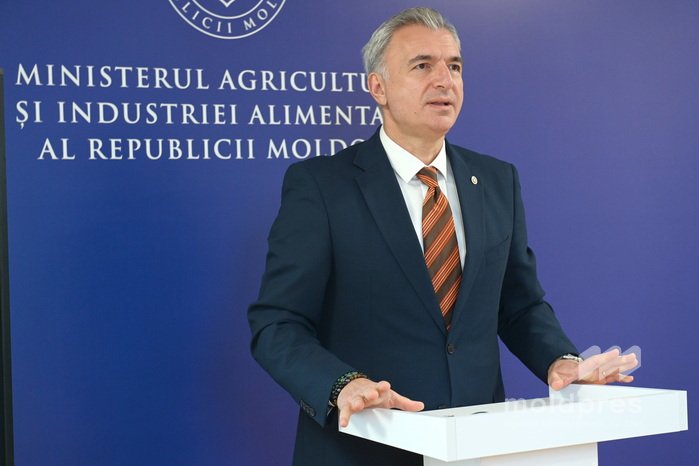
The Ministry of Agriculture and Food Industry (MAFI) is proposing to extend the licensing regime for imports of wheat, corn, and sunflower seeds until December 31, 2026. The announcement was made today by Minister of Agriculture and Food Industry Eugeniu Osmochescu during a press briefing. According to the official, the measure is necessary to protect domestic producers and facilitate the sale of the harvest, amid falling import prices for sunflower seeds and logistical difficulties affecting exports.

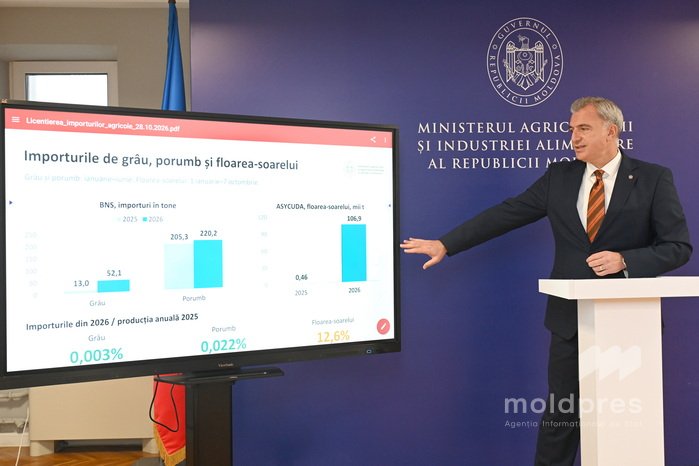
The current licensing regime is in force until October 31. The extension proposal is based on an economic and financial analysis conducted by the ministry using data from the National Bureau of Statistics, customs information from the ASYCUDA system, and reference prices for the first three quarters of 2026.


“Based on these needs, as well as the concerns we at the Ministry of Agriculture and Food Industry have regarding production in the Republic of Moldova and the need to make it possible to sell Moldova’s production both domestically and abroad, the Ministry of Agriculture and Food Industry, together with the Government as a whole, is proposing to extend the licensing regime until December 31, 2026,” said Eugeniu Osmochescu.


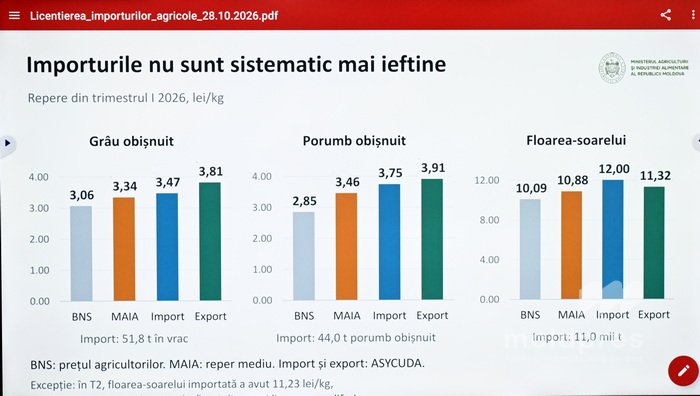
The minister explained that during the first half of the year, imports were not systematically cheaper than domestic products, while trade in grains and oilseeds was generally positive. However, the situation changed in the third quarter, particularly on the sunflower seed market.

According to the data presented, the prices offered to farmers in the Republic of Moldova remained relatively stable, while import prices fell sharply. The minister attributed this development to price reductions by some trading partners in neighboring countries in an effort to facilitate exports, coupled with an increase in the volume of sunflower seeds in transit.


“The alarming and concerning trend for us and for our producers, our farmers, is the sharp decline in import prices. We see that the price for our farmers remains stable, while imports are showing a tendency to decline,” the minister stated.


Another factor affecting the market is this year’s good harvest, while the transportation and export of agricultural produce are facing difficulties due to logistical congestion in the Black Sea region. Traders are unable to export the volumes needed to take in new stocks, and some farmers are forced to store their harvest in warehouses.

“It is very important to understand this, because they are all interdependent, both our farmers and our traders,” Eugeniu Osmochescu emphasized, explaining that decisions regarding the import regime must take into account the relationship between agricultural producers and exporters who purchase and market the harvest on foreign markets.

According to the minister, by October 31, three import licenses had been issued under the current legal framework. They covered 100 tons of spelt wheat imported from Ukraine, 22 tons of popcorn corn from the Czech Republic, and 4,000 tons of sunflower seeds from Ukraine, the Czech Republic, and Poland.

The official noted that statistical data on sunflower seed imports also include operations carried out through the Giurgiulești International Free Port. However, these operations are not subject to the general licensing regime, as the raw material is imported under the port’s special legislation, processed, and subsequently exported.

During the briefing, Eugeniu Osmochescu also rejected claims that congestion in the southern part of the country was caused by the transit of Ukrainian grain through the Republic of Moldova.


“According to the latest data available to us, not a single truck carrying grain from Ukraine has entered the Giurgiulești International Free Port. The port’s residents, in fact, have their own concerns about marketing all the processed and exported products,” the official said.


He also stated that most grain transit takes place by rail rather than on national roads. In September, for example, approximately 15 trucks carrying wheat in transit through the territory of the Republic of Moldova were recorded.

According to the minister, frequent road congestion in the south of the country is caused by the transit of other categories of goods, particularly petroleum products. At the same time, the Customs Service, Border Police, and National Food Safety Agency ensure, through the “green corridor” mechanism, the rapid crossing of the border for authorized economic operators.

Eugeniu Osmochescu assured that the ministry would continue monitoring the market and would apply other legal and institutional instruments if the situation required it, in order to protect the agricultural sector.

The proposal to extend the licensing regime covers the period through December 31, 2026.
 Facebook
 Instagram
 X/Twitter
 Telegram
Republic of Moldova seeks alternatives for natural gas procurement, including in Ukraine
Prime Minister explains failure of Zarea hotel privatization, announces changes for future auctions
Chisinau Airport to have new air connection with Serbia
Made in Moldova exhibition to take place on 27-31 January 2027
CFM resumes rail imports of scrap metal after several years of interruption
Four state-owned enterprises to be put up for privatization again after failing to attract investors
DOC // Currency operations to be simplified
Electricity consumption falls by 6.5 per cent in Moldova in one week; fuel stocks remain stable
IMF mission to visit Chisinau on October 21–28 for discussions with authorities
Moldovan Finance Ministry launches new subscription session for government securities with interest rates of up to 8.05 per cent
VIDEO // Moldova explores opportunities to import liquefied natural gas from United States
PHOTO // Railway of Moldova enterprise tests new Chisinau–Revaca–Sangera railway route
VIDEO // Shepherds' family of Moldova sets national record with 30.7-kilogram cheese
PHOTO GALLERY // 30.7-kilogram cheese set national record at Moldexpo
CEC: Electoral information systems and voter data not affected by cybersecurity incident
Government announces changes in leadership of e-Governance Agency and Agency for Geodesy, Cartography and Cadastre
Five European champions and six medals for Moldova at European Muaythai Championships in Paris
Deputy Prime Minister on working visit to Kingdom of the Netherlands
Ministry of Agriculture proposes extending licensing of grain and oilseed imports by late year
Moldovan, Romanian Prime Ministers visit Chisinau Electrical Substation
VIDEO // Moldovan president has meeting with Romanian PM
 National Bank of Moldova

Moldovan, Romanian Prime Ministers visit Chisinau Electrical Substation
Moldovan government launches new round of public consultations on legislative package for local public administration reform
Moldovan parliament speaker, at meeting with Romania’s PM: “We need more bridges over the Prut and fewer borders between us”
Moldovan PM says Moldova, Romania connected by future countries want to build together
Moldovan PM's address at joint news conference with Romanian counterpart

Moldovan parliament speaker, at meeting with Romania’s PM: “We need more bridges over the Prut and fewer borders between us”
PHOTO GALLERY // Romanian PM's first foreign visit to Chisinau
“The Prut will remain just a river, not a border separating two Romanian states,” Moldovan PM says at news conference with Romanian counterpart
Moldova, Romania examine joint programmes for counter-drone defense
Moldovan PM says Moldova, Romania connected by future countries want to build together
Moldovan PM says agreement signed in Kyiv not security treaty, but technical-military cooperation agreement
Moldovan PM's address at joint news conference with Romanian counterpart
Romania’s PM in Chisinau says European integration of Moldova strategic priority for Romania
VIDEO // PMs of Moldova, Romania discuss advancing bilateral cooperation: strategic infrastructure, energy projects prioritized
Moldovan PM says cybersecurity to stay priority for Moldova
Moldova might start importing gas from Neptun Deep field as of next autumn
LIVE // PMs of Moldova, Romania hold news conference
STISC: Personal data of around 750,000 people may have been extracted following cyberattack on digital public services in Moldova
VIDEO // Romanian PM welcomed with honors at Moldova's government
ARMENPRESS: Netherlands to provide financial assistance to Armenia in search for people missing in war
Deputy Prime Minister for Reintegration meets with Croatia’s State Secretary for European Affairs
Receive the latest news directly to your email

Receive the latest news directly to your email