
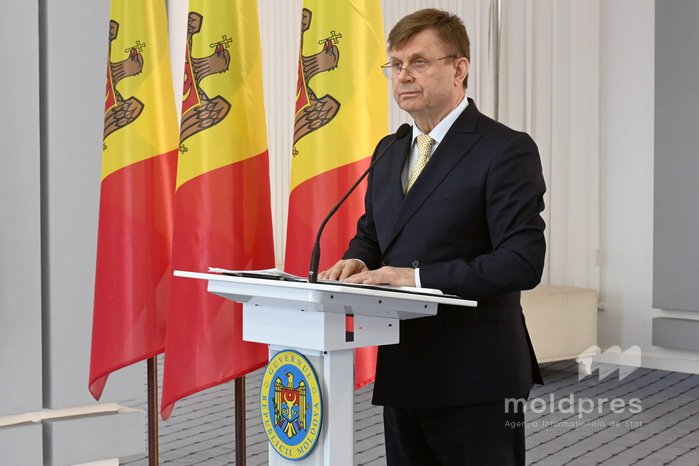
Moldovan deputy PM for reintegration presents results of visit to Brussels
European partners expect a Reintegration Plan for the country on behalf of Chisinau. At present, the authorities are working on such a document, which will not be a comprehensive one, but structured in modules. Deputy Prime Minister for Reintegration Valeriu Chiveri today made statements to this effect; he presented the outcomes of his visit to Brussels, paid on March 12-13, this year.

The agenda of the visit included meetings with Marta Kos, European Commissioner for Enlargement, as well as other European officials. The discussions focused on developments in the country’s reintegration process, as well as on the actions undertaken by the government to advance this process, including in the context of new ideas and elements previously submitted to the EU for information.

“During the discussions, I underlined that developments in this complex file are influenced not only by the efforts of national institutions – the government of  Moldova, which acts constantly to bring the two banks of the Dniester closer together – but also by other external factors, such as the illegal military presence of the Russian Federation on our country’s territory and the war in Ukraine. I said that progress in the settlement process also depends on the existence of political will on behalf of all actors involved, especially the decision-makers in Tiraspol. I stressed the importance of as close as possible coordination in the field of reintegration policies, as well as the extension of the implementation of European standards and best practices across the entire territory of the country, in particular with regard to respect for human rights. The important role of cooperation with European partners in supporting the efforts of the Moldovan authorities for the reintegration of the country and the creation of conditions for economic development was also highlighted. This cooperation contributes to maintaining peace and stability in the region, including by ensuring energy resources, thus underlining the commitment of our partners to contribute to the well-being of all citizens of Moldova, both on the right and on the left bank of the Dniester. The discussions were open and constructive, and the interlocutors reconfirmed their firm commitment to continue cooperation with Moldova, in order to support the efforts regarding the reintegration process of the country. This support is offered in full respect of its sovereignty and territorial integrity within its internationally recognized borders,” said Valeriu Chiveri.

The official referred to a working document on the basic approaches to the process of gradual reintegration of the Transnistrian region, which appeared in the public space and generated more interpretations.

“The existence of this non-paper reflects the efforts of the Moldovan authorities to analyze different scenarios and options in the reintegration process. The document provides and contributes to stimulating dialogue with international partners. I am sure that we have a common goal, which is precisely why calm, professional discussion based on mutual respect and less on subjective interpretations is necessary. In the context, we would like to clarify a few things, in order to avoid speculation. The document in question is a non-paper, therefore an informal document frequently used in diplomatic dialogue. It does not represent a public policy document, a political decision, does not create political obligations, is not a strategy, and is not a reintegration plan. It is incorrect to associate this working document with a settlement plan. We are referring to a tool for consulting external partners, a draft outline with certain ideas and possible directions, essentially a starting point for discussions with our European partners. Likewise, as a preliminary reflection document, it does not entail public consultations. However, in order to ensure its relevance and robustness, consultations were held with a select group of national and external experts, whose opinions contributed to shaping the ideas presented. It is clear that reintegration is a complex and long-term process, and comprehensive strategies are developed in more stages, on separate pillars. In other words, it is a modular approach,” said Valeriu Chiveri.

The deputy PM for reintegration emphasized that some elements of this document substantially changed the dynamics of the reintegration process, which is reflected in the extension, across the entire territory of the country, of the regulatory framework in the economic field.

“The facilities granted over the years to economic agents on the left bank of Dniester have not led to a change in the position of the Tiraspol authorities. On the contrary, they created conditions for the consolidation of the de facto state. At the same time, companies on the right bank of Dniester have, in practice, been discriminated against. This is to be corrected by creating the Convergence Fund. This initiative has already been announced. Personally, I believe that the fund could generate an unprecedented dynamic in the reintegration process, with results that could exceed any estimate at this point. Presently, we are in the process of  developing the implementation mechanism, but we want as active as possible  involvement of the European Union. We also consider the contributions and involvement of civil society important, as it could support the identification of optimal ways to implement this mechanism, which will be a complex one, but I am sure that we will succeed together with our partners,” he stressed.

Valeriu Chiveri underlined that the country’s reintegration process is and would remain fundamentally the responsibility of Moldova.

“It is important to clarify the impression of some, according to which we wanted to transfer the entire responsibility for reintegration to the European Union. This is an unfounded speculation that does not reflect reality. The reintegration of the country is and will remain fundamentally the responsibility of Moldova. At present, Chisinau has a deep understanding of the opportunities and vulnerabilities that exist. The dialogue with the member states of the European Union does not involve the transfer of responsibilities, but represents an active search for reintegration solutions and for the partnerships needed to manage a complex process that entails significant efforts from all points of view: political, economic and financial. These consultations are all the more natural, as the European integration process advances and the EU shows interest in creating an area of stability, security and prosperity that would cover the entire country. In this sense, it is normal for ideas regarding reintegration to be discussed with partners who can provide us with support,” he remarked.

The official also said that, at present, the reintegration process was a dynamic one. Today, the working group met and discussed more topics related to transport, and in mid-April a new meeting in the 1+1 format is planned in Rabnita, a location proposed by the Moldovan authorities. The participants in the meeting will discuss topics in the education field.
 Facebook
 Instagram
 X/Twitter
 Telegram
Expert Daniel Vodă on EPC Summit: Moldova asking Europe to see it as it really is – country of people who want peace and security
Moldovan Speaker attends EU Speakers' Conference in Copenhagen
ARMENPRESS: VIDEO // Moldovan President arrives in Armenia
President about informing citizens in risk situations and lessons from war in Ukraine: Panic can do more harm than lack of information
President about Chernobyl: It is shared tragedy and lesson we must learn
VIDEO // President calls on prosecutors and judges to show more courage in cases of treason
VIDEO // President about SIS officers swap operation: Emotions, tension and successful mission with international support
Strengthening Moldova–Japan relations: Speaker meets with President of Japan–Moldova Parliamentary Friendship Group
Japanese Minister to visit Moldova on 2–3 May
SIS Director reveals details on Alexandru Bălan’s espionage activities
Head of Moldova's National Integrity Authority reports in parliament: irregularities worth tens of millions of lei detected in 2025
Former president of European Council encourages Moldova on path to EU
Moldovan parliament expands foreign relations: friendship groups with United Arab Emirates, Saudi Arabia created
Japan’s Minister for Internal Affairs to pay visit to Moldova
Moldovan MPs to convene at plenary meeting on May 7; agenda includes draft laws on sport, energy, European integration
Discover Moldova with #MOLDPRES // “Grotto of Wishes” at Tipova, labyrinth hidden in rock on Dniester Riverbank
Moldovan president meets North Carolina Secretary of State Elaine Marshall in Chisinau
Moldova hosts global folklore event for the first time
First electrified railway segment of Moldova, part of connection with EU; Deputy PM says segment strategic step towards modern, cheaper, more efficient transport
Moldovan labour minister announces set of measures to prevent minors from leaving home
VIDEO // Moldova Presents exhibition to be staged in Brasov on June 27–28
 National Bank of Moldova
Moldovan president meets North Carolina Secretary of State Elaine Marshall in Chisinau
All children with disabilities to receive annual allowance of 3,000 lei on 1 June
Combating high-level corruption and financial fraud to be carried out more rapidly and efficiently
Simplified procedures for development of electronic communications networks in Moldova
Stronger environmental institutions for better management, more effective control, prevention of violations

Energy Minister at SolarPower Europe Summit: Solar and storage systems are now instruments of sovereignty, resilience and secure access to energy
Deputy Prime Minister about sugar market situation: We will hold discussions with all stakeholders
Travel alert for Belgium: air traffic to be disrupted due to national strike
Local Public Administration Reform: 435 decisions to launch amalgamation process approved
Government approves new regulation for Environmental Inspectorate
Prosecutors appealed court ruling in case of Vladimir Plahotniuc
All children with disabilities to receive annual allowance of 3,000 lei on 1 June
IMF team of experts coming to Chișinău
Combating high-level corruption and financial fraud to be carried out more rapidly and efficiently
Simplified procedures for development of electronic communications networks in Moldova
Stronger environmental institutions for better management, more effective control, prevention of violations
Giurgiulești–Cahul railway line fully operational
Germany to second expert to office of Deputy Prime Minister for European Integration of Moldova
Republic of Moldova and Poland to cooperate in defense
VIDEO // Children with disabilities to receive annual payment of 3,000 lei
Salary arrears of employees of Moldovan Railways company fully paid off
Receive the latest news directly to your email

Receive the latest news directly to your email