
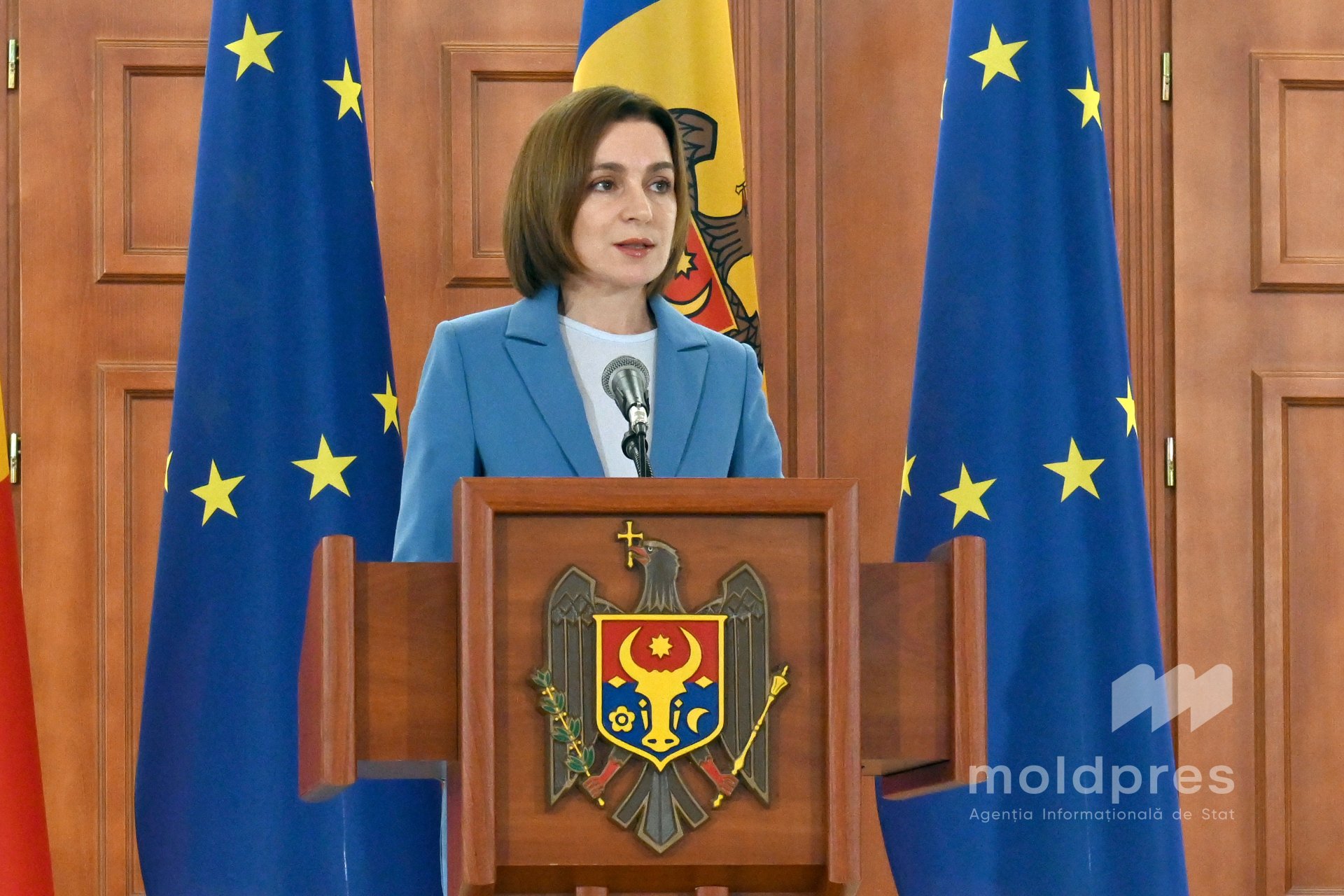
President provides details on Transnistria reintegration plan
Chișinău, October 1 /MOLDPRES/ – The reintegration process of the Republic of Moldova primarily involves the withdrawal of Russian troops from the country's territory, as well as significant economic costs to ensure the integration of the Transnistrian region in all sectors. President Maia Sandu made the statement at Moldova 1 TV channel show.

The head of state emphasized that the authorities have a reintegration plan, developed in 2023, which includes phased measures in the banking, social, and economic fields.


“The Russian army must leave peacefully. The most complicated issue now is how to get rid of the Russian troops, and after that, step by step, reintegration should occur. We need to make people understand that it is in their best interest for this process to happen. The living standards on the right bank are already better, and we can offer them a better life than what is happening under that regime,” Maia Sandu said.


The president mentioned that, to cover the reintegration costs, Chișinău is in discussions with international partners.


“The budget of the Republic of Moldova cannot handle these expenses alone. Substantial support is needed, and we have begun discussions with our partners, even though the subject has not advanced much due to the presence of Russian troops,” the head of state remarked, adding that developments in peace talks in Ukraine could also create opportunities for the Transnistrian issue.


Currently, the Transnistrian region's economy faces one of the most severe crises in recent decades. Following reduced financial support from Russia and restrictions on gas supplies, industrial production has dropped by over 40%, and sectors such as metallurgy, energy, and the chemical industry have recorded declines of 50–60%. The budget deficit for 2025 is estimated at over 130 million euros.

The Transnistrian conflict erupted in March 1992 amid the proclamation of independence by the Republic of Moldova and was fueled by the presence of the 14th Army of the Russian Federation. Fighting ceased on July 21, 1992, after the signing of the agreement between Mircea Snegur and Boris Yeltsin, but the region remained under separatist control, with a few thousand Russian soldiers stationed under the guise of a peacekeeping mission and maintaining the Cobasna ammunition depot.

Chișinău has repeatedly requested, including at the UN, the withdrawal of Russian troops, but to date, they continue to be stationed on Moldovan territory.
 Facebook
 Instagram
 X/Twitter
 Telegram
LIVE // Moldovan president welcomes Romania's head of state in Chisinau on Moldova’s Independence Day
VIDEO // President of Romania starts visit to Moldova; first stop: Cahul
Parliament speaker on Independence Day says Moldovans move forward, united, upright, free
Romania’s PM sends message to Moldova on 35th anniversary of Independence
PM says road covered by Moldovans to become masters of own destiny difficult
Foreign Affairs Ministry condemns violation of Moldova’s airspace by five drones
MOLDPRES INTERVIEW // Ambassador Iwona Piorko: ''Moldovans chose the European future and EU is determined to turn this choice into reality''
Moldovan PM conveys message on Independence Day
King Charles of United Kingdom congratulates Moldova on Independence Day
PHOTO GALLERY // August 27, 1991 – the Day Moldova chose freedom
U.S. Secretary of State congratulates Moldova on 35th anniversary of Independence
Elections for People’s Assembly of Gagauzia to take place on November 15; Moldovan Central Electoral Commission approves electoral calendar
Presidents of Moldova, Romania, Ukraine together in Chisinau on Independence Day
DOC // Published in Official Journal of Moldova: new regulations on postal voting, organization of elections in Gagauzia Autonomous Territorial Unit enter into force
Over 7,000 tons of fuel imported in Moldova in last two days; energy minister says volumes allow for gradual replenishment of stocks, resupply of filling stations
Vice-president of Shor political party, unofficial member of formation to be tried for party's illegal financing
New economy minister of Moldova introduced to team of competent ministry
Moldovan PM attends opening of Local Product national exhibition
Foreign affairs minister meets Polish Ambassador to Moldova
Dniester Commission rules to maintain river flow at 60 m³/s for next two weeks
VIDEO // Over 300 companies from Moldova take part in Local Product 2026 exhibition; Moldovan MP says government to be ally of entrepreneurs who have courage to produce at home
 National Bank of Moldova
Moldovan PM attends opening of Local Product national exhibition
Moldovan president awards state distinctions on Independence Day
Ministers Claudiu Năsui and Eugen Osmochescu sworn in today
New Ministers of Agriculture and Food Industry and of Economic Development and Digitalization sworn in today
Moldovan president's statements at joint news conference with presidents of Ukraine, Romania

Dniester Commission rules to maintain river flow at 60 m³/s for next two weeks
VIDEO // Over 300 companies from Moldova take part in Local Product 2026 exhibition; Moldovan MP says government to be ally of entrepreneurs who have courage to produce at home
Moldovan president awards state distinctions on Independence Day
DOC // Tax regime applied to goods imported by economic operators from Transnistrian region to be standardized
Minister Claudiu Năsui responds to criticism after appointment to Moldovan Government: Some shared problems also have shared solutions
Ministers Claudiu Năsui and Eugen Osmochescu sworn in today
European integration and more open economy for entrepreneurs
New Ministers of Agriculture and Food Industry and of Economic Development and Digitalization sworn in today
Minister Eugeniu Osmochescu announces mandate priorities: EU accession and smart agriculture
Turkish Ambassador to Chișinău awarded by Foreign Minister at end of term
Prime Minister’s message to Năsui and Osmochescu: They have difficult but very important mandates
Parliament to begin second 2026 session on 1 September
Head of State conveys message of condolences following death of King Harald V of Norway
VIDEO // New Ministers Claudiu Năsui and Eugeniu Osmochescu took oath of office
CEC: Electoral period begins for elections to People’s Assembly of Gagauzia
PHOTO GALLERY // Thousands celebrate Independence of the Republic of Moldova in Great National Assembly Square
Receive the latest news directly to your email

Receive the latest news directly to your email