
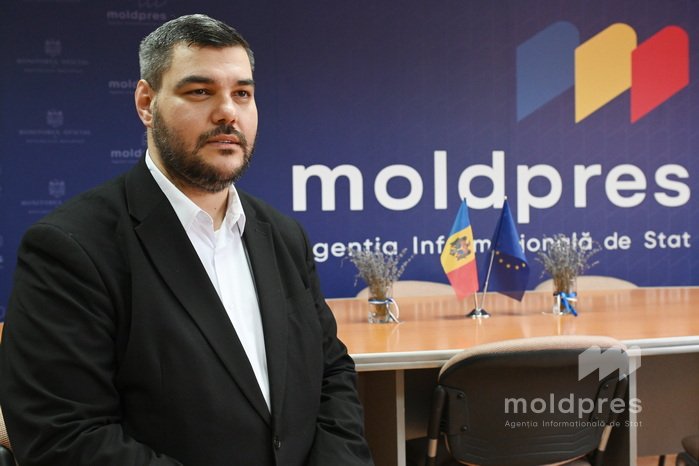
Romanian political analyst: War in Ukraine amplified Moldova’s vulnerabilities but strengthened European choice
The war has amplified Moldova’s vulnerabilities, but at the same time it has accelerated processes of strategic clarification. The European direction is no longer just a political option but a security necessity, said Romanian political analyst Mihai Isac.

Isac stressed that the official position of the Republic of Moldova has consistently been one of political solidarity with Ukraine and substantial humanitarian support. The war in Ukraine has deeply affected the Republic of Moldova, especially in terms of the security of the state and its citizens, trade, energy, and beyond. The Republic of Moldova has experienced repeated shocks in energy prices and high import costs, in a context where the economy is small and vulnerable.

The IMF notes that, after very weak performance in 2024, growth is gradually returning, but with major external imbalances. The current account deficit widened in 2025 to about 20% of GDP, driven by import demand, including for electricity, amid weak exports, while the outlook remains dominated by uncertainties related to the war and energy shocks.

On the social side, the impact has been of two types: direct pressure on the standard of living and pressure on public services. The Republic of Moldova has managed a long-term humanitarian effort.

In addition to the massive transit flow of over one million refugees from Ukraine, the country continues to host a significant number of Ukrainian refugees (official data indicate approximately 140,000 refugees from Ukraine in the Republic of Moldova as of December 2025).

The war has also caused security effects, visible in public anxiety and in additional costs for the state.

For example, in November 2025, Moldovan authorities lodged an official protest after Russian drones entered its airspace, including an incident in which a drone fell on the roof of a building. This reinforces the perception of a “war at the border” and obliges institutions to invest more in resilience. Politically and socially, the environment remains tense, with disinformation pressure and external interference, especially during election periods, which amplify polarization and mistrust. The official position of the Republic of Moldova has consistently been one of political solidarity with Ukraine and substantial humanitarian support, within the limits of internal resources and its status of neutrality.

Diplomatically, Chișinău has reaffirmed at the UN its support for the sovereignty and territorial integrity of Ukraine within its internationally recognized borders and has condemned the war launched by the Russian Federation. At the bilateral level, joint presidential declarations have underlined Moldova’s solidarity with Ukraine and its commitment to continue practical and humanitarian assistance. Beyond declarations, the crucial aspect is protecting people.

The government of Chișinău recently extended temporary protection for people displaced from Ukraine until 1 March 2027, explicitly invoking solidarity and the need for stability for people, including access to education, healthcare, and work.

The Republic of Moldova has treated the tragedy of Ukrainians not as a short crisis but as a long-term reality that requires public policies, not just emergency reactions. At the same time, the Republic of Moldova has tried to remain consistent with its constitutional neutrality, avoiding moves that would turn the country into a theater of direct confrontation, while cooperating with European partners in the areas of humanitarian aid and resilience. For example, the EU has announced humanitarian funding that includes the Republic of Moldova, precisely to support the response to the effects of the war in the region. The strategic orientation has also been visible in broader political decisions, such as concrete steps to withdraw from structures dominated by Russia, like the CIS, a signal that Chișinău is anchoring its future in the European space.

On Tuesday, 24 February, four years passed since the military invasion of Ukraine by the Russian Federation. The effects of the war are being felt worldwide, with a major impact on the states in the region, with all eyes on peace talks whose results are still awaited.

Civil society in the Republic of Moldova is calling for a just peace for Ukraine, so that life and dignity are protected, and those who committed war crimes are held accountable. The Institute for European Policies and Reforms (IPRE) has launched a Declaration in support of Ukraine and the Ukrainian people.

In Chișinău, a solidarity march with Ukraine was organized to mark four years since the start of Russia’s full-scale invasion.
 Facebook
 Instagram
 X/Twitter
 Telegram
PM welcomes EU’s intention to demand Russia withdraw troops from Transnistrian region as part of possible peace deal in Ukraine
Moldovan PM to present report in parliament
Simple motion against Moldova's energy minister fails
BTA: Ambassadors of Bulgaria, EU to Moldova Discuss EU Integration and Regional Development During Visit to Taraclia
PHOTO // Moldovan electoral authorities discuss process of organizing parliamentary elections
Moldovan parliament speaker says reform of local public administration must be carried out in next autumn, there is no time to wait
Moldovan parliament speaker talks about former president of Gagauzia's people's assembly
Government earmarked over 185 million lei for projects in capital’s suburbs
Deputy Prime Minister meets with new Ambassador of Cyprus
Parliamentary opposition submits simple motion against Ministry of Defence policies
VIDEO // Moldovan government's secretary general says chances for faster development in communities higher when mayoralties
PHOTO // Moldovan foreign affairs minister holds talks with three newly accredited ambassadors to Moldova
Remembrance and Gratitude Day to be marked in Moldova through events
Energy Ministry without State Secretary
Moldovans settled in Quebec, Canada to be able to receive social benefits
Government approves 2026 Road Fund Allocation Program: over 1.82 billion lei for national roads
New State Secretary appointed at Justice Ministry
Relations between Moldova and Liechtenstein on agenda of foreign ministers’ talks
 National Bank of Moldova
Faster emergency response: New equipment rules for Internal Affairs structures
Moldovans working in Quebec to be eligible for pensions, social benefits
Deputy Prime Minister for Reintegration, Ambassador of State of Qatar to Moldova approach current situation
Moldovan government, civil society cooperate for implementation of reforms, development projects
Moldovan president meets delegation of Lithuanian parliament

Romanian political analyst: War in Ukraine amplified Moldova’s vulnerabilities but strengthened European choice
Superior Council of Magistracy to propose to Moldovan president appointment of three judges to Supreme Court of Justice
VIDEO // Moldovan ambassador to USA says embassy works intensively to turn Moldova-United States partnership into one beneficial for both sides
Moldovan government, civil society cooperate for implementation of reforms, development projects
PHOTO GALLERY // Four years since start of war: march of solidarity with Ukraine held in Chisinau
Lithuania’s support for advancing European path of Moldova reconfirmed in Chisinau
Moldovan, Swiss diplomacy heads discuss strengthening bilateral cooperation
Moldovan parliament speaker has meeting with Lithuanian MPs
New U.S. commercial tariffs on imports: Economic Development Ministry comes up with clarifications for exporters from Moldova
VIDEO // Moldovan PM says Ukrainian spirit has been victorious for four years, even though tragedies are unimaginable
Moldovan foreign affairs minister says country stands firmly with Ukraine in its efforts to build just, lasting peace
Equal access to education: thousands of refugee children from Ukraine integrated into educational system of Moldova
Supermarkets of Moldova to be required to display country of origin of food products on shelves
Energocom company of Moldova uses commercial natural gas stocks to cover peak consumption during cold season
PHOTO // Moldovan parliament speaker conveys message after watching documentary “Once Upon a Time in Ukraine”
Moldovan Civil Aviation authority says online booking, check-in services of airline operating flights from Chisinau Airport to be temporarily unavailable
Receive the latest news directly to your email

Receive the latest news directly to your email