
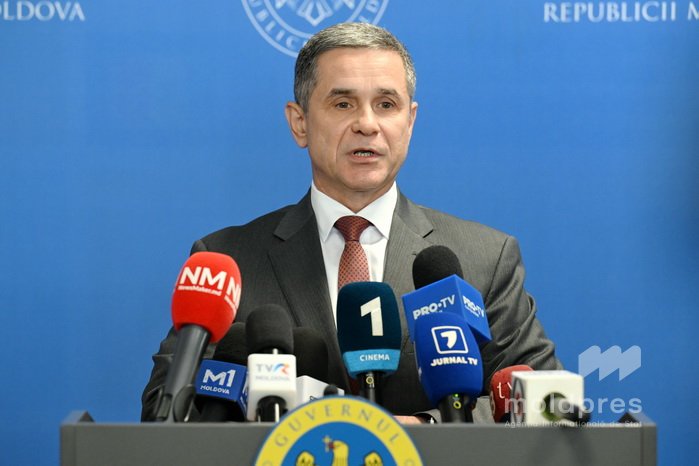
Technical-Military agreement with Ukraine: Moldovan defense minister debunks false claims, explains under what conditions document to be published
Defense Minister Anatolie Nosatii has rejected the false claims circulating in the public space regarding the technical-military cooperation agreement signed with Ukraine. The official explained that the document did not provide for Moldova’s involvement in the war, does not allow the deployment of foreign troops on the country’s territory and does not violate its neutral status. The full text of the agreement will be made public after it is signed by the sides and submitted for ratification to parliament, in accordance with legal procedures. The minister made statements to this effect at the Cabinetul din umbră (Shadow Cabinet) programme on JurnalTV channel.

The minister specified that the agreement was a framework document consisting of 12 chapters, contains no secret provisions and aims to develop cooperation in the technical-military field, including through the exchange of information, experience and technologies.

“I would read Article 3 of the agreement, which reads that that cooperation is exclusively consultative in nature and involves the analysis and exchange of technical and scientific information, specialized documentation, best practices and professional experience. Article 2 reads that actions carried out in the context of implementing this agreement may not be interpreted as an agreement to provide direct military assistance to either state involved in a conflict,” the minister said.

According to him, the agreement covers 16 areas of cooperation, including the modernization, repair and maintenance of military equipment, logistics, material resource management, the training of specialists, the protection of critical infrastructure and the development of cyber defense capabilities.

Another important area concerns the development and implementation of technologies for monitoring and protecting airspace, in the context of the security risks facing Moldova.

“This would mean that we could learn from the practices Ukraine uses to protect its critical infrastructure and people. We would have access to the products they are now selling to other countries. Drones and other systems—it is not only about drones. This is important, but it is not stipulated that factories or anything else will be built,” the official noted.

The minister also turned down claims that the agreement would allow damaged Ukrainian military equipment to be brought to the territory of Moldova for repairs.

“This agreement does not provide for that, and such a thing cannot happen in our country, because our neutral status does not allow it. We respect the laws of the Republic of Moldova and the Constitution,” Nosatii said.

In this regard, the official referred to Article 4 of the agreement, which stipulates that the implementation of the document does not affect the neutral status of the Republic of Moldova, as enshrined in the Constitution.

“Point 2 reads that no activity carried out under this agreement will contribute directly or indirectly to the conduct of military operations as part of an armed conflict. Point 3 reads that the results of the cooperation will not be used for operational or offensive military purposes. And Point 4: this agreement may not be interpreted as permitting the deployment of foreign military troops on the territory of Moldova,” the minister specified.

Nosatii emphasized that the agreement cannot be interpreted as a violation of the country’s neutrality and noted that the illegal stationing of Russian military forces on the territory of Moldova constitutes a violation of this status.

“Presently, the only state violating our neutrality, including Article 11.2, which prohibits permanent stationing on the territory of Moldova, is the Russian Federation, through the illegal deployment of its forces on the left bank of Moldova. So, there is nothing secret. Only after the required procedure, will the full agreement be made public and submitted to parliament for approval, in accordance with the legislation in force,” Nosatii said.

The minister also said that the document cannot be made public before the legal procedures are completed, as international agreements are processed in accordance with Law No. 595 of 1999 on the international treaties of Moldova.

“Agreements are not public until they have been signed by the parties and submitted for ratification. In our case, once the signed agreement is received by the government through the Foreign Affairs Ministry, we will promote it as a law for ratification in parliament and, accordingly, once it is registered, it becomes public. So, they will have access to it then,” the minister said.

The official also said that the document had been discussed in last March in the parliamentary commission, attended by representatives of both the ruling party and the opposition, who had access to the text of the agreement.

The technical-military cooperation agreement with Ukraine was negotiated by the defense institutions of the two states between 2019 and 2021. According to the minister, the document reached parliament in 2021 and was examined by the foreign policy commission, after which it was sent to the government to advance the negotiations. In 2025, the sides agreed to revisit the issue and sign the agreement, amid the need to develop Moldova’s defense capabilities and exchange experience in the security field.
 Facebook
 Instagram
 X/Twitter
 Telegram
VIDEO // Romanian PM welcomed with honors at Moldova's government
Foreign Minister approached European integration and countering hybrid threats in Cyprus
Speaker at meeting with Slovak ambassador: Slovakia’s experience in European integration process remains valuable
Moldova strengthens relations with Cyprus: Honorary Consulate inaugurated in Nicosia
ANALYSIS // Moldovan Prime Minister in Kyiv, consolidation of Moldovan-Ukrainian cooperation
Romania’s Prime Minister expected in Chișinău
VIDEO // Moldovan, Ukrainian officials discussed current issues in Kyiv
Prime Minister's message of appreciation for Ukraine: Your resistance allows us to live in peace
Technical-military cooperation agreement between Moldova and Ukraine signed in Kyiv
Moldova and Ukraine accelerate Bălți–Dnestrovsk power line project to increase energy exchanges between two countries
Prime Minister in Kyiv: Moldova to remain reliable neighbor and partner of Ukraine
Moldova's European path and regional security discussed by Foreign Ministers of Moldova and Cyprus
Romania’s Prime Minister to visit Chișinău on Tuesday
Republic of Moldova and Cyprus seek to deepen interparliamentary cooperation
Moldovan finance minister provides details on new salary law: which employees to benefit from largest pay increases
Moldovan defense minister goes to Bucharest: meeting with Romanian counterpart, signing of military cooperation agreement
Moldovan finance minister says cold-season compensation might be covered by savings from public spending's optimization
Technical-Military agreement with Ukraine: Moldovan defense minister debunks false claims, explains under what conditions document to be published
PM, industry representatives discuss development of medical tourism in Moldova
VIDEO // Moldovan PM says Energocom company bought two million cubic meters of gas from Ukraine at price lower than on spot market
BUILDING MOLDOVA // Authorities accelerate preparations for construction of Chisinau bypass road
 National Bank of Moldova

PM, industry representatives discuss development of medical tourism in Moldova
Summary of Moldovan parliament's plenary meeting of October 29, 2026
Moldovan president revokes Moldova's citizenship from three individuals
Moldovan parliament approves, in first reading, denunciation of two agreements with Commonwealth of Independent States that were not implemented
Moldovan PM, at Building Moldova event: ''A European country is not declared, it is built''

VIDEO // Moldovan parliament speaker says farmers need solutions, not politicians who speak on their behalf
Summary of Moldovan parliament's plenary meeting of October 29, 2026
Moldovan president revokes Moldova's citizenship from three individuals
BUILDING MOLDOVA // Deputy PM says more than 95 per cent of Moldova’s settlements set to have access to tap water by 2030
Moldovan parliament approves, in first reading, denunciation of two agreements with Commonwealth of Independent States that were not implemented
Moldovan PM, at Building Moldova event: ''A European country is not declared, it is built''
BUILDING MOLDOVA // Moldova to have center for collection, processing of special waste
Chisinau Electrical Substation enters inspection stage ahead of energization
BUILDING MOLDOVA // Ten health centers to be renovated, endowed with modern equipment in Moldova
Moldovan parliament speaker explains why he met Metropolitans of Bessarabia, Moldova: “There must be good cooperation between the two Metropolitan Sees”
Licensing of cereal and oilseed imports extended by late 2026
UPDATE // Heavy cross-border traffic at Leușeni Border Crossing Point eased
BUILDING MOLDOVA // New runway and terminal at Chișinău Airport
Over 2,400 students from 31 countries admitted to Moldova’s universities
Moldova to strengthen integrity of electoral processes by joining International IDEA
New guide set with Sweden’s support explains investigation of pollution, poaching and illegal logging
Receive the latest news directly to your email

Receive the latest news directly to your email