
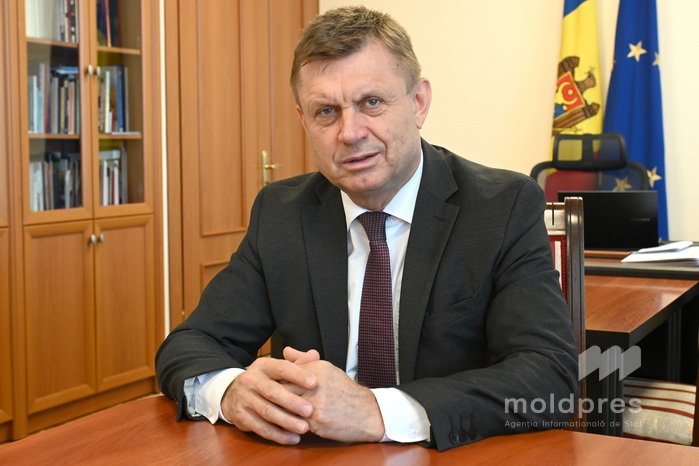
Deputy Prime Minister: Reintegration has already begun through things that bring people closer together
Moldova's reintegration must be built gradually, through measures that bring people closer together and improve their everyday lives, and the process “has already begun,” Deputy Prime Minister for Reintegration Valeriu Chiveri told an interview with MOLDPRES.

According to the official, the Republic of Moldova must not wait for the final political settlement of the Transnistrian conflict before addressing citizens’ concrete problems.


“Reintegration has already begun, gradually, through the things that bring people closer together and improve their everyday lives,” Chiveri said.


He noted that tens of thousands of residents of the left bank of the Dniester work, study, access services, or develop their businesses on the right bank, and that these experiences show them the benefits of closer ties with the Republic of Moldova.

The Deputy Prime Minister emphasized that the authorities’ objective remains the reintegration of the Republic of Moldova “on the basis of sovereignty and territorial integrity, within the internationally recognized borders.”

In the official’s view, reintegration cannot be achieved through a single decision. The process involves strengthening institutions, resolving security issues, and gradually bringing the region closer to the country’s economic, educational, and legal space.

Chiveri said that the success of the process must be measured by the concrete benefits experienced by citizens, including better access to services, education, the labor market, and economic opportunities.


“If, after some time, we can say that a citizen from the left bank has more opportunities, better access to services, and more rights than they have today, then it means that the reintegration process has produced results and that people have benefited from it,” the official said.


According to the Public Services Agency, as of June 30, 2026, the State Population Register recorded 366,830 residents domiciled in localities on the left bank of the Dniester and in the municipality of Bender, of whom 359,867 were citizens of the Republic of Moldova.

According to data provided by the State Tax Service, during the first half of 2026, 23,029 people domiciled in the Transnistrian region were registered as officially employed on the right bank of the Dniester. Of these, 57.28% were men (13,190 people) and 42.72% were women (9,839 people), representing a 66.8% increase compared with the previous year, when 13,810 people were registered.

The main areas of activity attracting workers from the region are trade, manufacturing and industry, construction and transport, the public sector, and services.

At the same time, approximately 4,000 children and young people from the Transnistrian region and the municipality of Bender are enrolled in the national education system, benefiting from studies in general, vocational and technical, and higher education institutions.

In the 2025–2026 academic year, 971 students domiciled in the Transnistrian region and the municipality of Bender studied at general education institutions located on the right bank of the Dniester. At the same time, 346 young people domiciled in the Transnistrian region are enrolled in vocational and technical education institutions in state-funded places. The average annual cost of educating one student is 26,000 lei in vocational schools and 32,500 lei in colleges and centers of excellence.

Another 674 young people from the region are pursuing studies in state-funded places at public higher education institutions, including through the compensatory year program. The costs of their education, scholarships, and accommodation in dormitories are estimated at more than 37.4 million lei. These measures contribute to expanding educational opportunities and integrating young people into the unified educational space of the Republic of Moldova.

Also, according to the National Health Insurance Company, between January 1 and June 30, 2026, 82,325 Moldovan citizens domiciled in the Transnistrian region were registered in the compulsory health insurance system. At the same time, 52,975 citizens domiciled in the Transnistrian region were enrolled on the lists of family doctors working in medical institutions participating in the compulsory health insurance system. Their number increased by 35% compared with the first half of 2025, when 39,238 people were registered. The number of insured persons enrolled with family doctors increased from 20,171 to 31,890, by more than 58%.
 Facebook
 Instagram
 X/Twitter
 Telegram
Local authorities from 11 districts of Moldova learn to manage sanitation services, beekeeping activities more effectively in EcoContact programme
New ARBOM project in Taraclia: modern, safe playground for children of “Plămîce” Center
Cross-border partnership for children: 177 specialists of Moldova, Romania join professional network
Moldovan authorities announce special measures at border amid transit of Hasidic pilgrims
Tudora–Starokazacie Moldovan-Ukrainian border crossing point resumes operations; traffic through crossing point proceeds as normal
Truck traffic redirected through Palanca customs checkpoint; Moldova's Customs Service increases number of officers
Assigning young specialists in healthcare system to be optimized
Prime Minister about PISA test results: We must continue education reforms
Defense Minister: Russian Federation continues to represent main threat to state’s military security
President after drone attack at Moldova’s border: Brutal war reaching our border
Cold-season assistance program in finalization stage
UPDATE // Customs Service's information systems operating normally
Eight properties worth over 9.6 million lei permanently seized for benefit of state
Drone crash in Mihăilenii Vechi shows characteristics similar to Geran aircraft
Convergence fund for Transnistrian region expected to finance infrastructure, education and public services
Moldovan Speaker to pay working visits to Slovenia and Hungary
PHOTO // Students from Moldova win bronze medal at International English Language Olympiad
Prime Minister welcomed participants in Chișinău Marathon 2026
Deputy Prime Minister: Reintegration has already begun through things that bring people closer together
PHOTO, VIDEO // More than 500 artists attend Gala. Speaker: I hope it becomes beautiful tradition for Parliament
Drone entered Moldova. Airspace temporarily closed
 National Bank of Moldova
Moldovan Speaker to pay working visits to Slovenia and Hungary
Prime Minister welcomed participants in Chișinău Marathon 2026
Over 500 artists from Moldova gathered in Parliament square and sang about homeland, nation and national values
Moldovan, Hungarian PMs have phone conversation
PM, European Commissioner discuss European agenda, strengthening resilience of Moldova

PHOTO // Moldova promotes gastronomy and traditions in Paris
Chisinau maintains position on withdrawal of Russian troops and demilitarization of Transnistrian region
Tudor Bratu - World University Weightlifting Champion
5+2 format no longer works
PHOTO // Moldovan PM commemorates victims of September 11, 2001 terrorist attacks in Chisinau
Border control at three Moldovan-Ukrainian crossing points to be temporarily organized solely on territory of Moldova
PHOTO // Head of state meets Moldovan rugby players who achieved European performances
European Commissioner reconfirms EU support for advancing reforms in European integration process
Moldova stands in solidarity with United States; victims of September 11, 2001 terrorist attacks commemorated in Chisinau
Cyberattack takes place on government resources of Moldova; authorities working to restore access
Moldovan, Hungarian PMs have phone conversation
PM, European Commissioner discuss European agenda, strengthening resilience of Moldova
Message to Moldova's public authorities on absolute unacceptability, “Zero Tolerance” for arbitrary detention, extralegal transfers
Moldovan president, European Commissioner discuss European path, resilience of Moldova
Moldovan president, Hungarian PM have phone conversation
European Commissioner holds talks with Prime Minister
Receive the latest news directly to your email

Receive the latest news directly to your email