
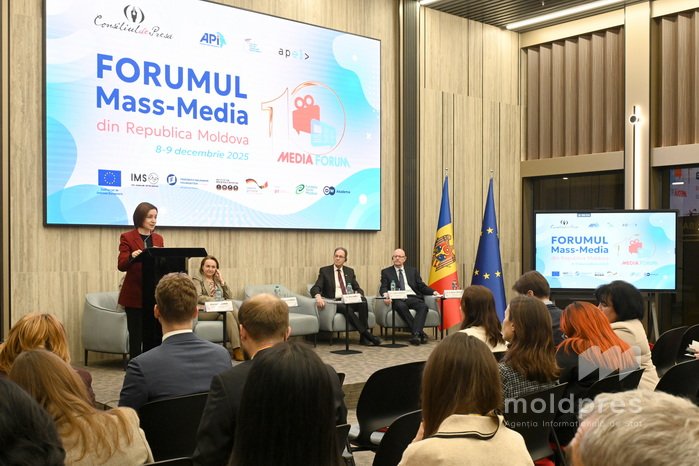
Head of State calls for modernization of media legislation: We can no longer defend democracy with tools from decades ago
The Republic of Moldova urgently needs a modern legislative framework capable of countering new forms of manipulation and informational attacks. President Maia Sandu made the statement at Media Forum held today in Chisinau. The head of state said “we can no longer defend democracy with tools from decades ago” and urged the media community, experts, and authorities to actively participate in developing rules adapted to current realities.
Maia Sandu highlighted the crucial role of the press in protecting democracy in recent years, noting the maturity and resilience demonstrated by media institutions, even in the context of reduced support programs for free media. The president warned that threats to the informational space will become even more aggressive in the coming years.
“Globally, the battle for democracy will not only be fought at the polls and in institutions but will largely take place in the informational space. It may well be the toughest battle of our generation. Manipulation, technologies allowing for near-perfect fabrications, coordinated attacks on public trust, propaganda heavily funded by hostile actors, and disseminated through fake accounts - all these constitute a sophisticated arsenal, creating an extremely volatile informational environment. In this context, the volume and aggressiveness of disinformation risk surpassing what we have seen so far. Impersonation using artificial intelligence or the fabrication of pseudo-realities are no longer theoretical risks but widely used means against us, with even greater intensity. If we do not acknowledge this, prepare ourselves, and join forces, democracy risks being defeated by lies and manipulation. Our internal problems also amplify the risks. In a media ecosystem with limited resources, the temptation to sacrifice analysis for speed or visibility is high. Therefore, solutions must be sought through collaboration, efficiency, and professionalization. In light of these realities, modernizing the legislative framework is imperative. We need clear rules for online spaces and standards for transparency and accountability. New forms of manipulation must be sanctioned,” Sandu said.
The head of state urged newsrooms to collaborate to strengthen their capacities, emphasizing that resource sharing and joint projects can be effective solutions. The president stressed the importance of developing journalistic expertise in European affairs to explain the European integration process accurately and in-depth to the public.
“And for three years now, at the Media Forum, I have returned to this idea because it remains crucial: European integration, the country's most important project, CANNOT be explained only by state institutions. It is essential for the press to also have an in-depth understanding of European mechanisms, analyze documents, and translate each stage of this journey for the general public. Therefore, I encourage newsrooms to develop expertise in European affairs and ensure journalistic presence in Brussels. When individual resources do not allow for this, newsrooms could form joint teams or collaborate through co-employment or correspondent rotation,” Sandu added.
The president also called on educational institutions to treat journalist training as a shared responsibility and reiterated the need to introduce media education in schools as a tool for protection against manipulation.
In conclusion, Maia Sandu emphasized that, although the fight against propaganda is unequal, the press and society have an essential advantage: the truth. She urged participants to use the forum platform to identify solutions that strengthen society's resilience and announced that the resilience plan recently approved by the National Security Council will offer new opportunities to consolidate the informational space.
Present at the Forum, European Union ambassador to Chisinau Iwona Piórko stated that the press in the Republic of Moldova remains “an important democratic partner, contributing to the promotion of good and transparent governance.” She thanked the organizers for addressing pressing topics such as new technologies and media policy challenges, underscoring that the discussions during the forum “will reinforce the development of the press in the Republic of Moldova.”The European diplomat noted the dedication of journalists, especially those from the regions, who traveled for hours to attend the debates and reiterated the importance of explaining the European integration process to all regions of the country. Piórko also mentioned meetings with Moldovan journalists in Brussels to provide them direct access to information and a correct reflection of EU accession stages.
Over 200 journalists, media experts, press institution managers, professors, students, and representatives of profile organizations are participating in the two-day tenth edition of the Media Forum in the Republic of Moldova, held in Chisinau under the auspices of the Press Council.
The forum was opened by the president of the Press Council, Viorica Zaharia, who noted that until today, a new media law has not yet been adopted, and threats against journalists remain high. She called on state institutions to become more efficient in investigating threats, including online ones.
The agenda of the 2025 edition includes six discussion panels on critical media topics: legislative priorities in the context of European integration; the impact of technological giants on press freedom; malign external influences on the informational space; evolution and challenges of the advertising market; professional journalist training; sustainability of independent media and international support.
Three practical workshops are dedicated to promoting journalistic content on social networks, using artificial intelligence tools and protecting journalists from online attacks.
Representatives of the parliamentary commission for the media, several ministries, the Audiovisual Council, the Central Electoral Commission, the Center for Strategic Communication and Counteracting Disinformation, as well as representatives from higher education institutions, foreign diplomats, donors, and international organizations are also participating in the forum.
Among the international experts present are Julia Haas (OSCE), Jan Lublinski (DW Akademie), Anna Pohrebna (Suspilne, Ukraine), Marian Vogel (MiCT, Germany), Attila Biro (Context.ro, Romania), Jasper Steinlein (Deutsche Welle, Germany), and Mariia Leonova (media consultant from Ukraine).
Traditionally, the National Prize for Journalistic Ethics and Deontology and the awards of the Journalistic Investigations of the Year contest will be presented.
Participants will draft a final resolution with recommendations and requests addressing the authorities and the media community. The document will be sent to national institutions and international organizations monitoring the democratic evolution of the Republic of Moldova.
The 2025 edition is organized by the Press Council, in partnership with the Independent Press Association (API), the Independent Journalism Center (CJI) and the Electronic Press Association (APEL), with support from the European Union.

 Facebook
 Instagram
 X/Twitter
 Telegram
Eight violations of Moldova’s Airspace recorded in recent days; five cause explosions on ground
VIDEO // Intelligence and Security Service chief, at Moldova Security Forum 2026, says money replaced ideology in attempts to destabilize Moldova
Moldovan president says local power must be in mayor’s office
DOC // New general structure, staffing of Moldova's National Army enter into force
PHOTO GALLERY // Moldova Security Forum 2026 held in Chisinau; over 90 experts from 20 countries discuss regional security
Romanian Defense Minister in Chișinău: We cannot discuss strong eastern flank without including Moldova
Moldova Security Forum // Defense Minister: War in Ukraine changed Europe’s security environment
VIDEO // Government proposes reorganizing local administration into 273 city halls and three regions
LIVE // Moldova Security Forum 2026 taking place in Chișinău
Civil society invited to discussions on European integration of Moldova
“Black Swans in the Black Sea” launched in Chișinău
Perception of human rights' observance improve in Moldova - study
PHOTO // Experience of Green Justice project could underpin new environmental justice initiative in Moldova
Medical technologies, artificial intelligence at center of new partnerships proposed by Moldova's State University of Medicine and Pharmacy
European Commissioner for Enlargement announces visit to Chisinau
Luxembourg Meeting // Irish Minister for European Affairs says Ireland to continue to support Moldova in EU accession process
Luxembourg Meeting // EU Commissioner for Enlargement says reforms can bring Moldova more European funds, investments
Luxembourg Meeting // Deputy PM for European integration says today’s decision gives Moldovan citizens one more reason to trust European choice
VIDEO // Moldovan deputy PM for European integration, ahead of the Luxembourg meeting: “We are ready and quite determined to carry out the reforms necessary for EU accession by 2030”
PM says Moldova in race against time to conclude EU accession negotiations by 2028
Republic of Moldova elected to UN Human Rights Council for second time
 National Bank of Moldova
Moldovan Prime Minister discussed advancing European integration of Moldova with Malta’s Prime Minister
State Chancellery and European partners discuss support for public administration reform
Books, photographs, stories from interwar Chisinau brought together in exhibition at Moldova's parliament
Deputy PM for reintegration has courtesy meeting with Ambassador of Norway to Moldova
Moldovan PM has meeting with representatives of construction companies

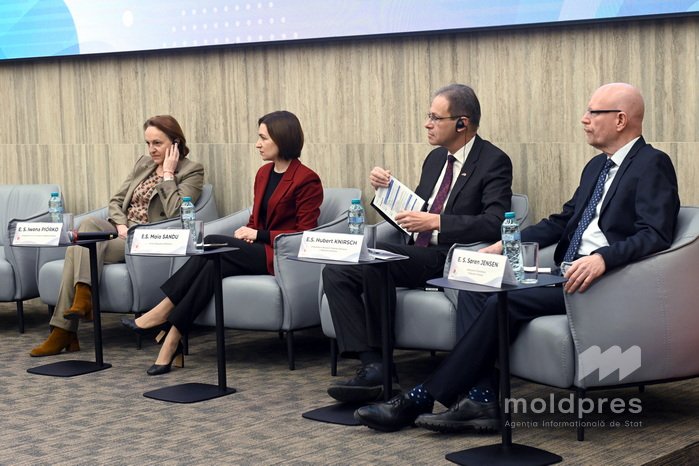
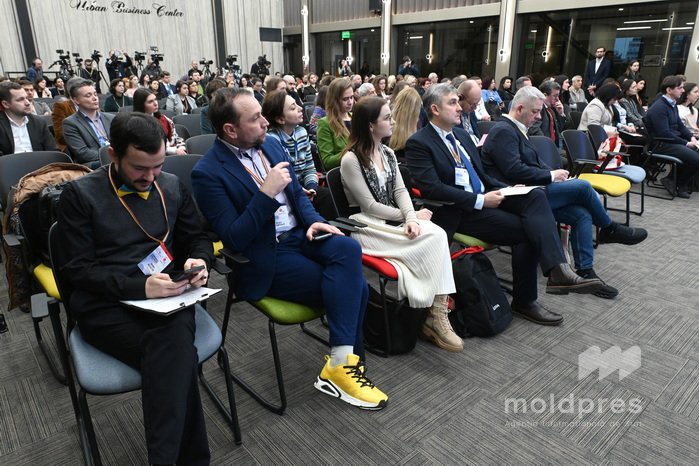
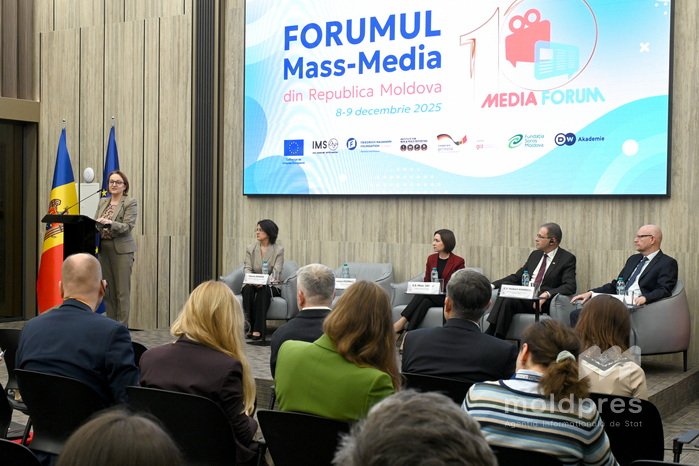
PHOTO // General Carabineer Inspectorate provided with 16 vehicles and modern equipment with EU support
STISC warns of spear-phishing campaign targeting Government institutions
PHOTO // First monument commemorating Roma victims of Holocaust to be erected in Cosăuți, Soroca
Seven hospitals to receive new equipment for storing blood products
VIDEO // EBRD and EU to support modernization of Moldova’s irrigation infrastructure
National, international observers can apply for accreditation for regional elections due in Moldova till November 8
Foreign affairs minister meets Austrian Ambassador to Moldova; discussions focus on EU integration, strengthening bilateral cooperation
One in four pupils involved in bullying or physical aggression situations; Moldovan authorities develop action plan to prevent, manage violence cases in schools
Moldovan parliament speaker says young people must study in modern conditions, be able to build future at home
VIDEO // European Commissioner for Enlargement, ahead of Luxembourg meeting: "Candidate countries are fulfilling their commitments. Let us prepare to welcome new members"
VIDEO // Moldova to open negotiations on 17 EU accession chapters in single day
Books, photographs, stories from interwar Chisinau brought together in exhibition at Moldova's parliament
Deputy PM for reintegration has courtesy meeting with Ambassador of Norway to Moldova
Moldova must strengthen air defense, create conditions for drone production; Moldovan parliament speaker: “We must seek solutions”
Moldova to open EU negotiations for clusters 2 – Internal Market, 3 – Competitiveness and Inclusive Growth
Vocational technical education of Moldova to be modernized with EU's support; Moldovan president: “An example of the benefits brought by the European path”
Receive the latest news directly to your email

Receive the latest news directly to your email