
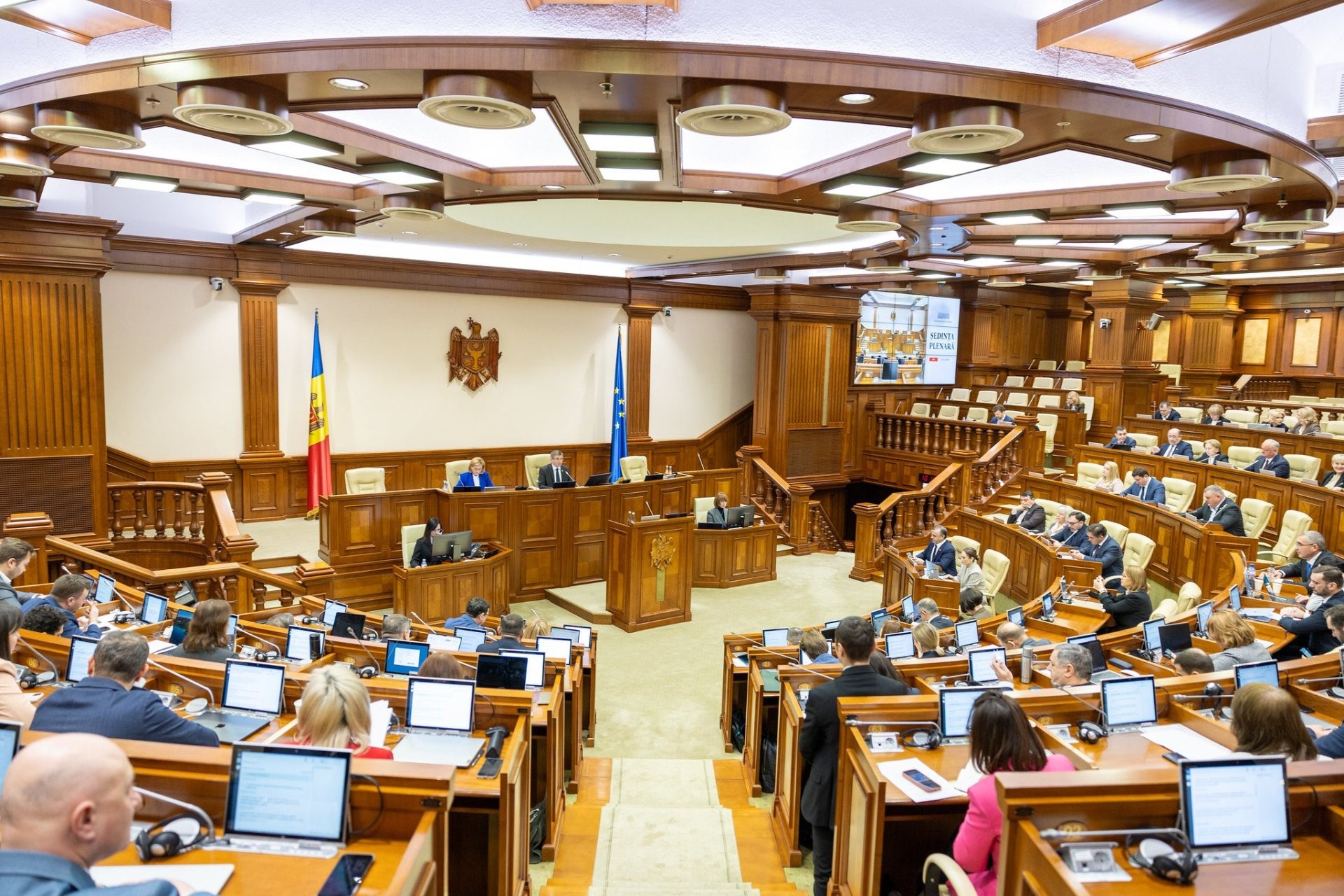
Moldovan parliament approves amendments to Education Code in first reading
The lawmakers today approved, with 55 votes for, the draft law amending the Education Code. The changes concern the reorganization of 73 schools, the provision of Romanian language study programmes for children of the Diaspora, the inclusion of children with severe disabilities, the reintroduction of marks for 4th-grade pupils, the consolidation of the school network, and support measures for young specialists. At the same time, university rectors will be able to run for multiple terms.

The document was presented in the parliament’s plenum by Education and Research Minister Dan Perciun. He specified that the proposed amendments addressed pressing problems of the system and responded to requests gathered following discussions with parents and employees in the sector. The minister also answered questions put by the opposition, which criticized the document.

“We, at the Action and Solidarity Party (PAS), are aware that both the administrative-territorial reform and the amendments to the Education Code will cost us politically. But we did not come to power to stay for life or to be concerned only with our own interest. As a society, we must respond to major challenges. And even if these answers cost us politically, they are necessary and we will implement them,” the minister said.

The education minister noted that changes in the education system were also dictated by the demographic situation.

“The education system of Moldova is facing a pronounced demographic decline, and by 2040, the number of pupils in schools might decrease by approximately 30 per cent,” Perciun pointed out.

After three hours of debates, 13 MPs registered to speak.

“I do not understand how some politicians, although they say that education is a priority, oppose changes. We are all aware that a child who wants to conduct an experiment in biology, chemistry or physics in a school with 3–4 classmates will not be able to do so. But they will be able to in another school, 5 or 10 kilometers away. And yes, the state will provide transportation,” MP Victoria Belous said.

The parliamentary opposition harshly criticized the draft, claiming that the amendments aim to ensure a new term as rector for one of the heads of Moldova’s universities and to reduce the number of village schools.

“The amendments to the Education Code presented today are nothing but political pressure on the education system, which favors the rector of the Technical University of Moldova (UTM),” MP Ala Ursu-Antoci said.

Based on the criteria proposed in the Code, 73 schools are to be reorganized, of which 10 will be transformed into kindergartens, 43 into primary schools, and 17 into primary school–kindergarten institutions. The total number of schools concerned represents approximately six per cent of all public school institutions of Moldova. In total, 1,200–1,300 children will be affected by this measure, which represents only 0.5 per cent of the total number of pupils.

The authorities will also introduce support measures for families and teachers. Thus, school transport will be free of charge and the parents of pupils transferred to other institutions will receive a monthly allowance of 1,000 lei for two years of study. The teaching staff affected by the reorganization will receive support through professional retraining, relocation and coverage of transport costs. Teachers who cannot find employment in their district will be able to benefit from a relocation allowance of up to 300,000 lei to take a job in another district. The eligibility criteria and the procedure for granting this allowance will be later regulated later by the government.

The amendments to the Code also provide for expanded access to Romanian language study programmes for children returning from the Diaspora and for children who are foreign nationals.

Support groups will also be created for children with severe disabilities, each with two teachers, and support classes will be organized in auxiliary schools as well. Pupils will be able to continue their studies for another three years after completing the 9th grade, in a special regime, under a pilot program.

Starting from next September, marks will be reintroduced in 4th grade for exam subjects. In the last ten years, in primary classes, teachers have used a system of descriptors (“excellent,” “very good”).

Another new measure concerns young specialists, who will receive higher placement allowances.

As of 1 January 2027, schools with more than 400 pupils will move to financial autonomy. Thus, headmasters will manage the budget and plan procurements independently, without depending on local authorities. Presently, 939 schools already benefit from financial autonomy, while another 172 are managed by the accounting departments of local authorities.

The document approved by the parliament also provides for the introduction of clear criteria for terminating the open-ended employment contracts of deputy headmasters, as well as the mandatory organization of public competitions for these positions. At present, almost 39 per cent of deputy headmasters hold the position for an indefinite term and another 27 per cent are acting in an interim capacity. There are also cases in which the interim period exceeds 10–15 years.
 Facebook
 Instagram
 X/Twitter
 Telegram
Moldovan expert says Moldova becomes strategic constant in Romania
Romania supports Moldova's economic integration; Romanian president says Romania to continue to support Moldova's integration into European Union, integration of two economies
Prime Minister at The Economist conference on accelerating EU accession process: Moldova moves forward despite challenges
PAS to have new MP in Parliament
Ben Gurion Airport in Tel Aviv remains closed until 16 April
National airspace overflown by Shahed drone
Perspectives on Moldova's European integration: experts says joint declaration announced today by officials from seven states good political signal
European Union member states' MPs call for speeding up EU accession talks with Moldova; declaration to this effect signed in Chisinau
Moldovan president to meet Moldovans living in Ireland
PHOTO // Republic of Moldova opened Honorary Consulate in Almaty, Kazakhstan
President on 108 years since Union of Bessarabia with Romania
Prime Minister conveys message on anniversary of Bessarabia's Union with Romania
Speaker - 108 years after Union of Bessarabia with Romania
PHOTO // Moldovan foreign affairs minister meets Romanian senators
New oil slicks on Dniester River; Moldovan authorities order reinforcement, expansion of anti-pollution barriers
New wave of oil products' slicks detected on Dniester River; authorities convene for emergency meeting
Moldovan PM participates in awards ceremony recognizing rescuers' achievements
Large wind farms with energy storage systems to be built in Moldova: 16 bids submitted in tender
Environmental protection experts from two banks of Dniester hold new working meeting
Moldovan Central Electoral Commission accredits 14 national observers to monitor new local elections, local referendums
New milestone for green energy: Moldova surpassed 1 Gigawatt of installed renewable energy capacity
 National Bank of Moldova
Moldovan authorities step up prevention, response measures on Dniester, amid anticipated new pollution wave
Moldovan PM participates in awards ceremony recognizing rescuers' achievements
Environmental protection experts from two banks of Dniester hold new working meeting
Moldovan deputy PM has meeting with Ambassador of Germany
President met with U.S. Senator

President met with U.S. Senator
PAS faction to have new MP
VIDEO // Single institution to manage Moldova’s forests
CNMC: Eenergy sector remains fragile, ending state of emergency requires caution
Foreign Ministry: We condemn violation of airspace. Such actions endanger citizens’ security
Support for export promotion: 16 business associations to receive 14.6 million lei through Bridge Export Program
Over 20 media projects to get funding from media subsidy fund
Shahed drone illegally flew over airspace of Moldova
Over 25,000 residents from left bank of Dniester commute daily to right bank, Deputy Prime Minister for Reintegration says
BTA: Bulgarian Literature Has Become Increasingly Visible on International Stage - Deputy Culture Minister Stoyanov
Simple motion on public policies implemented by Ministry of Labour and Social Protection failed
Proposals for improving efficiency of ministries discussed at roundtable
PHOTO GALLERY // Premiere at Mihai Eminescu National Theater: “Intrigue and Love,” directed by Alexandru Cozub
Moldova to sign social security agreements with Quebec (Canada), Albania, Croatia and Ireland
Around 622,000 vulnerable families receive energy compensation
Prime Minister visited agricultural business in Unguri village, Ocnița district
Receive the latest news directly to your email

Receive the latest news directly to your email