

Shortage of teaching staff in general education decreasing in recent years
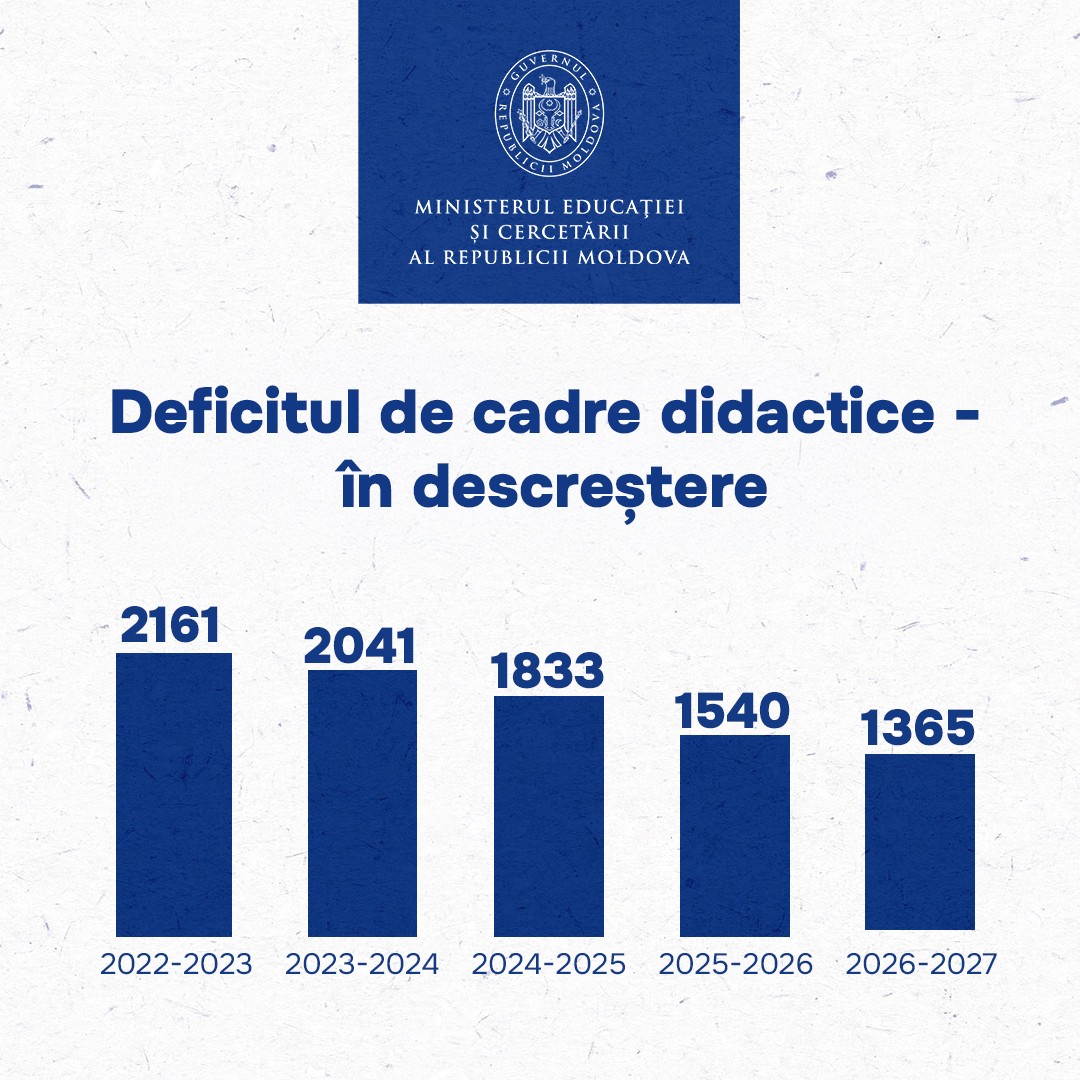
The number of vacant teaching positions in general education institutions in the Republic of Moldova is decreasing, according to the Ministry of Education and Research (MEC). According to data presented by local specialized education authorities, for the 2026–2027 academic year there are 1,365 vacant teaching positions with a workload of more than 14 hours per week on an open-ended basis.

According to the MEC, an analysis of the evolution of this indicator over the last five years shows a constant downward trend. Compared to the previous year, when 1,540 vacancies were recorded, their number has decreased by about 12%. Compared to the situation two years ago (1,833 positions), the drop is about 26%.

The highest number of vacant teaching positions is recorded in the municipalities of Chișinău (273) and Comrat (88), as well as in the districts in the central area of the country: Ungheni (88), Cimișlia (85), Nisporeni (84), Anenii Noi (65), Hâncești (63).

In 2025, a record number of 426 young specialists were employed in schools and kindergartens, marking the highest response so far to the Ministry of Education and Research’s call to join the education system. In 2024, 404 young people were employed in educational institutions, in 2023 – 365, and in 2022 – 296.

Of the total number of young hires, most opted for positions as primary school teacher (89), early childhood educator (74), Romanian language teacher (36), and history teacher (23). In terms of regional distribution, most graduates chose to work in institutions in Chișinău, Gagauzia, Bălți, Orhei and Ialoveni.

The MEC explained that this dynamic is influenced, among other factors, by policies aimed at attracting and retaining teaching staff in the system. Benefits of the teaching profession include a one-time allowance of up to 300,000 lei for teachers, a 75% reduced teaching load during the first five years of activity, compensation for teaching materials, support for housing expenses in rural areas, annual leave of up to 62 days, as well as mentoring provided by an experienced teacher.
 Facebook
 Instagram
 X/Twitter
 Telegram
PHOTO // National Army sappers conduct demining missions in Orhei, Chișinău, Cimișlia
Well-known actor of Moldova passes away at 78
DOR government programme of Moldova: children, young people from Diaspora can submit participation files till April 22
PHOTO GALLERY // Orthodox Christians celebrate Resurrection of the Lord: traditions, faith that unite generations
VIDEO // EU Ambassador to Moldova says people on Eastern holidays return to things that matter most: family, traditions
Moldovan PM conveys message on Easter
VIDEO // Moldovan parliament speaker says may Light of Resurrection brings us peace, courage, new hope
Moldovan president congratulates citizens on Resurrection of the Lord
Orthodox Christians celebrate Holy Easter; Orthodox priest says peace should be sought in hearts, Light of Resurrection should be shared with everyone”
Holy Light from Jerusalem brought to Moldova
PHOTO GALLERY // Old Orhei on Easter Eve
Direct train from Kyiv to Chisinau Airport launched in test mode
VIDEO // Moldovan government's secretary general says Easter fills villages, all Moldova with life, warmth
Ungheni municipality, 18 other settlements unite in voluntary amalgamation; Ungheni mayor says largest cluster in Moldova takes shape
Speaker about Transnistrian issue: 5+2 format is dead, we will no longer accept pointless talks
Local elections 2026: CEC announces start of election campaign
DOC // National Bank of Moldova puts into circulation commemorative coin - In memoriam: Famine in Bessarabia 1946–1947
President participates in Antalya Diplomacy Forum at invitation of Turkish President
 National Bank of Moldova
Relaunch of competition for selecting civil society representatives in Open Governance Coordination Committee
President participates in Antalya Diplomacy Forum at invitation of Turkish President
Moldovan head of state meets former president of Poland
Political representatives in process of negotiations for Transnistrian settlement convene at second working meeting of 2026
Dialogue between Moldova's central and local authorities in Comrat

Speaker: Change of regime in Hungary removes obstacle to our European integration
Speaker criticizes Russian diplomat Oleg Ozerov’s attempts to visit Evghenia Guțul in prison: It’s none of his business
Speaker confirms: Leadership of Russian troops in Transnistrian region declared undesirable in Moldova
Moldovan head of state meets former president of Poland
Moldovan deputy PM for reintegration says Tiraspol must come back down to earth, reality changed dramatically
Political representatives in process of negotiations for Transnistrian settlement convene at second working meeting of 2026
PHOTO // Taraclia-based Museum of History and Culture renovated through European Village programme with investments of over 7 million lei
Governor of National Bank of Moldova attends constituency meeting of IMF, World Bank: inflationary pressures, financial stability on agenda
New hearings in prosecutors' evaluation process in Moldova: four sessions scheduled for late April
Moldova's General Police Inspectorate launched internal investigation into police officer who drew up report in name of deceased person
Dialogue between Moldova's central and local authorities in Comrat
Number of fraud attempts rising in Moldova: over 500 attempts reported to 112 in just one week
New local elections: 40 polling stations to be open in 12 localities of Moldova
Progress achieved by Moldova in implementing structural reforms discussed with World Bank Vice President for Europe and Central Asia
VIDEO // Chisinau–Tiraspol dialogue continues; deputy PM reiterates commitment to reintegration, European integration
Head of State at commemoration of victims of 1946–1947 famine: When truth is told, even after decades, it brings justice
Receive the latest news directly to your email

Receive the latest news directly to your email