
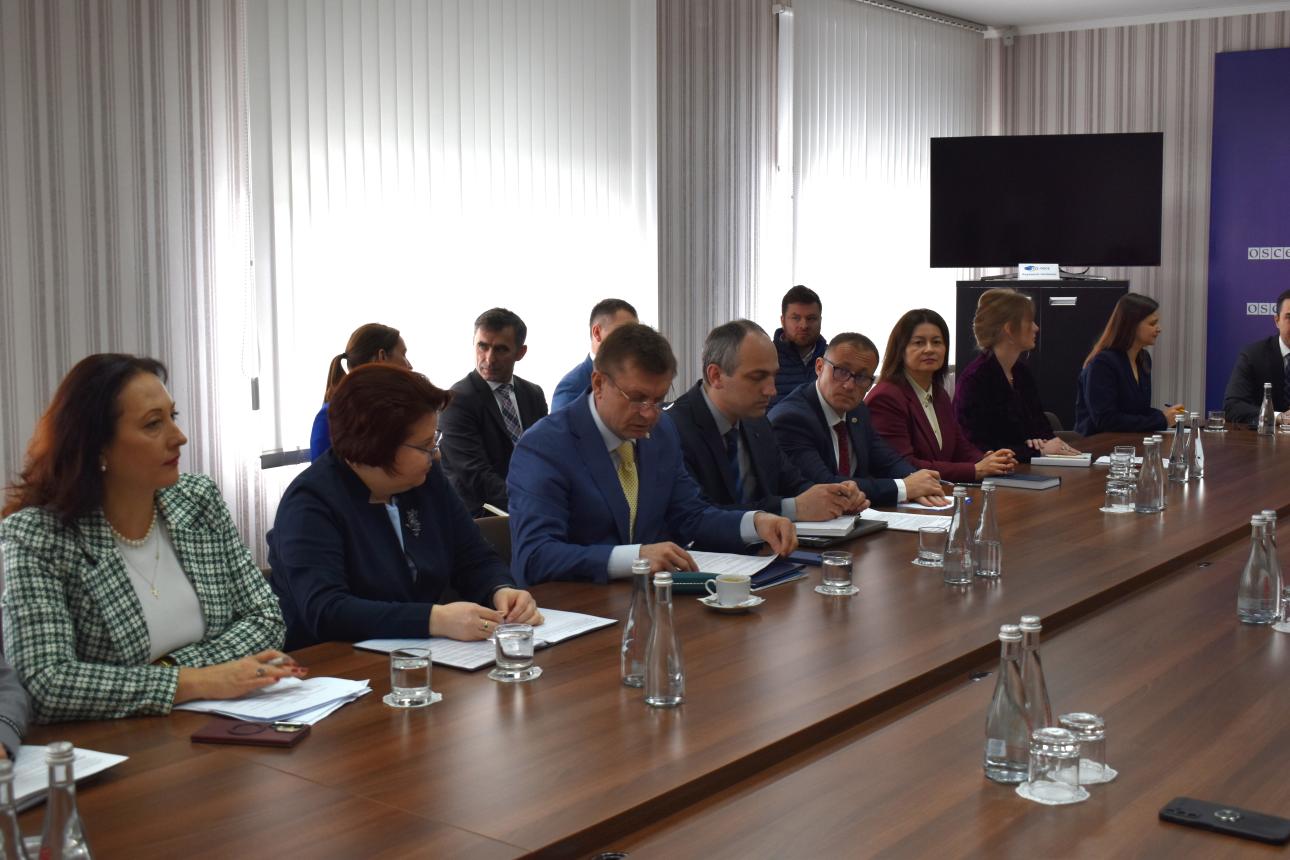
Political representatives in process of negotiations for Transnistrian settlement convene at second working meeting of 2026
The second working meeting of this year between the political representatives in the process of negotiations for the Transnistrian settlement on behalf of Chisinau and Tiraspol, Valeriu Chiveri and Vitalii Ignatiev, took place at the Tiraspol-based office of the OSCE Mission to Moldova today

As in the round from February 26, 2026, a team of journalists from the right bank of the Dniester River was present on site, where they had the opportunity to record the introductory part of the meeting and to put questions to both negotiators at the end of the discussions.

Deputy Prime Minister Valeriu Chiveri recalled that Chisinau continued to firmly promote reintegration policies and the expansion of common spaces throughout the entire territory of the country. He also said that awareness of the sovereignty and territorial integrity of Moldova, along with the advancement of the European integration process opened up essential prospects for the Transnistrian settlement and for sustainable development in the entire state.

The Moldovan official highlighted the lack of progress on behalf of Tiraspol regarding the issue of human rights, ensuring freedom of movement, including for journalists and representatives of civil society, while ignoring Chisinau’s requests for the release from illegal detention of some citizens of Moldova, as well as neglecting initiatives aimed at improving the living conditions of residents of the Bender municipality and more localities on the left bank of Dniester (e.g. access to the 112 Service, repair of bridges across the Dniester, regeneration of certain forested areas in the region).

The proposal was reiterated to introduce the study of the Romanian language into the educational process in all Moldovan educational institutions in the region, in order to restore normality and education in the mother tongue. Likewise, in the educational field, emphasis was placed on the need to provide dedicated premises for schools with teaching in Romanian in the region (with priority for the theoretical lyceums Evrika from Rabnita and “Stefan cel Mare si Sfant” of Grigoriopol), to end the practice of coercing pupils to register with the so-called local military authorities, and to avoid harmful propaganda from Tiraspol regarding the events reflected in history textbooks.

Chisinau brought back to the table the most pressing issues in the area of environmental protection that require proactive involvement from both banks: quick management of ecological crises on the Dniester, elimination of air pollution sources, information exchange on fish stocking in water basins and on fishing prohibition periods, measures to combat poaching, inventory of forest resources and planning of necessary reforestation and ecosystem restoration measures.

The sides also returned to the initiative to create a convergence fund, made up of payments collected from economic agents in the eastern districts of the country, as well as of internal and external budgets, through which social and infrastructure projects will be financed in the region, in order to improve the living standards of the population. In the context, the political representatives emphasized that the fund was not about collecting financial means as such, but about contributing to the resolution of pressing problems faced by citizens of the region.

The negotiator from Chisinau suggested the need to abandon speculative and manipulative approaches by Tiraspol on a broad range of issues concerning the activity of economic agents in the region that carry out external commercial operations, in accordance with the requirements of the legislation in force, freedom of movement and the removal of infrastructure related to illegal checkpoints in the Security Zone.

Chisinau stressed that, in order for the actions provided for by the current legal framework to be carried out, the competent authorities of Moldova must have access to the perimeter of the Transnistrian region.

The sides agreed that, in the coming period, the dynamic of convening new sectoral working groups would continue.

The deputy PM for reintegration expressed openness to continue the rounds of discussions on a regular, constructive basis and according to the principle of rotation, and reiterated the invitation to hold the next meeting in Chisinau.
 Facebook
 Instagram
 X/Twitter
 Telegram
Better access to treatments: Government modernizing medicine authorization system
Involvement of Moldova's authorities in Interreg programming process, in context of new EU multiannual financial framework 2028–2034
MOLDPRES INTERVIEW │ Deputy Prime Minister: Gradual reintegration in different areas - path toward lasting settlement of Transnistrian conflict
Deputy Prime Minister for Reintegration meets with Head of International Committee of Red Cross Mission
Head of State to pay official visit to Ireland, which will hold rotating presidency of Council of European Union starting July
Moody’s Agency upgrades Moldova’s rating to B2, highest level in last 25 years
Moldovan authorities step up prevention, response measures on Dniester, amid anticipated new pollution wave
Moldovan PM participates in awards ceremony recognizing rescuers' achievements
Environmental protection experts from two banks of Dniester hold new working meeting
Moldovan deputy PM has meeting with Ambassador of Germany
President met with U.S. Senator
Proposals for improving efficiency of ministries discussed at roundtable
Prime Minister visited agricultural business in Unguri village, Ocnița district
Prime Minister visited rescuers and firefighters unit in Ocnița
PHOTO // Taraclia-based Museum of History and Culture renovated through European Village programme with investments of over 7 million lei
Governor of National Bank of Moldova attends constituency meeting of IMF, World Bank: inflationary pressures, financial stability on agenda
New hearings in prosecutors' evaluation process in Moldova: four sessions scheduled for late April
Moldova's General Police Inspectorate launched internal investigation into police officer who drew up report in name of deceased person
Dialogue between Moldova's central and local authorities in Comrat
Number of fraud attempts rising in Moldova: over 500 attempts reported to 112 in just one week
New local elections: 40 polling stations to be open in 12 localities of Moldova
 National Bank of Moldova
Dialogue between Moldova's central and local authorities in Comrat
Head of State at commemoration of victims of 1946–1947 famine: When truth is told, even after decades, it brings justice
President’s message at commemoration event for victims of 1946–1947 famine
Moldovan PM pays tribute to maestro Gheorghe Urschi
Moldova consolidates mechanism for implementing international sanctions with EU's support

Head of State at commemoration of victims of 1946–1947 famine: When truth is told, even after decades, it brings justice
President’s message at commemoration event for victims of 1946–1947 famine
President condemns Russian attacks and calls for additional sanctions against Russia: War will stop only when Russia stops
PHOTO // Dniester River under constant monitoring thanks to European states that provided Ministry of Environment with intervention equipment
PHOTO // Victims of 1946–1947 famine commemorated in Mingir
General Prosecutor’s Office announces legislative initiatives to strengthen preventing and combating domestic violence, developed following analysis of recent cases, including that of Ludmila Vartic
PHOTO // Moldova could become strategic hub for U.S. business
New local elections: CEC announces number of candidates and referendum participants
CSP gives green light: Acting Prosecutor General passes external evaluation
Silver and bronze medals for Moldova at World Sambo Cup
ARMENPRESS: Armenia to restrict drone, private flights during EU summit
Romanian Embassy in Moldova says creation of Relations with Romania Service strengthens bilateral cooperation
Improved access for people with disabilities in Moldova: 30 ramps to be installed in public institutions hosting polling stations
VIDEO // Moldovan government transfers land needed to continue work on bridge across Prut river at Ungheni, connecting Moldova and Romania
Ana Racu elected vice-chair of UN Committee Against Torture
Victims of the organized famine from 1946–1947 to be commemorated in central Moldova settlement
Receive the latest news directly to your email

Receive the latest news directly to your email