
VIDEO // Schools, hospitals, roads of Chisinau modernized with government's support
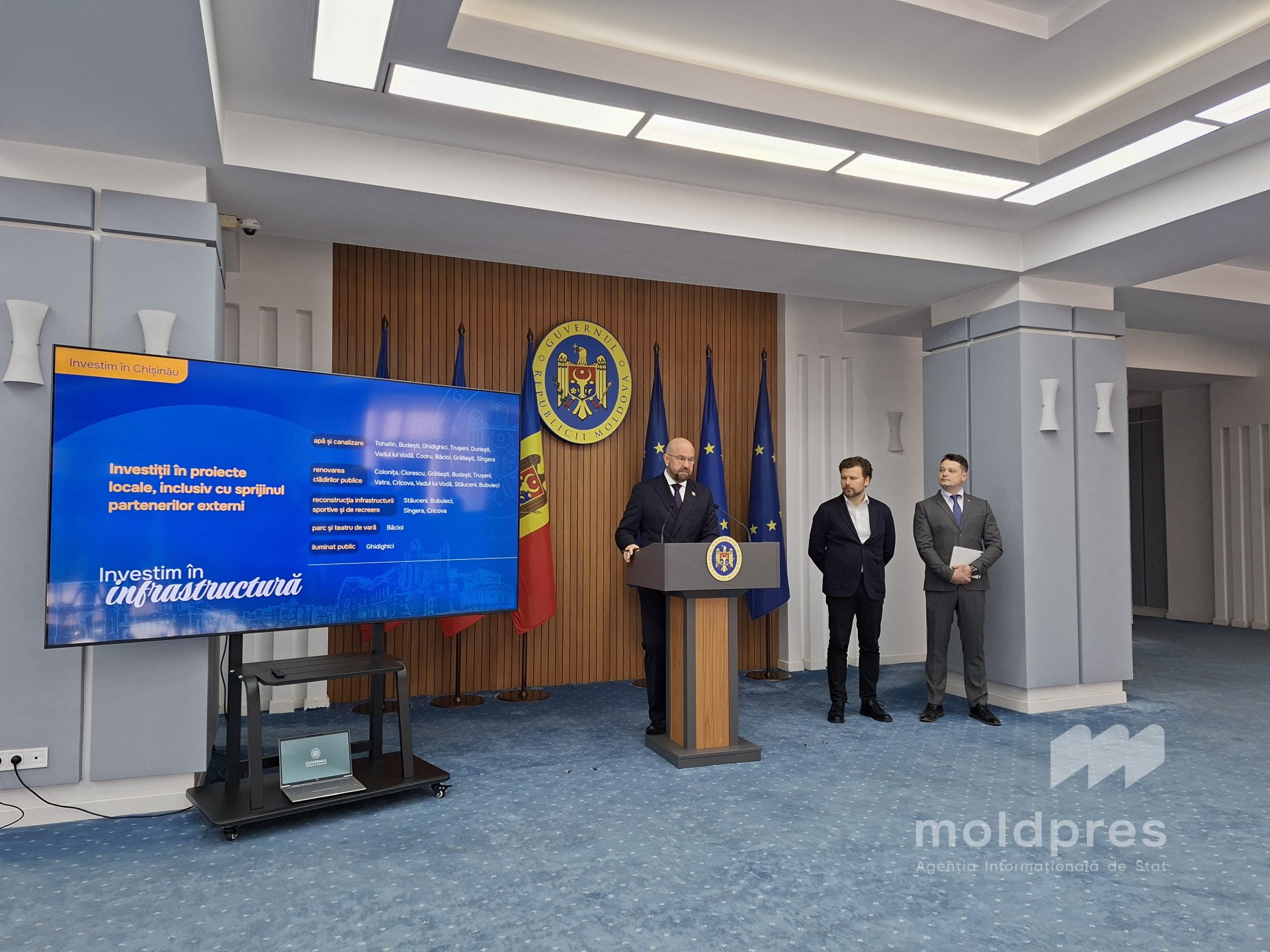
The government has announced investments worth billions of lei in roads’ infrastructure, apartment-block courtyards, educational institutions and hospitals in the Chisinau municipality. For 2027, the authorities plan to start work on two more sections of the capital’s ring road, continue modernizing apartment-block courtyards and allocate approximately one billion lei for investments in the healthcare system. In education, capital investments mobilized in recent years close to billion lei, according to information presented today by Minister of Infrastructure and Regional Development Vladimir Bolea, Minister of Education and Research Dan Perciun and Minister of Health Alexandru Gasnas at a news conference titled, Investing in Chisinau.
The event was organized on the occasion of Chisinau City Day and officials presented projects implemented between 2022 and 2026, as well as priorities for the coming years, including investments in the capital’s suburbs.
Approximately three billion lei for infrastructure
The portfolio of projects managed by the Ministry of Infrastructure and Regional Development for the municipality of Chisinau amounts to about three billion lei, of which 1.5 billion lei represents investments currently being implemented.
One of the programmes presented is European Courtyard, under which 469 projects have been declared eligible, with a total value of 2.3 billion lei. The works concern the rehabilitation of access roads, sidewalks, lighting, green spaces and playgrounds between apartment blocks. Presently, 70 courtyards are under construction, with a budget of more than 350 million lei for this year, while the rehabilitation of at least 100 additional courtyards is planned for 2027.
“We decided to work alongside citizens and for citizens on objectives that matter greatly to each person individually, even if they are not as visible. I believe this is what matters most to our people,” said Deputy Prime Minister Vladimir Bolea, Minister of Infrastructure and Regional Development.
According to the official, the projects are determined based on the needs expressed by residents.
“The decisions were made from the bottom up. We built what the majority of people in those courtyards decided. This is what being inclusive means; this is what standing alongside citizens means,” the minister stated.
Thirty-seven projects are also being implemented in the municipality, in order to expand or create nursery groups in public kindergartens, with total investment amounting to 93 million lei. Bolea noted that the authorities had not limited the number of groups that can be established in a locality, if there is sufficient space and a need for them.
“This is extremely beneficial for young mothers and for children who can benefit from early institutional education,” the minister said, adding that these services allow parents to continue their studies or professional activities, knowing that their children are receiving care and education.
The historic building of the former Bessarabian Governorate Zemstvo, located on Alexei Sciusev Street in Chisinau, is also set to be restored. The building has an area of 1,855 square meters and the reconstruction project is currently being prepared.
“The building is completely deteriorated and damaged. The project is now being prepared, and reconstruction works will begin as soon as possible,” Vladimir Bolea said. According to the minister, after restoration, the building could become a new attraction on the capital’s tourist map.
Works on two more sections of the Chisinau ring road are expected to begin in 2027
One of the major road infrastructure projects presented by the minister concerns the continuation of construction of the capital’s ring road. The first section, approximately 6.5 kilometers long, has been completed, with the investment amounting to 9.9 million euros.
For sections 2 and 3, works are planned on approximately 18 kilometers of four-lane road along the Ialoveni–Sculeni–Cricova Bridge route.
“The second section of the Chisinau ring road is fully prepared. We have feasibility studies, financial resources provided by the European Bank for Reconstruction and Development (EBRD) and all decisions have been taken by the government. The National Road Administration is preparing the tender documents, so that we can open the tender for this section as soon as possible,” Bolea said.
For section 2, which will connect the Ialoveni area with Sculeni, the estimated budget is approximately 100 million euros, with support from the European Bank for Reconstruction and Development. In the case of section 3, from Sculeni to the Cricova Bridge, the feasibility study is expected to be completed in the coming weeks, after which the estimated costs and sources of funding will be established.
“We are preparing the tender documents, so that works can begin in 2027 on both section 2 and section 3 of the Chisinau ring road, meaning approximately 18 kilometers of four-lane road,” the minister said.
According to Bolea, the completion of these sections is expected to improve travel safety and comfort and facilitate transit through the capital.
More than 82 projects in the capital’s suburbs
More than 82 projects are being implemented in localities across the municipality through the European Village, European Village Express and Europe is Close programmes. They include the expansion of water and sewerage networks, roads’ rehabilitation, renovation of public buildings, development of recreational spaces and sports infrastructure.
A regional sports hall is under construction in Budesti, while sewerage network works are also planned in the locality. In Cruzesti, Budesti and Tohatin, projects are being developed to interconnect sewerage systems, so that wastewater can be taken over by the centralized system of the municipality of Chisinau.
“By building 8.2 kilometers of shared sewerage networks and several pumping stations, we are connecting these three localities to Apa-Canal and to the centralized sewerage system of Chisinau,” the minister explained.
The official said that the solution would allow for a reduction in the number of local treatment plants and contribute to improving the quality of wastewater treatment.
Road investments also target access to economic zones. In Truseni, a 1.6-kilometer access road to businesses has been put into operation, while in Bubuieci, a 1.1-kilometer section providing access to the industrial zone is being rehabilitated.
“Satisfied businesses mean more financial resources and more tax revenue, meaning that more businesses come because they have suitable working conditions,” Bolea said, stressing that infrastructure development can contribute to increasing local budget revenues.
Seven kilometers of sewerage networks and pumping stations are due to be built in Bacioi, in order to connect the locality to the capital’s centralized system. At the same time, more suburbs are benefiting from projects to expand nursery services, amid the growing number of young families settling near Chisinau.
One billion lei for the modernization of schools
Minister of Education and Research Dan Perciun said that capital investments mobilized in recent years to modernize school infrastructure in the municipality of Chisinau were getting close to one billion lei. More than 60 educational institutions have benefited from various projects, ranging from renovations and equipment to the modernization of cafeterias and sanitation facilities.
“Ninety percent of the budget of all schools and kindergartens in the municipality of Chisinau comes from the government and is financed through earmarked transfers,” Perciun said.
According to the minister, these transfers cover the institutions’ operating expenses, including salaries, energy and other current needs.
At the same time, the Ministry of Education and Research has mobilized funds to modernize infrastructure. One of the priority programs is the Model Schools programme, under which 25 institutions from Chisinau have been selected for investments of approximately 2.5–3 million euros each.
The aim of the programme is to modernize schools that have additional space, but are not attractive enough to parents and students, which contributes to overcrowding in other institutions.
“We still have educational institutions with places available for students, but they are not attractive enough. Parents do not want to send their children there, because they do not look good enough, and this results in overcrowding at other institutions, where we end up with 35 or even 40 students in a class,” the minister said.
According to Perciun, modernizing these schools should distribute students more evenly among educational institutions in different sectors of the capital.
Another 16 institutions are included in energy-efficiency projects, while sanitation facilities have been renovated in 20 schools and high schools through an investment of more than 24 million lei.
One hundred million lei has been allocated to modernize school cafeterias in the municipality, amid the expansion of free meals for students in grades 5–9.
“In virtually every school in the city that you visit, you will find new equipment purchased and delivered by the ministry, so that we can equip and prepare schools for the meal service,” Perciun said.
The ministry has also initiated the transfer of buildings, in order to expand the space available to students. The former premises of the Igor Vieru High School are to be transferred to the Lucian Blaga Theoretical High School after renovation, which is expected to provide approximately 400 places for primary-school students. Another building in the Ciocana sector is undergoing the same process to expand the space available in the education system.
At the same time, the minister called on Chisinau City Hall to increase investments in the institutions it manages.
“It is very important that, alongside the efforts made by the government, as long as Chisinau City Hall manages the educational institutions, it should make comparable efforts and identify real solutions of its own, especially for problems related to overcrowding and infrastructure modernization,” Dan Perciun said.
More than 1.6 billion lei for medical institutions of the capital
In the healthcare sector, investments made over the past four years in 24 medical institutions in the Chisinau municipality have exceeded 1.6 billion lei. Almost 800 million lei came from the state budget and the funds of the National Health Insurance Company, while approximately 810 million lei represents external financing.
Approximately 65.7 million lei has been invested in six municipal medical institutions. Among the most important projects, there are equipping the Valentin Ignatenco Municipal Clinical Children’s Hospital with a computed tomography scanner worth 15.2 million lei and modernizing its intensive care unit.
Health Minister Alexandru Gasnas said that installing the scanner allowed examinations to be carried out directly at the hospital, without transporting young patients to other institutions.
“The important thing is that doctors can establish a diagnosis more quickly without the child having to be transported elsewhere. This is the change we want to achieve through investments in healthcare,” the minister said.
Investment at the Valentin Ignatenco Municipal Clinical Children’s Hospital has reached approximately 27 million lei. The intensive care unit has been equipped with nine beds, ventilators and monitoring equipment for the treatment of critically ill children. According to the minister, approximately 900 children requiring such interventions are treated there every year.
Approximately 32 million lei has been invested in the Gheorghe Paladi Municipal Clinical Hospital. The intensive care unit was reconstructed, increasing its capacity from six to 13 beds. The institution was also equipped with technology for the early detection of precancerous lesions and cervical cancer.
“For a woman, this may mean identifying a problem before the disease reaches an advanced stage,” Alexandru Gasnas noted.
Investments have also been made in other municipal institutions. An early-intervention center for children was established at the Ciocana Territorial Medical Association, which also purchased equipment for endoscopic examinations. At the Municipal Clinical Hospital for Children’s Infectious Diseases, the airborne infections ward and the roof were renovated for approximately 3.4 million lei, while the Holy Trinity Municipal Clinical Hospital received multifunctional medical beds and equipment to develop services for patients with strokes.
A significant portion of the investments was directed to republican hospitals from the capital. The Emergency Medicine Institute received approximately 430 million lei to modernize its infrastructure, including the Emergency Department, intensive care units and operating block. The Oncology Institute received about 270 million lei to modernize radiotherapy and diagnostic services, while the Mother and Child Institute benefited from approximately 192 million lei to modernize operating blocks and several departments.
The Timofei Mosneaga Republican Clinical Hospital received investments of approximately 170 million lei, including for the modernization of its outpatient department.
“The Health Ministry invests in Chisinau regardless of who founded the medical institutions. We do not divide patients’ needs according to a hospital’s administrative subordination; we invest where infrastructure needs to be modernized, where equipment is needed and where new medical services must be created,” Alexandru Gasnas said.
Investments worth approximately 600 million lei are underway in the medical sector in 2026, while for 2027 the Health Ministry aims to mobilize around one billion lei. The funds will be directed toward the development of interventional cardiology, oncology, intensive care, medical rehabilitation and day surgery services.
At the end of the conference, Vladimir Bolea said that investments in the capital and its suburbs must respond to residents’ needs and contribute to the development of communities.
“Through its programs, the government of Moldova is coming to work alongside people in the city to create better conditions every day. I firmly believe that for hundreds of thousands of Moldovans, the city of Chisinau has become home,” the deputy prime minister said.

 Facebook
 Instagram
 X/Twitter
 Telegram
Investments in training specialists; PM says well-learned trades bring better salaries in Moldova
Eighty million euros invested in vocational schools of Moldova: 47 buildings to be renovated
Government launches Moldova Prepared Program to train citizens to cope with crisis situations
Director of Center for Contemporary Art dies in accident in Vaslui county
Ministry of Education honors participants with best results at Great National Dictation
MFA: Moldovan citizens not among victims of attack on airport in Riyadh, Saudi Arabia
Drone detected in Anenii Noi district
VIDEO // Leova water intake station operating normally
Moldovan citizens to receive energy compensation this cold season as well
Drone unauthorizedly flew over national airspace and exploded in Anenii Noi district
VIDEO // President: Priority for Moldova in defense is improving air defense
National Robotics Team wins FIRST Global Challenge 2026 in Korea
Hydrological situation of Dniester River, rehabilitation of Bender wastewater treatment plant discussed by experts from both banks
Moldova's Diaspora children can enroll in free Romanian language courses
Moldova counts on France’s support to open final two clusters of EU accession negotiation chapters
Moldovan parliament speaker in Rome says cooperation between Moldovan, Italian parliaments essential to Moldova's EU accession process
Moldovan PM attends event on launch of Moldova AI Hub
Moldovan parliament speaker presents Moldova’s experience in countering foreign interference at European Conference of Presidents of Parliament
PHOTO // European Village: Over 7 million lei invested in Taraclia museum
Moldova, Council of Europe assess progress in implementing 2025–2028 Action Plan
Moldova's Constitutional Court declares unconstitutional amendments that allowed Herman von Hebel’s appointment to prosecutors’ evaluation commission
 National Bank of Moldova
Moldovan PM attends event on launch of Moldova AI Hub
Moldovan parliament speaker presents Moldova’s experience in countering foreign interference at European Conference of Presidents of Parliament
Progress in implementing public administration reform roadmap discussed with civil society of Moldova
Moldovan deputy PM for reintegration has meeting with Special Representative of OSCE Chairperson-in-Office for Transnistrian Settlement Process
More opportunities for small-, medium-sized enterprises in Moldova; national legislation to be harmonized with EU acquis

Approved by Moldova's government: personal allowance to rise to 46,680 lei, VAT-free electricity consumption threshold to reach 150 kWh
Progress in implementing public administration reform roadmap discussed with civil society of Moldova
Moldovan deputy PM for reintegration has meeting with Special Representative of OSCE Chairperson-in-Office for Transnistrian Settlement Process
Training for future teachers to be reformed in Moldova: practical experience from first year, master’s degree tailored to specialization
Moldovan energy minister speaks about new value added tax thresholds for energy, additional funding for energy efficiency
Moldovan environment minister says Chisinau has water, solutions needed to capture it at lower levels
More opportunities for small-, medium-sized enterprises in Moldova; national legislation to be harmonized with EU acquis
Defense Minister about drone over territory of Moldova: This is 95th case of violation of country’s airspace
VIDEO // MOLDAGROTECH, FARMER 2026 exhibitions open at Moldexpo center
PHOTO GALLERY // MOLDAGROTECH and FARMER 2026 brought together manufacturers and suppliers of agricultural technologies at Moldexpo
Speaker after meeting with Moldovan entrepreneurs in Italy: We can make Moldova more attractive for investment
Authorities purchasing vehicles through public procurement procedures to have to consider environmental impact and energy efficiency
VIDEO // Prime Minister announces simplifications for small food producers
Farmers to gain access to modern agricultural machinery and irrigation systems with Japan’s support
Public buildings in Moldova to be modernized to reduce energy consumption and maintenance costs
Prime Minister: Dniester’s flow has been increased by 20%, but situation still complicated in both Moldova and Ukraine
Receive the latest news directly to your email

Receive the latest news directly to your email