
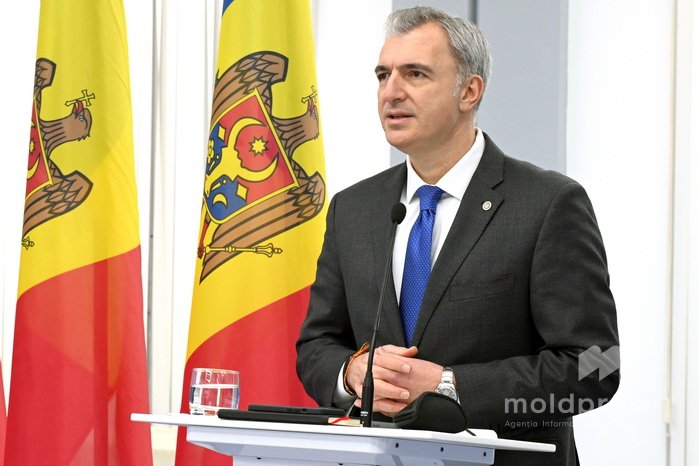
MOLDOVA#35 – What We Have Built // Deputy Prime Minister: We Have Followed Complex Economic Path. Next Step Is Full Integration into European Economy
On the occasion of the 35th anniversary of Independence, MOLDPRES is launching MOLDOVA#35 – What We Have Built, dedicated to Moldova's achievements and the transformations that have shaped the country’s development. In this section, ministers review their work in the areas they manage and talk about the results achieved and the projects that have contributed to the development of the Republic of Moldova. From economy and infrastructure to education, culture, health, agriculture, energy and European integration, each edition highlights the changes and results in areas that are essential to the country.

Over the 35 years of independence, the Republic of Moldova has experienced a complex and profound economic path. We have moved from an economy integrated into a centralized system to a market economy, in which entrepreneurship, investment, competition, exports and innovation have become essential drivers of development. Deputy Prime Minister, Minister of Economic Development and Digitalization Eugeniu Osmochescu made the statement to MOLDPRES. The official emphasized that the next step is full integration into the European economy.

“At 35 years of independence, I believe that the most important achievement is that the Republic of Moldova has built its own economy and created the capacity to transform itself. The next stage is full integration into the European economy,” said Osmochescu.

The official stressed that the main transformation that has marked the economy of the Republic of Moldova in the 35 years of Independence is the emergence and consolidation of the private sector.

“Today we have entrepreneurs who have built competitive companies, export-oriented production and businesses integrated into international value chains,” the Deputy Prime Minister said.

At the same time, according to him, the economy of the Republic of Moldova has opened up to the world, and Moldovan companies have expanded their export destinations. Accession to the World Trade Organization, the Association Agreement with the European Union and the Deep and Comprehensive Free Trade Area have created the framework for gradual integration into the European economy.

“Today, the EU is our main trading partner, and more than two-thirds of Moldovan exports reach the European market. This is one of the most important economic changes that occurred during the period of independence: Moldovan companies have access to a market of more than 450 million consumers and are increasingly connected to European production chains,” he said.

At the same time, the Deputy Prime Minister underlined that in recent years we have also seen a change in the model of economic growth.

“In 2025, GDP increased by 2.4%, industrial production by 5.4%, and investments in fixed assets grew by 21.8%. These are indicators showing that investment and production must increasingly become the engines of the economy,” he said.

He pointed out that investment attraction policy plays an important role in this transformation, noting that the authorities aim to create clearer and more predictable conditions for both local and foreign investors.

“Investment means capital, but it also means technology, know-how, new markets and jobs. At present, we seek to attract investments in areas with high growth, innovation and value-added potential: industry, digital technologies, energy, infrastructure, health, research and innovation. The new investment framework approved recently aims precisely to create clearer and more predictable conditions for local and foreign investors,” Osmochescu emphasized.

At the same time, financing programs implemented through the Organization for Entrepreneurship Development (ODA) have become an important instrument for the development of SMEs – from launching a business to retechnologization, energy efficiency, digitalization, innovation and export. Statistical data show that the EU project for SMEs alone has supported 377 businesses and contributed to the creation of over 5,600 jobs.

Another area in which transformation is very visible is digitalization. Currently, more than 78% of public services intended for the business environment are available online via EVO, and entrepreneurs have digital access to 425 services.

“A few years ago, we were talking about the first online public services; today we are building a digital ecosystem in which the entrepreneur can interact with the state remotely. More than 78% of public services intended for the business environment are available online via EVO, and entrepreneurs have digital access to 425 services. The next step is to move from the digitalization of individual services to an integrated digital infrastructure that covers the entire life cycle of a business,” said Osmochescu.

In parallel, the Ministry of Economic Development and Digitalization has set out to simplify the relationship between the state and the business environment through the deregulation reform and “REUȘIM” Program. The goal is very concrete: less bureaucracy, clearer rules and more time for entrepreneurs to develop their businesses, the Deputy Prime Minister explained.

Eugeniu Osmochescu pointed out that European integration is currently the most important accelerator of this transformation. According to him, the Republic of Moldova’s Growth Plan for the period 2025–2027, worth up to 1.9 billion euros, creates an unprecedented opportunity for investment, reforms and modernization of the economy.

“For us, European integration means not only adopting European legislation, but building an economy capable of functioning and competing in the single market: with predictable rules, higher productivity, European standards and competitive companies. This alignment with European standards is also visible in areas such as the free movement of goods, standardization, metrology, accreditation, conformity assessment and market surveillance. And this is directly linked to consumer protection. A modern economy must provide both good conditions for entrepreneurs and safety and confidence for consumers,” he said.

The official noted that going forward, the authorities’ focus is to move to an economy with higher productivity and added value.

“We need more modern industry, more investment, more complex exports, our own technologies and products, research, artificial intelligence, digital services and skills adapted to the economy of the future,” he said.

Osmochescu reiterated that the next stage is full integration into the European economy.

“Our objective is for this integration to translate into concrete results for people and companies: better-paid jobs, more competitive businesses, more investment, stronger Moldovan products on external markets and a better quality of life,” he concluded.

On August 27, the Republic of Moldova marks 35 years since the proclamation of Independence.
 Facebook
 Instagram
 X/Twitter
 Telegram
Energocom reserved necessary electricity for today: Energy available on external markets remains more expensive, especially during peak hours
PHOTO // Traffic now open on new section of road R8.1 between Arionești and Otaci
Prime Minister at Diaspora Forum: We must improve people’s lives and restart engines of economy
VIDEO // Moldelectrica: Final consumers were not affected by damage to Bălți–Dnestrovsk Line
330 kV Bălți–Dnestrovsk power line severely damaged by natural disasters
President explains current energy crisis and urges reduced consumption during peak hours
Energocom: Electricity shortage during peak hours; consumers urged to save energy
Prime Minister: This government’s focus is to moderate rise in real estate prices
Finance Minister explains key proposed 2027 tax policy changes on income tax
DOC // Draft fiscal policy for 2027 submitted for public consultation
Government to increase personal tax exemption for employees to 40,000 lei
Prime Minister presents new fiscal policy concept for 2027
Apple harvest in Moldova could grow by 17.5% this year, while EU production expected to decline
LIVE // Prime Minister presents main provisions of fiscal policy for 2027
Moldovan electoral body announces start of electoral period for new local elections and referendum of 1 November
VIDEO // Foreign Minister about cooperation with Romania: Strategic relationship between two states based on shared language, history and traditions is major asset for our country
MOLDOVA#35 – What We Have Built // Deputy Prime Minister: We Have Followed Complex Economic Path. Next Step Is Full Integration into European Economy
Over 12,000 jobs offered by ANOFM
Prime Minister attended Sports Festival held in Nisporeni
Gold and silver for Moldova at Lima Grand Prix: judokas Radu Izvoreanu and Denis Vieru step onto podium
Moldovan driving licences to be recognized in Latvia
 National Bank of Moldova
Information session for businesses on both banks of Dniester on application of VAT and excise duties to goods imported into Moldova
Prime Minister attended Sports Festival held in Nisporeni
Information session for economic agents on both banks of Dniester River on application of VAT and excise duties to goods imported into Moldova
Mayors from northern regions participated in first round of consultations at Government on investments for merged localities
Plan for construction of Moldova HiTech Park – new technology and innovation center presented in Stăuceni

Citizens returning to Moldova informed about employment opportunities and support measures offered by ANOFM
Information session for economic agents on both banks of Dniester River on application of VAT and excise duties to goods imported into Moldova
Mayors from northern regions participated in first round of consultations at Government on investments for merged localities
PHOTO GALLERY // EU & My Grandparents contest 2026
ARMENPRESS: Armenian citizenship applications exceed 32,000 in 2025, historical high, Deputy Minister says
Moldovan carriers will no longer pay road taxes in Armenia for ECMT trips
Foreign Minister meets with new Head of Council of Europe Office in Chișinău
UPDATE // Traffic flowed smoothly at Leușeni border crossing
USMF „Nicolae Testemițanu” published final results of admission contest for higher education
Moldovan driving licences can be exchanged in Ireland without driving test
Grandparents and grandchildren discover Europe together at contest
Maia Sandu meets with Lilia Neagu and Asea Andruh-Scorpan
Jewish Community of Moldova has new Chief Rabbi
Moldovan firefighters helping to extinguish large forest fire in Greece
DOC // Deadline for submitting bids in privatization of Zarea hotel extended
DOC // Strategic Programme for Aquaculture Sector 2026–2030 published in Official Journal
Receive the latest news directly to your email

Receive the latest news directly to your email