
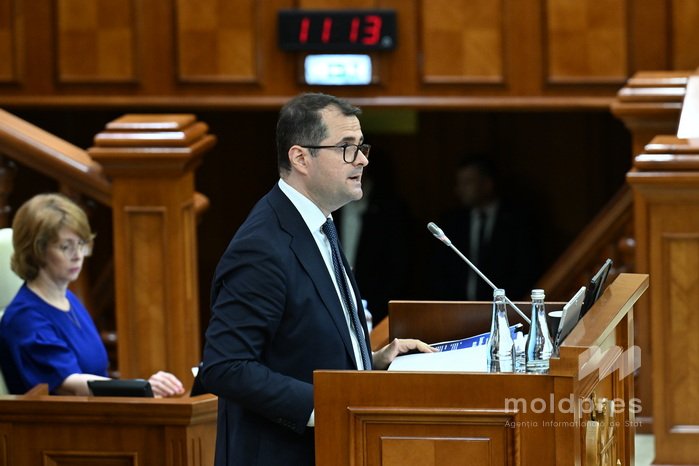
Speech of candidate for position of Moldova's PM, delivered in parliament's plenum
Dear citizens,

Honourable MPs,

I am honoured to be here today, so that we can have this important debate. You are the people elected by the citizens to represent not only their expectations, but also their concerns. Different people, with different needs, different professions, people with different visions of development, have placed their trust in you to be their voice. Today’s discussion is important because each of you, elected by the people, brings here the voice of these people. Today I present to you the governing programme and the team that will implement it. This programme is not a drawer strategy or an academic paper full of beautiful ideas, but starts from a simple question: can we build Moldova as a country where young people want to live, raise their children and invest, or are we content to continue losing people and opportunities? The answer depends on us.

The plan starts from an unvarnished diagnosis: the problems are serious and decisions can no longer be postponed. The action counter is not in years, it is in days and hours. Every day must become a deadline for finding and implementing solutions. Any delay has a real cost: every day, another young person may decide to build his/her life in another country, and another investor may choose a different market. Lost time costs us the future.

The problems are many and difficult. They are even overwhelming. But they are not insurmountable. I have a plan for this country and I am determined to fight for a stronger economy, a more efficient state and a better life for people.

The list of challenges is long. Yes, we must acknowledge that we have a budget deficit of 20 billion lei. Expenditures have increased from 49 to 92 billion over the last five years, while investments have not kept pace. The crises forced us to double social protection spending – half of the increase in costs is social in nature. The state had to help people by increasing pensions or paying compensations at the meter, but this did not generate growth – we distributed what we had collected, but we did not produce more.

The pension and social insurance system is dependent on the budget, with a deficit of 3.6 billion lei in the State Social Insurance Budget (BASS), plus 15 billion in social benefits. If we do not find solutions to change the ratio of 1.1 employees per one pensioner, then things will continue to worsen.

To all these problems we must add the demographic challenge and people’s fatigue with regional and global crises. Society is ageing, the labour force is shrinking, and artificial intelligence technologies are disrupting everything we know and have learned. In recent years, we have managed to open the European market, but we still do not have a sufficiently strong exportable offer.

Economic tension is amplified by political tension. Citizens have gone through two complicated election years and have withstood Russia’s attempts to sow chaos. These elections reconfirmed the European path, but also brought division, frustration and fatigue. And recent abuses in some state-owned enterprises have sharpened the feeling of injustice.

I understand the revolt and anger. I feel it too, as do my family, my friends and my neighbours. But I know they come from a desire for change, not from a desire to destroy. And it is important not to waste the immense effort that has brought Moldova so close to EU accession – a stage that would have been unthinkable just a few years ago.

The state needs capable people. We do not want them to leave abroad for higher salaries. Therefore, we must not put all discussions into a single basket of emotions. Competent people must be paid fairly, and unjustified privileges and gains must be eliminated.

We have two major tensions – economic and political – and a single window of opportunity for the coming years. There is no point in denying that we are going through a crisis. The question is whether we remain stuck in confusion and frustration or whether we can use this moment to repair and move forward.

I am putting this programme before you not as a perfect solution, but as an implementable one. I want us together to find the balance between the changes that are necessary and the stability of the foundation. To carry out a capital repair, but not shake the walls. We are not the first country to go through such challenges. Other small countries – Ireland, Estonia, New Zealand – have had such difficult moments and emerged victorious from them. I know no comparison is perfect, but such examples encourage us.

We have everything we need for growth – hardworking people, access to the European market, digital potential, and the beginnings of a revitalization in 2026. Now we must align people, money and institutions in the same direction – towards growth, with greater speed and discipline.

Dear lawmakers,

The programme you have before you has 147 pages. I will not attempt to read it today, chapter by chapter. I do not think that would be useful.

Nor will I go ministry by ministry, ticking off sectors and listing actions. People’s problems do not follow the Government’s organizational chart.

An entrepreneur is not interested in whether a blockage concerns the Ministry of Economy, Finance, Environment, or an agency. He wants to know how long it takes to receive an authorization and whether he can invest under predictable conditions.

A farmer is not interested in who manages the irrigation station, who issues the permit and who manages European funding. He needs water, access to capital and a market for his production.

A patient does not need to know the complex machinery between the ministry, the National Health Insurance Company (CNAM), the family doctor and the hospital. He must get to the right medical service on time.

And a parent is not interested in why the teacher or the place in the nursery is missing. They expect a solution.

Therefore, I will present the programme through five questions:

In the first quarter, we grew by only 0.4 per cent. We import almost three times more than we export. Public investments are below 1 per cent of the Gross Domestic Product (GDP).

These figures are added to structural problems that we can no longer postpone: a small domestic market, a declining population, labour shortages, insufficient capital, agriculture vulnerable to drought, and an economy that exports too much raw material and too little added value.

The old engines of the economy are slowing down. Traditional agriculture, wiring harnesses and exports to the East can no longer sustain growth on their own. New engines exist – technology, services, agri-food processing, energy, tourism, creative industries – but they are still running at too low a speed and are underfunded.

The challenge is enormous. We must call things by their name.

But I do not accept the idea that Moldova is condemned to stagnation and failure.

Pessimism is the most dangerous disease of an economy. If entrepreneurs lack confidence, they postpone investments. If people do not see opportunities, they leave. If institutions fail to decide, capital goes elsewhere.

Therefore, the starting priority of this Government is to restore confidence, energy and initiative in the economy. Not through optimistic speeches, but through decisions that show people it is worth investing, working and building here.

At the current pace, we cannot close the gap with European economies. We cannot sustainably finance salaries, pensions, hospitals, education, infrastructure and security just by redistributing the same limited resources.

We must produce more value here, in Moldova.

Economic value is not created in ministries. It is created in factories, farms, IT companies, workshops, construction, services, and in small and large enterprises.

The role of the Government is to ensure stable rules, protected property, infrastructure, fair competition and access to markets. And, very importantly, not to waste people’s time, capital and energy.

Our ambition is for Moldova to become the most business‑friendly European country for entrepreneurs.

This ambition is not measured by a slogan. It is measured in days needed to open and expand a business, in the cost of compliance, in the number of reports, in the time spent at customs, and in the predictability of inspections.

A company already provides the state with information about its founders, employees, income, taxes, imports and authorizations. It makes no sense for it to bring the same certificates to more institutions.

By 2028, priority tax and customs interactions must be digital. The “once only” principle must be applied effectively: if the state holds a piece of information, it must not request it again from the citizen or the business.

We will review permits and reporting requirements. Any authorization that does not protect a clear public interest must be removed or replaced by a simple notification.

And we will change how inspections are carried out.

An enterprise that operates correctly must not be subject to repeated inspections just because it is visible and easy to find, while high‑risk activities remain outside the authorities’ attention.

And I want to state something very clearly.

In an ordinary tax dispute, the state must not send masked officers at six in the morning to an entrepreneur’s home, in front of his children and family.

The coercive power of the state must be used where there is a real danger – organized crime, violence, serious fraud – not as an instrument of intimidation in a routine accounting or tax dispute.

The law must be applied. But it must be applied proportionately and with common sense.

The digitalization of services will be assessed by the user experience, not by the number of platforms launched.

By 2029, ten of the most important life and business events must be fully digitalized – from application to decision – and priority public services must be available online.

An economy cannot grow without capital.

We will expand guarantees and investment loans, develop investment and venture capital funds and attract more private capital alongside public and European funds.

Exports of technology products and services currently amount to around one billion euros. The goal is to reach two billion euros by 2029.

At least ten local companies will be prepared for listing on the stock exchange. We will also create instruments so that the savings of the diaspora can finance companies and productive projects in Moldova.

Our domestic market is small. Precisely for this reason, a company built here must be able to reach the European market quickly.

Legal access to the single market is not enough. A producer must be able to test and certify in Moldova, at a reasonable cost, that his product meets European standards.

We will invest in laboratories, certification and quality infrastructure. We will digitalize customs services and reduce costs for operators who comply with the rules.

Diplomacy will also have economic objectives.

Missions in priority markets will have annual plans for investments and exports. We will not evaluate an embassy only by the number of meetings it organizes. What matters is how many investments it has facilitated, how many exporters’ problems it has solved and which markets it has helped open.

Entrepreneurs need predictability. The state needs revenues. And society needs fairness.

By 2029, the budget deficit as a share of GDP must be reduced by at least two percentage points compared to the 2026 level. Tax revenues as a share of GDP must increase by at least two percentage points.

We cannot achieve these results by constantly putting more pressure on the same taxpayers who are already paying correctly.

We must reduce the informal economy, undeclared work, envelope wages and tax evasion. We must assess tax exemptions and keep only those that produce an economic or social benefit greater than their cost.

We will systematically review public expenditures. Not to produce more reports, but to take decisions: closing a programme that does not work, reducing a cost, changing a mechanism or transferring money to a more important priority.

Every leu spent on a structure that duplicates another’s function is a leu that does not reach a school, a medical service, a road or a social service.

I will not promise that taxes and tax rules will not change. We need tax reform. It would be unserious and irresponsible to pretend otherwise.

But I can commit that changes will be consulted, decisions will be explained, and we will not treat compliant enterprises as the simplest source of additional revenue.

Any significant change will be analyzed according to three criteria: its effect on investment, on jobs, and on public revenues.

Public investment must increase from around 0.9 per cent to 2 per cent of GDP in the next two years.

But we do not need more construction sites started and then frozen. We need well‑prepared projects, fully financed and completed on time.

An unfinished road, a hospital without staff or a water network without an operator does not represent a result.

The EU Growth Plan makes 1.9 billion euros available to the Republic of Moldova. About a quarter are grants and the rest are loans on favourable terms.

This money must be turned into roads, bridges, water systems, energy infrastructure, hospitals, schools and better conditions for investment.

Each strategic project will have a responsible person, a timetable, a full budget and public reporting on progress.

Agriculture clearly illustrates the difference between allocating money and changing an economic model.

Since 2021, the National Fund for the Development of Agriculture and Rural Environment has increased by about 70 per cent, reaching 1.9 billion lei in 2025. Over 8,200 farmers have received support, and 61 per cent of beneficiaries were micro‑farmers.

This support was necessary. There have been droughts, frosts, floods and energy shocks.

But we cannot remain stuck in a model where the drought comes, the harvest is lost, farmers protest and block customs, and the Government hurriedly looks for money for compensations. This is not a sustainable model.

By 2029, the programme foresees mobilizing at least 7 billion lei in public and private investments in the agri‑food sector.

A minimum of 70 per cent of investment‑type resources will be directed towards modernization, processing, irrigation, technology and added value. AIPA will be reorganized and prepared to manage European funds. The Farmers’ Register and the parcel identification system must become functional.

This is the condition for Moldovan farmers to gradually access instruments similar to those available to farmers in the European Union.

The change we seek is simple, but challenging:

Not just how much we compensate losses after a drought, but how much we invest so that the next drought causes smaller losses.

Not just how many tons of wheat or fruit we export, but how much we process here and how much income stays in the country.

Not just how large the subsidy fund is, but how much productivity and extra income each leu generates.

Water will be treated as a strategic resource. The Government cannot make it rain. But it can rehabilitate irrigation systems, develop storage and capture capacities, reduce losses and manage existing resources better.

Approximately 48 per cent of the national road network is rated as being in poor condition.

The goal is to rehabilitate or modernize at least 100 kilometres per year and at least 300 kilometres by 2029. A larger share of the maintenance budget must go towards prevention, not towards repairs after a road has fully deteriorated.

The state railway company has structural financial and operational problems. Covering losses periodically without changing the operating model only postpones the problem.

We will separate infrastructure management from service operation and concentrate investments on corridors that have economic and strategic justification.

In water and sewerage, the priority is regionalization of services. It is not enough to build the network. There must be a capable operator, resources for maintenance and a service that still works ten years from now.

In energy, the goal is a safe, flexible and less dependent system.

The Vulcanesti–Chișinău power line must be put into operation by the end of August 2026, and the Suceava–Balti interconnection by 2028.

Also by 2028, the programme provides for at least 1,200 MWh of battery storage capacities, at least 100 MW of new flexible power plants, and a share of over 35 per cent renewables in electricity generation.

This means less dependence on a single source and more stability for families and businesses. I cannot promise that international gas and energy prices will not rise. No Government controls global markets.

But we can diversify sources, conclude more stable contracts, increase domestic production, invest in energy efficiency and protect vulnerable consumers better.

The environment is not a topic separate from the economy.

Polluted water, unauthorized dumpsites, soil degradation and drought generate costs for health, agriculture, communities and businesses. Therefore, waste management, water, air, afforestation and climate adaptation are economic investments, not just environmental obligations.

Our first commitment is clear: to increase the capacity of Moldova to produce, invest and export, while maintaining fiscal discipline and protecting the vulnerable.

The second question is how we use the accession process to modernize the country.

The objective of the mandate is to be ready to finalize negotiations and prepare the signing of the Accession Treaty by the end of 2028.

This is an ambitious timeline. It will not be achieved through statements, but through implemented laws, functioning institutions and projects executed on time.

In 2026, we must open all six negotiation clusters, and the annual rate of implementation of commitments must exceed 90 per cent.

But I do not want us to measure accession only by the number of laws passed.

A European law transposed and adopted but not enforced does not change people’s lives. Sometimes it only adds a new paper obligation.

Every new rule must be accompanied by the institution that enforces it, the necessary staff, a realistic budget, functional systems and transition periods where compliance costs are too high. European convergence does not mean blind copying. It means rules applied pragmatically, with real resources and without unnecessary costs. And where adaptation requires large investments, we will negotiate time and support from the European Union.

We will strengthen teams in ministries and train the civil servants who negotiate and implement EU legislation. Accession is not achieved through political will alone. It requires expertise, discipline and a lot of work.

We will also pursue gradual integration before accession – in the energy market, payment systems, transport, research, education and digital services.

People and businesses must not wait for the formal accession date to feel the benefits.

Diplomacy will work systematically with all 27 Member States. We will continue the strategic partnership with Romania, cooperation with Ukraine and relations with EU Member States, the United States and other partners of Moldova.

We will support a just and lasting peace for Ukraine. Our security is directly tied to Ukraine’s resilience and to regional stability.

At the same time, we do not seek to join the European Union only by requesting support. We have the responsibility to build a competitive economy and serious institutions that contribute to the strength of the Union.

The third question is how the state should function.

Too often, the state asks the citizen to be more organized than the state itself.

It asks for documents that another institution already has. It sends the citizen from one counter to another. It asks businesses for repetitive reports. It maintains institutions with overlapping responsibilities and funds programmes without measuring results.

Under current demographic and budgetary conditions, this model can no longer continue.

The state must be smaller where it duplicates functions and stronger where it is indispensable – security, justice, infrastructure, education, health and the protection of the vulnerable.

We will carry out a functional audit of the central administration, agencies and subordinated institutions.

It will not be another report for the drawer.

We will identify unnecessary functions, overlaps and programmes that do not justify the money spent. Some institutions will be reorganised or merged. I have no illusion that this will be easy, but those that have lost their utility will be liquidated.

Each institution will have to explain why it is indispensable. Every structure will find arguments to remain exactly as it is. Resistance will be strong.

I also understand people who fear for their jobs. Any administrative reform must be done correctly, with clear rules and respect for those affected.

But keeping all structures just to avoid difficult decisions would be irresponsible. I am determined to see these reforms through. We will not apply mechanical cuts.

Blindly cutting staff in an institution that manages accession, cyber security or European investments can cost more than the savings achieved.

We will protect critical functions and rare competences. But the pay system must be transparent, coherent and explainable to taxpayers.

I will not tolerate excessive remunerations, opaque bonuses or exemptions created through loopholes.

Rare competences can be paid competitively. Significant responsibility can be remunerated accordingly. But criteria must be public, and pay must be linked to responsibility and performance.

The state cannot demand discipline from taxpayers if it does not start with its own discipline.

Services will be organized around people’s and businesses’ life events, not around the structure of institutions.

Digitalization does not mean posting the old form on the internet and asking the citizen to print it, sign it and bring it back to the counter.

It means redesigning the process from scratch.

At the birth of a child, when opening a business, buying a home, retiring or requesting a benefit, a person must have a coherent interaction with the state, even if several institutions work behind the scenes.

The EVO platform will become the main point for documents, payments, notifications and services. Registers must communicate with each other, with clear rules for data protection.

For years I have used Diia in Ukraine – a genuine “state in a phone”, "держава в смартфоні", recognized as the best government app in the world, even ahead of Estonia’s, built by Mykhailo Fedorov’s team. I have seen what good digitalization means: simple, fast services built around the citizen.

We also have good experience in Moldova. We also have access to people who have built some of the most advanced digital services in the region. I want to use this experience to raise the bar significantly.

Local government reform is difficult, but can no longer be avoided.

Depopulation and ageing have reduced many municipalities’ ability to hire specialists, prepare projects and manage services.

Keeping a town hall formally, but leaving the community without an engineer, architect, social worker, water system and investment capacity does not mean functional local autonomy.

I have publicly supported a more ambitious option – 40 strong municipalities and the elimination of the district level. I know that some of you in this chamber, including in the opposition, share this vision.

But today is 21 July, ten days before an important amalgamation deadline and with local elections next year.

To overturn the entire process now and change the rules at the eleventh hour would be irresponsible. It would be madness.

I did not come into this office to prove that I am right at all costs. I came to deliver results and must work with the reality we have. We will continue the amalgamation process already under way, improve it where it is still possible, and seriously prepare the reform of the district level.

The desired result is not a prettier organizational chart. The result is that more money reaches local services and investments, instead of administrative structures that no longer reflect reality.

The state must know what it owns, how much it is worth, how it is used and what results it produces.

We will complete the digital inventory of public property, the audit of enterprises and the evaluation of assets. Boards will be selected competitively, and performance indicators will be public.

Viable state‑owned enterprises will be restructured. Some can be partially listed if this brings transparency, capital and better management. Commercial assets for which the state has no strategic justification will be privatized through open and competitive procedures.

We cannot tolerate situations in which a state asset is rented at a symbolic price and the difference ends up in an envelope for the director. And I do not believe the solution is to hire another round of inspectors. More inspections in a non‑transparent system can simply mean more opportunities for corruption.

The solution is simple: what the state does not need to keep and cannot manage properly must be sold transparently, through real and visible competition.

I know that “privatisation” is today a compromised word. People have reasons to distrust, after deals concluded in the shadows, with unclear rules and public assets divided among insiders. I will not accept a repeat of these practices. I personally commit that every privatisation will have maximum transparency, real competition and clear rules, so that every citizen can see who is buying, at what price and under what conditions.

But we will not pretend that an abandoned building, an unused plot of land or a loss‑making enterprise serves the public interest simply because it appears as state property. A public asset must provide a service, an income or an investment. Otherwise, a better use must be found.

In short, the principles I will follow in this area are simple:

The fourth question is how we protect peace, democracy and the rule of law.

Moldova is located next to the most serious war in Europe in recent decades. At the same time, we have been subjected to illegal political financing, electoral interference, propaganda, cyberattacks and energy pressure.

I do not speak about these risks only from reports.

I lived in Kyiv. I know the sound of the air‑raid siren. I know how a Shahed flies and how a Kalibr hits. I know what it is like to collect in the morning the fragments of windows shattered by the explosion of an Iskander 50 metres from your home.

That is precisely why I neither want to dramatize nor to minimize.

The risks are real and interconnected. An energy blackout can turn into a social crisis. A cyberattack can stop a public service. Organized crime can finance destabilization. Manipulation can affect elections and trust in institutions.

Ignoring them is not prudence. It means leaving the state unprepared.

Constitutional neutrality does not oblige the Republic of Moldova to be weak. It does not forbid us to protect our airspace, border, critical infrastructure, communications and citizens.

We will make gradual investments in air surveillance, communications, mobility, cyber protection and crisis‑response capacity. We will modernize the public warning system and civil protection.

At the border, coverage with modern technologies must rise from about 25 per cent to 60 per cent by 2029.

A safer border must not be a slower one. Technology and risk‑based control must facilitate legal trade and mobility and focus resources on real threats.

The police must be closer to communities, and investigations must focus on the most pressing threats – drug and human trafficking, organized crime, cybercrime and the financing of destabilization.

It is not enough to arrest the executors. We must identify who organizes, who finances and who benefits.

In justice, a difficult process of external integrity assessment has begun.

Of those evaluated, over a third are no longer in the system. Between 2023 and 2025, the Superior Council of Magistracy proposed the appointment of almost 90 new judges.

These figures show the scale of the change. They do not mean that the problems of justice have been solved.

Citizens do not assess reform by the number of commissions. They assess it by the length of civil cases, the quality of judgments, their enforcement and the existence of the same rules for the ordinary person and the influential person.

The evaluation of judges and prosecutors must be completed, vacancies filled, and the Supreme Court of Justice made fully operational.

We must reduce the backlog of cases and extend the electronic case file.

Judicial independence is essential. But independence does not mean lack of professional and integrity accountability.

The fight against corruption cannot be measured just by the number of cases opened. We need professional investigations, cases tried within a reasonable time and damages recovered.

Assets derived from crime must be identified, confiscated and monetized transparently.

Those who steal public money do not steal from an abstract institution. They steal from a road, a medicine, a school or a pension.

The rapprochement between the two banks of the Nistru will be pursued peacefully, gradually and without escalation.

We will maintain peace and stability in the Security Zone and protect the interests of citizens on both banks.

Avoiding escalation does not mean permanent acceptance of different rules, violations of fundamental rights or the illegal presence of Russian troops.

The application of European legislation must be prepared for the entire territory of the Republic of Moldova within its internationally recognized borders.

The Convergence Fund will become operational as of 1 January 2027, with public rules and transparent reporting.

We will broaden the access of residents of the region to national public services and gradually apply common tax, customs, economic, social and environmental rules.

Reintegration must advance through concrete benefits for people – services, infrastructure, education, economic opportunities and protection of rights.

Our commitment is clear: we will protect peace without ignoring risks, democracy without hesitation, and the law without double standards.

The last question is how these reforms will be seen in people’s lives.

Citizens do not live in macroeconomic indicators. They live on the salary they receive at the end of the month, the bill they have to pay, the waiting time to see a doctor, the quality of their child’s school, and the assurance that their parents will have support in old age.

Economic growth must generate jobs, higher incomes and better services.

The employment rate of the population aged 20 to 64 is about 57 per cent. The goal is to reach 62 per cent by 2029.

Between 2026 and 2029, at least 100,000 people must be integrated into work through employment services.

The rate of young people who are neither in education nor in employment is 23.2 per cent. The goal is to reduce it to 15 per cent.

These targets are important for the economy and for the sustainability of pensions and social protection.

We will simplify hiring, introduce the digital employees’ register and adapt legislation to modern forms of work while maintaining effective protection of employees.

We must make better use of the potential of women, young people, people with disabilities, refugees from Ukraine, returnees from the diaspora and older people who want and are able to continue working.

I want to be very clear: our vision does not forget those who cannot work.

A society is also judged by how it protects those who cannot protect themselves – children, people with disabilities, the sick, lonely elderly and families in crisis.

The eSocial system will connect benefits, services and employment measures so that support responds to the real situation of the family.

We do not want a system that sends people from one institution to another. But we also do not want one that maintains dependency when a person can be supported to return to education, work and community life.

At least 3,000 new nursery places will be created. This means better services for children and the possibility for more parents – especially women – to return to work.

Child protection will focus on supporting parents to raise their children in a family environment, preventing separation, violence or abuse.

We will continue de-institutionalization of people with disabilities, develop community services and extend the network of centres for victims of violence.

In the area of pensions, we must be honest.

We have too few employees compared to the number of pensioners, and contributions do not cover the system’s expenditures. The demographic clock is working against us, and without changes this ratio will worsen.

There is no simple formula.

We need more people working legally, higher salaries and productivity, correctly collected contributions and additional savings for old age.

We will prepare the introduction of a second pension pillar based on savings in individual accounts. Part of the revenues from transparent privatizations can finance the start‑up cost and the transition, so that the reform is not paid for by current pensioners.

The current system, based almost exclusively on the contributions of today’s workers, cannot remain the only solution in an ageing society.

Protecting the elderly also means access to doctors, home care, community services and combating isolation.

In 2025, the pass rate in mathematics at the 9th‑grade exams was about 71 per cent.

The goal is to reach at least 80 per cent in all districts.

The gap between rural areas and Chișinău municipality in mathematics is about 24 percentage points. By 2029 it must be reduced by at least one third.

These figures show us that if a child receives a good education regardless of locality and family income, he or she will achieve good results.

From 2027, new curricula and textbooks will be introduced, including financial, digital, media and environmental skills.

But reform begins with the teacher.

The goal is to attract at least 500 young people per year into schools and kindergartens. The average salary of teaching staff must reach at least 120% of the average salary in the economy.

We will modernize the network of 90 Model Schools and invest at least six billion lei in educational and research infrastructure.

The school network will be adapted according to one main criterion – the quality of the child’s education.

There is no point in formally keeping a school where there are no teachers for basic subjects. But we will not reorganize an institution without safe transport, investments and an obviously better alternative for the child.

The savings obtained must remain in education.

Vocational and dual education will be better connected to employers, and universities and research to the economy.

Artificial intelligence will profoundly change occupations. We must prepare children and adults not only for their first job, but for several professional changes over their lifetime.

The health system must be organized around the patient, prevention and continuity of care.

The family doctor must coordinate the patient’s path and solve more problems close to home.

The goal is to fill at least 90 per cent of family doctor positions.

Uncomplicated acute conditions must be managed quickly – through consultation, triage, mobile team or telemedicine. Vaccination coverage for priority vaccines must reach at least 95 per cent.

We will invest in prevention and screening. It is better for the patient and more efficient for the budget to detect an illness early than to intervene only when complications appear.

We will implement the hospital masterplan and the regional hospital projects in Balti and Cahul. We will better integrate oncology, mental health, rehabilitation, geriatrics and palliative care.

The electronic medical file must ensure that medical information follows the patient, not remain isolated in different registers.

Medical staff must be paid and motivated, but also freed from reporting that does not contribute to patient care.

Culture is not an annex to this programme.

It contributes to identity, education, tourism, the local economy and social cohesion. In a society exposed to propaganda and division, culture and a free media also contribute to democratic resilience.

We will protect heritage, modernize museums and libraries and support cultural workers, film and creative industries. We will defend pluralism, editorial independence and journalists’ safety, without turning regulation into a political control tool.

Dear MPs,

These five blocks are not separate.

The economy creates the resources.

European integration gives us direction, standards and a significant part of the financing.

An efficient state turns resources into results.

Security and justice protect what we build.

Education, health and social protection determine whether development reaches people.

In the first one hundred days, we will not solve all the country’s problems. Such a promise would not be credible.

But our working method must become visible.

We will present tax policy for 2027.

We will continue the inventory of administrative barriers and the review of permits.

We will limit non‑essential inspections and move to risk‑based control.

We will start the functional audit of the administration and the inventory of public property.

We will approve the portfolio of priority industrial, logistics and infrastructure projects.

We will operationalize the central mechanism for tracking EU commitments and the Growth Plan.

Each minister will have objectives, deadlines and indicators. Progress will be regularly examined in the Government and reported publicly.

When an institution delays, we will say where the blockage is and who must resolve it.

When a measure does not work, we will change it.

I will not pretend that we will not make mistakes. There will be decisions that need to be corrected.

But we will not hide mistakes, we will not defend them out of pride, and we will not replace a lack of results with more communication.

I will ask ministers to spend less time explaining processes and more time unblocking issues.

And institutions will have to cooperate. Citizens must not pay for rivalries between ministries, agencies or their leaders.

Consultation is necessary. But it will not be used as an excuse for postponement.

We will listen. We will calculate. We will decide. And we will implement. —

For this programme I ask you to grant a vote of confidence to the following team:

Cristina Gherasimov – Deputy Prime Minister for European Integration;

Mihai Popsoi – Deputy Prime Minister and Minister of Foreign Affairs;

Eugen Osmochescu – Deputy Prime Minister and Minister of Economic Development and Digitalisation;

Vladimir Bolea – Deputy Prime Minister and Minister of Infrastructure and Regional Development;

Valeriu Chiveri – Deputy Prime Minister for Reintegration;

Dan Perciun – Minister of Education and Research;

Radu Musteata – Minister of Agriculture and Food Industry; Daniella Misail‑Nichitin – Minister of Internal Affairs;

Vladislav Cojuhari – Minister of Justice;

Victoria Belous – Minister of Finance;

Natalia Plugaru – Minister of Labour and Social Protection; Alexandru Gasnas – Minister of Health;

Gheorghe Hajder – Minister of Environment;

Dan Suruceanu – Minister of Culture;

Dorin Junghietu – Minister of Energy;

Anatolie Nosatii – Minister of Defence;

and Alexei Buzu – Secretary General of the Government.

Honourable Members of Parliament, I am not asking you for a blank cheque.

I am asking you to vote for a programme with a clear direction, measurable indicators and assumed deadlines. I will be open to good proposals, regardless of the parliamentary group they come from. A good solution for the country does not become less good because it was put forward by the opposition.

But I also invite you to a more responsible debate than simply listing problems.

It is not enough to say that the tax reform proposed by the Government is wrong. Present your own tax reform – with rates, tax bases, costs, effects on investment and budgetary impact.

It is not enough to criticize salaries in the public sector. Present your own vision of the Pay Law – which functions should be paid better, where there are privileges, what we should remove and how much it costs.

It is not enough to say that the local government reform is too slow or too fast. Present a solution applicable to the situation we are in today – 21 July 2026, with the amalgamation process underway and local elections next year.

That would be a responsible opposition. That would be a state‑level debate, not just a political fireworks show.

I promise you that any such proposal – calculated, coherent and implementable – will be seriously examined by the Government, regardless of who submits it.

Criticism is necessary. But the most useful criticism also comes with an alternative.

Moldova has serious problems. I do not minimize them.

But we also have real assets – access to the European market, unprecedented financial support, capable entrepreneurs and professionals, a strong diaspora, experience in digitalization and a society that has defended its European course under very difficult conditions.

My optimism is not based on the idea that it will be easy.

It is based on the fact that we have a direction, instruments and people capable of doing this work.

Success will not be measured by the number of meetings, laws or press releases.

It will be measured by completed investments, growing enterprises, higher exports, completed European projects, better public services and by the number of people who choose to build their future here.

Honourable MPs, —

This is the programme for which I ask for your vote, and the team in which I would like you to place your trust. I understand that you cannot govern a country alone. I prefer a good idea, assumed and implemented together, to a perfect idea carried out in isolation. I am a team person and I want us to work together. —

At the same time, I understand that when people are tired and frustrated, every word becomes sensitive. I will not sell hopes. I will come with solutions: figures, actions, unblocking and execution. I do not want to contribute to the noise. I want us to replace scandal with action. —

Dear lawmakers,

Let us compete on actions, solutions and figures, not quarrel for the sake of likes. Figures can be manipulated, but they do not lie. If you see a problem or a solution, I am open to proposals – with calculations, not with slogans. Political spectacle satisfies egos, but does not bring money into the budget.

—

In conclusion, I want to ask you something – we all know the problems of the Republic of Moldova. How much confidence do we have in our country’s ability to succeed?

—

Because we face two options – to throw up our hands in despair, or to roll up our sleeves and work together.

—

I choose to roll up my sleeves.

For a European economy and an efficient state.

May it be a good hour, and God help us.
 Facebook
 Instagram
 X/Twitter
 Telegram
Acting Prime Minister at meeting with European Commissioner: We continue working to prove through concrete results that Moldova belongs in European family
Moldova opens EU accession negotiations for Cluster 6 External Relations
European agenda and implementation of Growth Plan discussed at meeting between Acting Prime Minister and European Commissioner
Deputy Prime Minister for Reintegration in dialogue with OSCE Chairperson-in-Office’s Special Representative for Transnistrian settlement process
Acting Prime Minister in dialogue with Director-General for Neighbourhood and Enlargement Negotiations of European Commission
Strengthening institutional capacities in management of European funds
Speaker met with Head of Council of Europe Office in Chișinău, ending term in Moldova
Secretary General of Government attends UN High-Level Political Forum
President at Coalition of Willing meeting: Ukraine’s security - Moldova’s security
Speaker held farewell meeting with Director of Swiss Cooperation Office
Acting Prime Minister leads delegation of the Republic of Moldova at third Moldova – EU intergovernmental conference
President participates in Coalition of Willing meeting in Paris
President met with Ambassadors of EU member states and G7 countries accredited to Moldova
President nominates Vasile Tofan as candidate for Prime Minister
VIDEO // Authorities to develop new concept of fiscal policy; Moldovan PM-designate says government to propose reform due to place emphasis where it is needed
PM-designate says grateful to Romania for its constant support of Moldova’s European path
Moldovan parliament speaker says Tofan Government to receive parliament’s vote, to immediately get to work
Moldova aims to open all EU negotiation chapters in next six months
Moldovan Ambassador in Moscow summoned to Russian Foreign Affairs Ministry
Moldovan PM-designate says government must cut out cancer of corruption from justice system
LIVE TEXT // Moldovan PM-designate in parliament says fully intend to carry mandate through up to next parliamentary elections
 National Bank of Moldova
Moldovan president has meeting with mayors of Gagauz autonomy
Moldovan president has meeting with members of People’s Assembly of Gagauzia
Moldovan president says leadership wants relationship with India to bring concrete results for people of Moldova
Moldova–India Business Forum: new perspectives for economic partnerships, bilateral investments
Moldovan president’s speech at joint news conference with President of India Droupadi Murmu

Moldovan designated PM says Gagauzia an important bridge to Turkey
Moldovan PM-designate speaks about government team
Moldovan PM-designate says local administration reform difficult, can no longer be avoided
Moldovan PM-designate says ambition is for Moldova to become most entrepreneur‑friendly European country
Moldova's prime minister-designate says shares people’s indignation as for ''outrageous'' salaries, does not tolerate such cases
Moldovan PM-designate says government must focus on real efficiency, not just tick populist box
PM-designate says rapprochement between two banks of Dniester to be pursued peacefully, step by step, without escalation
Concluding EU accession negotiations, preparing signing of Accession Treaty by 2028 among goals of Moldova's Tofan Government
Prime minister-designate in parliament has plan for Moldova, determined to fight for stronger economy
Moldovan PM-designate in parliament says asking for MPs' vote for programme with clear direction
Speech of candidate for position of Moldova's PM, delivered in parliament's plenum
PHOTO GALLERY // Results of Peer-to-Peer Mathematics campaign presented at wrap-up event in Moldova
Moldova's parliamentary opposition says not to support investiture of Government led by Vasile Tofan
Energocom company of Moldova launches tenders for purchase of natural gas for next gas year
Moldova's National Energy Regulatory Agency approves modification of fuel commercial margin by including contribution for emergency stocks
PHOTO // Advanced digestive endoscopy techniques taught to resident physicians at course organized by Nicolae Testemitanu Medical University of Moldova
Receive the latest news directly to your email

Receive the latest news directly to your email