
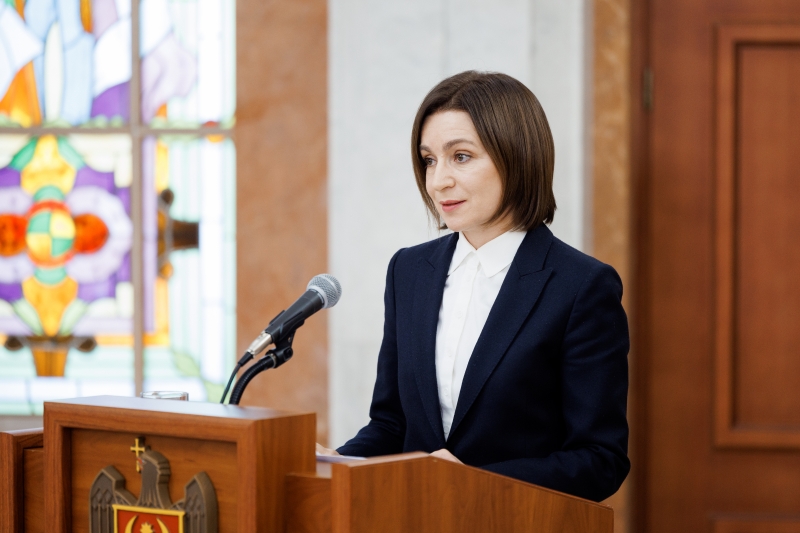
Moldovan president's message at news conference of New Year beginning
Thank you for accepting the invitation to this news conference.

Today, I want to present the Presidency’s priorities for 2026.

Based on the constitutional powers of the President, the main areas I will talk about are, obviously, the foreign policy and security. But there are other areas as well, on which, together with my colleagues, we want to focus this year.

Before moving on to priorities, we need to talk a little about the global situation, which is becoming increasingly uncertain.

As we can all see, the world around us is going through rapid and deep changes, characterized by geopolitical instability, armed conflicts, fierce strategic rivalry, and the increasingly frequent use of hybrid tools.

The world order we have been used to for decades seems to be falling apart. Internationally accepted rules, which provided a degree of stability and predictability, are no longer respected as before. Fundamental principles, such as respect for borders and sovereignty, are being called into question.

Major powers are trying to create spheres of influence and cooperation between states is weakening, making the world more uncertain and more dangerous, especially for small countries.

Moreover, new technologies and artificial intelligence are increasingly used to compromise democratic processes, sometimes by forces within the country, but especially by external forces.

In our region, but also across the continent, Russia stays a major source of destabilization. Russia’s war against Ukraine continues to be a significant security risk for Moldova.

Under these increasingly worrying conditions, I believe we must focus on two fundamental objectives:

1. To preserve peace, and

2. To remain part of the free world, of the democratic world.

There is no need to explain why it is important to preserve peace. But it is important to understand that, in addition to peace, we need freedom. Because only in a free, democratic world can we live with dignity.

Authoritarian regimes have no respect for human dignity and life. It is enough to see how the regime in Iran kills its own citizens, how the Kremlin regime imprisons innocent people, mobilizes its own citizens, as well as people from the occupied territories in Ukraine, in order to use them in its war of aggression.

We know how our grandparents suffered during the totalitarian regime. We do not want Moldovans to go through such horrors again. We want to continue to be free to decide our own fate. We want to live in a world where the rights of each citizen are respected.

Securing these two fundamental objectives – peace and freedom – will allow us to develop and ensure prosperity: economic growth, secure energy, markets for our products and therefore greater opportunities to increase our citizens’ incomes and living standards.


The first area of our activity concerns foreign policy

Foreign policy is becoming a key instrument in the new circumstances.

When international law no longer protects you sufficiently, you must be part of alliances, have good, reliable friends, who are able to come to your aid when needed.

Therefore, the foreign policy of Moldova will be oriented towards firmly anchoring our country in solid, credible, pragmatic partnerships. Partnerships with states that help each other in an increasingly hostile world.

Our most important partnership is with the EU: accession to the European Union represents the most realistic strategy for the survival and development of Moldova as part of the free world.

The window of opportunity for achieving this project is limited and must be used as a priority.

Also, the strategic relationship with Romania is a central pillar of our security, stability and development, as well as of our European path.

Bilateral and multilateral partnerships in security and defense, including with NATO, are essential for strengthening the resilience and institutional capacities of the state.

As long as Russia’s invasion of Ukraine continues, the security and resilience of Moldova depend directly on Ukraine’s resilience; firm and consistent support for Ukraine is essential. We will continue to stand by Ukraine and support it with our modest resources and with our firm voice in international fora.

Economic diplomacy is very important, especially against the background of trade wars and the challenge to the rules that have guided international trade so far.

Our priorities in the EU accession process are clear:

• On the political side: our mission is to maintain the support of all 27 member states. Given that governments change and countries’ priorities change, we will use our full diplomatic capacity to preserve the political support we enjoy today from all member states.

• The image of Moldova is more important than ever. We must prepare public opinion in each EU member state for the ratification of the accession agreements. Therefore, we will make maximum effort to promote the country through political dialogue, visibility, economic integration and cultural diplomacy.

• On the technical side: we must ensure results and credibility.

We must continue the European path, building on the results achieved last year. As you all know, last year we completed the screening; we got a positive assessment in the Enlargement Report; we opened technical negotiations on clusters 1, 2 and 6.

• The objective for 2026 is to increase the level of preparedness in all chapters.

• To strengthen credibility as a candidate state capable of delivering results, not only in 2025, but every year.

• To advance negotiations on all chapters.

• Maximum internal mobilization of: the government and responsible authorities; parliament – giving priority consideration to initiatives related to the adoption of legislation relevant to EU accession; strengthening the role of the Parliamentary Committee for European Integration.

• It is important to have constant communication with: citizens, civil society, the business community, local authorities. We must promote educational exchanges, twinning between localities of Moldova and those in member states, economic exchanges. Moldova must be known and respected in each and every member state.

Security and resilience

It is clear that, in an increasingly uncertain and volatile world, it is important to be able to protect ourselves.

To protect ourselves from external interference, similar to what we have seen in recent electoral contests.

To strengthen resilience with an emphasis on prevention, but also on rapid response to security challenges in the cyber, information or public order domains.

At the end of last year, we carried out an audit of our vulnerabilities and approved within the National Security Council an action plan to strengthen resilience. The plan provides for a string of measures in the information and cyber fields, in combating illicit financing and in ensuring public order.

The plan also involves improving the legal framework, but especially increasing the capacity of institutions (by equipping and training those responsible in these areas) and inter-institutional cooperation. Implementation of the plan will be monitored by the NSC.

In addition to the resilience plan, within the NSC we will oversee the actions of the institutions responsible for the fight against cross-border crime. I mean here the trafficking of drugs, weapons, human beings and cigarettes.


- The defense sector: here the goal is to modernize the sector, in order to increase defense capacity and to deter hostile actions against our country.

A modern, capable, well-equipped army is fundamental for our development, peace and freedom. I know there are many irresponsible politicians who, every time, try to speculate and spread fear when this subject is discussed. I want to remind them that we have a very clear constitutional provision, which reads that the defense of the Motherland is a sacred right and duty of every citizen. And it is our responsibility to do everything, so that our country is safe.

I would like to remind you that, in recent years, we have significantly increased the defense budget from 0.38% of GDP (884 million lei) in 2021 to 0.58% (1.9 billion lei or 100 million euro) in 2025. However, these resources are small compared to needs and compared to the budgets of other states. I know that each time neutral countries are mentioned, and here I want to give a few examples. While the annual defense budget of Moldova is today a little more than 100 million euro, in Austria, which is a neutral state, the budget is 5 billion euro, and in Switzerland the budget is almost 10 billion dollars. It is important to aim to reach 1% of GDP in defense spending; until then, we are compensating through resources provided by partners. And these resources are important.

In the last four years, we have benefited from support from the European Union. This support amounts to approximately 190 million; we have benefited from support on behalf of NATO – 41 million euro – and from bilateral support on behalf of more states. The partners who have supported us the most in this sector are: Germany, the USA, Romania, Poland, as well as others. whose help we greatly appreciate. I want to underline that this non-repayable assistance is a sign of trust, earned through transparency, integrity and seriousness. These resources show that we are not alone and that our security matters to Europe. And when we talk about the resources we invest in defense, we must understand that these are not expenses, but investments in the country’s peace and development.

In this period, the National Defense Strategy was also approved. The regulatory framework was adjusted to ensure control of the airspace. And the structure of the National Army was reorganized. New subdivisions have appeared, such as the electronic warfare unit, cyber defense and strategic communication.

We have purchased air defense systems, anti-drone systems and others.

Priorities for 2026 in this area:

- First of all, for full monitoring of the airspace, it is not enough to have one modern radar, we need several. In 2026, we will receive another radar purchased from EU non-reimbursable aid.

- We will continue to invest in air defense means, especially to counter drones that enter our airspace illegally. These drones threaten our homes, our economy, our peace of mind.

- We will continue to invest in modernizing infrastructure, in order to offer the best service conditions to our defenders.

- We will continue the processes of alignment with Western standards across the full spectrum of the military field.

- And we will develop new partnerships with countries that promote peace.


The next priority, which is newer on our agenda, but extremely important, concerns children’s safety

We must care about what kind of world we leave to our children, but we must also care about our children’s health.

• Today, almost every child and adolescent lives also online – and some of them even more online than offline. There are studies showing a harsh fact: teenagers who spend more than 3 hours a day on social media platforms have double the risk of symptoms of depression and anxiety. And this intensity is increasing. The night is increasingly becoming screen time. Real social life – with friends, classmates, family, with small social conflicts and the development of skills to resolve them and to have dialogue – is gradually being replaced by life on the network, inauthentic, with no physical presence, without authentic relationships.

• My message is simple: we must not blame children for the world in which they grow up. Adults shape the environment. Adults set the rules. Adults build support.

• It is imperative to put greater emphasis on the health of children and young people. We will focus on three dimensions that feed into each other: mental health in the digital era, prevention of drug use, and reduction of risk factors for children’s health.

Why is it urgent to address these problems in Moldova?

The statistics do not look good:

• In 2024, over 1,700 cases of bullying were reported, and in 2025 their number increased even further.

• In 2024, 12.7% of adolescents aged 13 to 15 used electronic cigarettes.

• In 2024, the authorities registered 14,233 children in situations of risk.

These figures represent a warning sign. And they may not show the full extent of the drama. Our children are facing violence among themselves, addictions that begin early and growing social vulnerability. If we do not act firmly now, we risk normalizing these problems and losing generations.

What the data say about digital pressure

• Phone-related anxiety. One study shows that 43 per cent of pupils in OECD countries report anxiety when the phone is not nearby, and these students score on average 9 points lower in PISA tests. This is why, digital hygiene is becoming an education and public health measure.

The drug component: we must intervene before it is too late

• Data from the European School Survey Project on Alcohol and Other Drugs (ESPAD) for Moldova show, for 2024, a 2.5-per cent lifetime cannabis use and 2.4 per cent for other illicit drugs apart from cannabis. Promotion is moving online, and the market is changing rapidly. The data shows that drugs are already a reality, and the online environment makes them more accessible, which is why early prevention must be a national priority.

The third component, physical health: the same factors also affect physical health

• The study of the European Childhood Obesity Surveillance Initiative (COSI) shows that 20.7 per cent of first grade pupils are overweight and 8.8 per cent are obese.

• In 2025, approximately 142 thousand people were registered with diabetes, of whom over 700 are children.

• Risks increase from an early age. A large percentage of children enter school already overweight or obese. This means we must focus on healthy nutrition and the promotion of outdoor activities.


What we aim to do this year: what concrete measures and campaigns do we want to support?

• We need a national programme on mental well-being in the digital era and online safety, under the aegis of the Presidency, together with the government, schools, local authorities and civil society. Together – the state, the family, the school – we must find how to increase social integration, preparation for real life and for the future of children, while limiting dependence on networks and the online world. Children need our help to navigate this world, which is different from the one we grew up in.

• We must insist on protection for minors directly in the way digital platforms are built, how algorithms are set, how harmful content is reported, how the age of those who participate or live their lives online is verified, and how functions that push compulsive use are limited. Here we must have discussions with social platforms, which is not simple for a smaller country like Moldova. But precisely for this reason, we will try to use the platforms offered by international institutions to promote these requirements.

• We must introduce digital hygiene in schools: with short, practical, repeated sessions, with a simple protocol for online incidents, with clear roles for the school and the family.

• And we must strengthen rapid access to help: a national helpline and anonymous chat for teenagers, channels of communication connected to the institutions responsible for health, education and social protection. We will put these issues up for discussion and identify solutions together with all actors interested in this important topic.


Another priority area of action is the fight against corruption and justice reform. Even if these are not direct prerogatives of the Presidency, because the fight against corruption concerns national security, we will continue to monitor, supervise and – when things do not go well – raise issues related to justice reform.

These priorities are also important, in the context of the European integration agenda. In recent years, more measures have been taken, complex and ambitious measures, some with better results, others that still require work and proof of results. But it is important that we manage to build a system that our society trusts, a system that works according to European practices and a system that ensures justice for all citizens.


The fifth dimension of our activity this year concerns the Diaspora, and I say this because the Presidency has an important role in foreign policy in promoting the interests of our citizens who live abroad, as we have done so far through negotiating and promoting bilateral agreements in various areas: social protection, recognition of driving licences and many others. We will therefore continue our work in this direction.

We are interested in contributing to the government’s effort to make it easier for our fellow citizens to return home.

We recently had a discussion and we are waiting for the government to come forward with concrete proposals on how to make the return of our fellow citizens home more friendly and attractive. I believe the government must analyze more seriously the profile of the people who continue to leave.

And we all understand that the most important thing we can do so that Moldovans no longer leave is to manage to show a critical mass of progress in all areas: health, education, the business environment, justice reform, the quality of infrastructure, because these are the things that matter to people, and only when we have sufficient progress in achieving these things, will we be able to significantly reduce the number of those who want to leave.

But there is still room to analyze and see whether there are more specific, more concrete actions, that we can take now so as to get better results and reduce the number of those leaving. Even if we understand that one of the factors driving people to leave is the uncertainty created by Russia’s war in Ukraine, which is a problem we cannot solve ourselves.


In our relationship with our fellow citizens abroad, we aim to involve them much more seriously in the effort to promote Moldova in the member states of the European Union.  A major, sustained effort is needed, so that citizens of EU member states know us, develop a liking for us, and at the right time support the decision to ratify Moldova’s accession agreements to the EU. And we believe that our communities in the member states, which have already built a very good image through honest work and the way they have integrated into those societies, can do even more to help us increase our country’s credibility in EU states.

We will also follow the government’s efforts to improve consular assistance or the consular services offered in different states.


These five areas of activity will be the most important, they will guide my work and the one of my colleagues here at the Presidency.


In conclusion,

• Today I have spoken openly about a world that is changing rapidly and about challenges we cannot ignore.

• I know that these realities can create unease. Anxiety, fear of tomorrow, uncertainty affect each of our lives.

• But my duty is to call things by their name, especially at such times.

• It is natural to ask what we can do as a society, and what each of us can do, when so much is happening in the world.

• First of all, we must remember that we are not alone. We have trustworthy partners. We pursue a balanced, predictable and responsible foreign policy.

• And we understand that we must insist with even greater determination on European integration. European integration is our safety anchor in the face of an uncertain future.

• The entire political class must understand that any deviation from this path endangers our freedom, peace and prosperity.

• We must strengthen the state from within. Institutions must become more efficient, more respectful towards people, more prudent with public money.

• But most importantly, regardless of what decisions are taken by those who are now big and powerful, we must all remain human.

• We must have the courage not to give up our values. On the contrary, we must always be guided by the values of our nation: decency, diligence, honesty and care for our neighbour. Each of us matters.

• We must do our job every day in our workplace – because only through honest work can lasting prosperity be built.

• We must pay our taxes and contributions correctly, so that we can build schools for our children and pay pensions for our grandparents.

• We must show respect to one another and not turn away from the needs of those around us.

• We must not consume more than we need: we must save energy and avoid any kind of waste.

• We must take care of our health and protect our waters and forests.

• We must focus, therefore, on what truly matters, on what is lasting, on what we leave behind.

• Let us not forget: our forebears also went through difficult times – and they endured with dignity, with their heads held high.

• With the same dignity, with the same moral compass, we too move forward.

• Let us keep our confidence without deluding ourselves, be vigilant without living in fear, and remain united around our responsibility for the common good.


Thank you!
 Facebook
 Instagram
 X/Twitter
 Telegram
Moldovan PM meets representatives of the U.S. International Development Finance Corporation, to discuss new investment opportunities
Moldova, Ukraine align efforts to strengthen resilience, reduce vulnerabilities in critical sectors
Paid internships in public service of Moldova, at new edition: 146 internship positions in 48 public authorities
Moldova, Croatia to cooperate more actively on European, economic, regional agenda
Prime Minister at panel Black Sea and Middle Corridor: Critical infrastructure - essential for regional resilience
Prime Minister in dialogue with Chairwoman of Council of Ministers of Bosnia and Herzegovina
Prime Minister: Moldova open to investment and long-term partnerships
President appointed Ion Mocanu as presidential advisor for relations with religious denominations
Speaker on State Flag Day: This symbol unites us as nation and reminds us of path we have taken toward freedom, independence and our place in world
Prime Minister attends Three Seas Initiative Summit in Dubrovnik
Flag that unites us
Moldovan president in Chernobyl says contempt for human life did not disappear from Kremlin
President Maia Sandu’s message at ceremony of commemoration of Chernobyl nuclear disaster
Moldovan president in Kyiv says security of Moldova, security of Ukraine interconnected
Moldova and Italy launch cooperation project to align national agricultural sector with European Union requirements
Moldovan Speaker to attend EU Speakers Conference
MOLDPRES INTERVIEW // Irinel Ionel Scrioșteanu: We want every district along Prut river to have own road bridge within 5–7 years
President to attend European Political Community Summit in Yerevan
Changes for shipments to USA: Moldovan Post Office announces new rules and fees for parcels with goods
Government’s message on 1 May: Citizens’ work and dedication - pillars of building European and prosperous Moldova
VIDEO, PHOTO // Young Moldovan lawyers preparing to implement European environmental standards in context of EU accession
 National Bank of Moldova
Moldovan Speaker to attend EU Speakers Conference
President to attend European Political Community Summit in Yerevan
Moldovan head of state continues dialogue on children’s safety online in Balti
Paid internships in public service of Moldova: young people invited to apply for edition 6.1 of programme
VIDEO // Prime Minister at National Forum of Labour Market and Social Dialogue

PHOTO // Republic of Moldova celebrates International Workers’ Day, between tradition, social rights and relaxation
SIS Director reveals details on Alexandru Bălan’s espionage activities
EXCLUSIVE // Moldova's People's Artist, composer conductor marks 75th birthday anniversary
Writers from Moldova, Romania call for turning idea of unification into national priority
BTA: 45 Years since First Bulgarian Ascent of Eight-Thousander: Himalaya's Lhotse
Integrity assessment at Moldova's Anticorruption Prosecutor’s Office: two prosecutors pass, two fail test
Head of Moldova's National Integrity Authority reports in parliament: irregularities worth tens of millions of lei detected in 2025
Former president of European Council encourages Moldova on path to EU
Moldovan head of state continues dialogue on children’s safety online in Balti
Moldovan parliament expands foreign relations: friendship groups with United Arab Emirates, Saudi Arabia created
Paid internships in public service of Moldova: young people invited to apply for edition 6.1 of programme
Largest energy storage system of Moldova launched in Radeni; Energy minister says investment promises competitive prices for consumers
Moldovan parliament speaker comments on detection of drones on country’s territory
Moldovan parliament speaker says removing tax, legislative discrepancies between two banks of Dniester River to bring concrete benefits for citizens
VIDEO // Prime Minister at National Forum of Labour Market and Social Dialogue
Japan’s Minister for Internal Affairs to pay visit to Moldova
Receive the latest news directly to your email

Receive the latest news directly to your email