
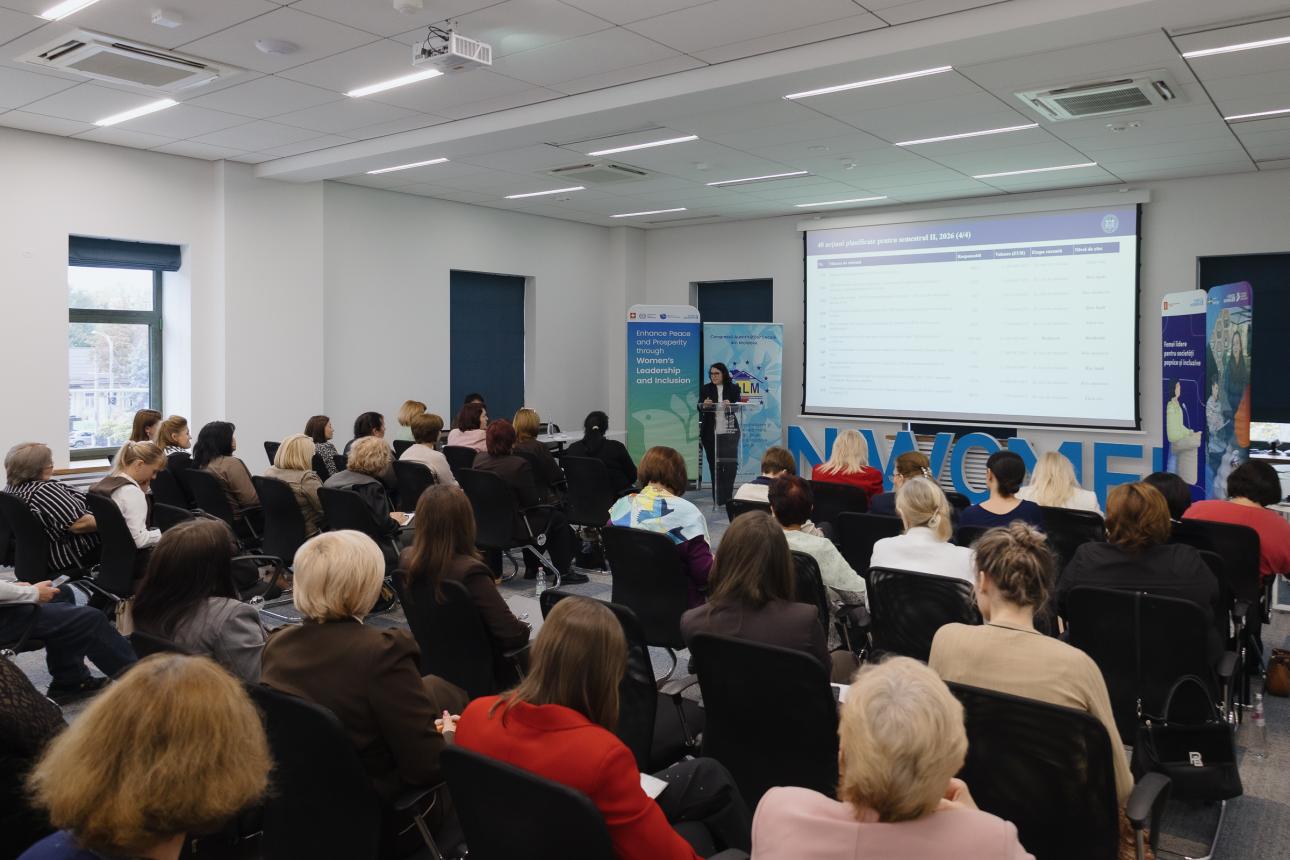
Moldovan government's deputy secretary general says Moldova’s European path runs through country's villages, benefits of reforms must be felt locally
Deputy Secretary General of the Government Lilia Dabija today participated in the event titled, Moldova’s Reform Agenda: Cooperation between Central Authorities and the CALM Women Mayors’ Network, held under the auspices of UN Women, with the participation of representatives of local public administrations.

During the meeting, Lilia Dabija presented the progress made in implementing the Reform Agenda related to Moldova’s Growth Plan for 2025–2027, the mechanisms for monitoring the commitments undertaken and the main investment projects supported by the European Union.

“Our European path runs through Moldova’s villages. Economic growth, which forms the foundation of the Reform Agenda, must be felt, first and foremost, at the local level. The ultimate beneficiaries of this support are the citizens of Moldova,” Lilia Dabija stressed. She highlighted the need for close communication between central and local authorities.

The deputy secretary general of the government noted that the 1.9 billion-euros-worth Growth Plan represented the largest financial support package offered to Moldova by the European Union. The Reform Agenda includes 56 reforms and 153 actions, structured around seven pillars targeting economic development, infrastructure, social capital, the green transition, energy security and the strengthening of democratic institutions.

According to the data presented, 46 of the 48 actions planned for 2025 and the first half of 2026 have been completed, representing an implementation rate of 95 per cent. At the same time, by October 2026, the European Union had disbursed 660.8 million euros under the Reform and Growth Facility.

Particular emphasis was placed on turning European support into concrete investments for communities, including the modernization of roads, educational institutions and medical infrastructure; expanding access to water and sewage systems; developing agriculture and improving energy efficiency.

Lilia Dabija highlighted the importance of involving local public authorities in the implementation and monitoring of reforms. In the context, she reiterated the need to integrate gender equality principles and proposed organizing regular consultations with representatives of local public administrations at least once every six months.

“It is important to maintain a constant dialogue, listen to the constructive proposals of local authorities and make use of this experience when preparing the next Reform Agenda,” the deputy secretary general of the government emphasized.

The event served as a platform for dialogue between the central public administration and women mayors from Moldova, contributing to stronger institutional cooperation and promoting inclusive implementation of European reforms focused on achieving concrete results for citizens.
 Facebook
 Instagram
 X/Twitter
 Telegram
Moldovans working in Ireland to benefit from pensions and social benefits
Moldovan Prime Minister held phone conversation with Romanian counterpart
Implementation of Growth Plan for Moldova discussed with civil society, business community
PM has meeting with China's Ambassador to Moldova
Parliament speaker meets Ambassador of China to Moldova
Meeting between Deputy Prime Minister for Reintegration and delegation of ambassadors of Weimar format member states to OSCE
PM visits factories in two settlements of Moldova
Moldovan president attends National Forum of Ethnic Minorities
Moldovan PM visits Chisinau Electrical Substation, in final preparation stage
Moldovan PM, Ambassador of State of Qatar discuss investments, expanding bilateral economic cooperation
Moldovan parliament speaker in Rome has meetings with counterparts from Norway, Lithuania, Armenia
Moldovan parliament's secretary general participates in meeting of secretaries general of parliaments of Council of Europe member states
Speaker held talks with counterparts from Italy, France and Türkiye
Moldovan PM attends event on launch of Moldova AI Hub
Moldova's parliament speaker calls on Moldovan, Ukrainian border authorities to find solutions to prevent incidents on Dniester
Moldovan foreign affairs minister meets Argentina’s Ambassador
Moldovan parliament speaker announces solutions to protect personal data, control payments after journalistic investigation into taxi platform
Speaker after Constitutional Court’s decision in von Hebel case: We will amend law where necessary
 National Bank of Moldova

Moldovan president to visit Hungary
Adopted by parliament: taxi platforms to be required to process payments through financial institutions licenced in Moldova
Access to cadastral information extended to more categories of individuals, institutions in Moldova
Persons with disabilities since childhood to be able to combine disability, survivor’s pensions; Moldovan parliament adopts relevant draft
Works for modernization of district heating systems from Chisinau, Balti declared to be of national public interest

Moldovan parliament speaker announces solutions to protect personal data, control payments after journalistic investigation into taxi platform
Speaker after Constitutional Court’s decision in von Hebel case: We will amend law where necessary
Environmental impact, energy efficiency made mandatory when purchasing vehicles with public funds in Moldova
Grant to strengthen cybersecurity: Republic of Moldova to receive $1.2 million in U.S. support
Parliament ratifies Agreement between Moldova and Denmark on gainful employment of family members of diplomatic staff
PHOTO GALLERY // Moldova to receive $1.2 million U.S. grant to strengthen cybersecurity
Clear rules for traffic organization, public transport development and establishment of paid parking
Voted in first reading // More enterprises could benefit from SME support programs
Prime Minister meets with IMF Mission visiting Chișinău
Students in grades 9–11 can receive fully funded scholarship for one year of high school in United States
More opportunities for small and medium-sized enterprises
Energy Minister at Energy Transition Agenda Conference: Moldova’s energy future is European, and regional integration path through which we can build it more quickly and efficiently
Four vocational schools and a college in Southern Moldova to receive over €12 million for modernization
EU Ambassador on support for Moldova: Reforms necessary, investments must be monitored
American investments on agenda of discussions between U.S. officials and Moldovan leadership
European Union Ambassador to Moldova says gradual integration into EU can bring additional benefits to country before accession
Receive the latest news directly to your email

Receive the latest news directly to your email