
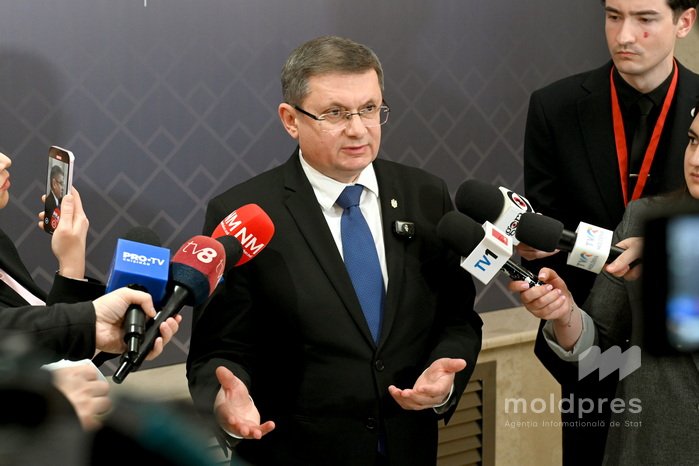
Speaker: Venice Commission’s recommendations on evaluation of judges to be examined and integrated into draft law
Chisinau authorities will analyze the recommendations issued by the Venice Commission in its opinion on the external evaluation of judges and will integrate them into a draft law wherever they are relevant. Speaker Igor Grosu made the  statement.

He emphasized that the Venice Commission’s opinion does not oppose the political decision to extend the process of external evaluation in the judicial system, but contains recommendations related to the safeguards granted to judges and to the exceptional nature of this measure.

“I have not seen that the Venice Commission is against the political decision of a state regarding the external evaluation or non-evaluation of judges. The Commission has certain recommendations regarding safeguards for judges and the extraordinary character of this process. These are recommendations that we must examine and take into account,” Grosu said.

According to him, the comments made by European experts will be examined, and the relevant provisions will be included in the final text of the law.

“We will review the recommendations; obviously we will analyze all of them, and those that are relevant we will incorporate into the draft law, as we have done before,” he said.

Grosu reiterated that the authorities’ objective is for all judges to be subject to the same evaluation standards.

“I find it fair that all judges are placed in equal conditions. If the judges from the Courts of Appeal, the Superior Council of Magistracy, the Superior Council of Prosecutors and the Supreme Court of Justice have gone through this exercise, then we cannot speak about exceptions. We aim for equal conditions for all judges,” Grosu affirmed.

Asked about warnings by some experts that the evaluation might lead to the departure of some magistrates from the system, the head of the Legislature dismissed these concerns.

“I have heard such forecasts before, that everyone will leave and the system will be left without judges. Those who have carried out their duties correctly and have nothing to hide will continue to work in the system. At the same time, we will encourage young graduates of the National Institute of Justice to join the system,” Grosu declared.

He noted that the decision to continue the external evaluation of all judges was also driven by problems identified in the functioning of the judicial system. According to Grosu, some controversial decisions are issued in first-instance courts, are subsequently challenged before already evaluated courts, and are sent back for reconsideration, which generates delays and affects the efficiency of the act of justice.

“Analyses have shown that we must continue this evaluation, and we have assumed this politically,” Igor Grosu concluded.

The Venice Commission has taken a position on the Justice Ministry’s intention to strengthen the mechanism for verifying the integrity of judges. The Commission clarified that “the initiative is compatible with European standards” and recommended a number of normative improvements. According to the Ministry of Justice, by requesting the Venice Commission’s opinion, the institution ensured an independent assessment of the initiative.

“The Ministry’s concept aims to establish a mixed mechanism for verifying the integrity of judges, which combines internal evaluation, carried out by the Board for the Evaluation and Selection of Judges, with external evaluation conducted by the Commission for the Evaluation of Judges. Through this initiative, the Ministry has sought to strengthen public trust in the judicial system and to develop a coherent framework for integrity verification at the level of the self-governing bodies of the judicial authority,” the institution announced.

The Commission also notes that certain elements can be improved to enhance the predictability, transparency and protection of the rights of the evaluated judges.
 Facebook
 Instagram
 X/Twitter
 Telegram
VIDEO // European Commissioner: This is extremely important day for EU enlargement
Prime Minister after last night’s attack on Kyiv: Republic of Moldova firmly stands with Ukraine
Speaker: Images of fire on roof of Kyiv Pechersk Lavra painful for all those who respect faith, culture, memory, and European heritage
President condemns attack on Kyiv Pechersk Lavra
Meeting in Luxembourg. Moldova officially begins EU accession negotiations
Republic of Moldova in spotlight of Council of Europe
Igor Grosu re-elected PAS president for new four-year term
Moldova inaugurated honorary consulate in Denmark
Prime Minister: Memory of deported obliges us to build society in which such tragedies never again possible
Head of State’s message on 85 years since deportations
Ambassador of Moldova to China: Cooperation with Guangdong Province can open new economic and investment opportunities
About 790 mayoralties involved in voluntary amalgamation process in Moldova
Moldovan government approves launch of negotiations with Tunisia on abolishing visa regime for holders of diplomatic, service, special passports
Moldovan parliament speaker urges local authorities to take urgent measures against floods
Labour minister says leadership wants Moldova with active, involved older people
Moldovan parliament speaker says human factor behind incident that led to death of National Army soldier
Speaker: Venice Commission’s recommendations on evaluation of judges to be examined and integrated into draft law
Parliament introduces new rules on minimum wage assessment and adjustment
EUROPEAN VILLAGE // Dumitru Blajinu House of Culture in Pererita renovated with Government support
Speaker to mayors involved in voluntary amalgamation process: We are building stronger and more European Moldova
DescOperă Festival starts at Orheiul Vechi on June 18: four evenings of classical music, opera, open-air performances
 National Bank of Moldova
Meeting between Deputy Prime Minister for Reintegration and Director of Konrad Adenauer Stiftung Office in Moldova
Moldovan PM has talks with delegation of Monitoring Committee of Parliamentary Assembly of Council of Europe
President to participate in Moldova – EU Summit in Brussels
New measures to prevent phone fraud: SIM cards can only be activated with identity document
First forest inventory in country’s history – Republic of Moldova launches national forest inventory process

Electoral authorities from Moldova, Ukraine, Albania and North Macedonia sign Memorandum to strengthen democratic resilience and European cooperation
DOC // Moldovans working in Ukraine to be eligible for pensions and other social benefits
Moldovan, Polish officials discussed next steps for Moldova on path to EU accession
DOC // Moldovan citizens who worked legally in Canada to be eligible for social benefits
Ludmila Catlabuga on farmers’ protests: They have every right to protest and I will stand by them
VIDEO // Expert says Russia massively collecting personal data, to be used in scam schemes
Books from Moldova at Beijing International Book Fair; Moldovan ambassador to China says event opportunity for Chinese public to discover cultural identity of Moldova
Moldovan MPs convene at plenary meeting on June 18; 16 draft laws on agenda, of which five marked with EU logo
Moldovan deputy PM for reintegration says government to vigorously promote process of country's reintegration
Moldovan PM has talks with delegation of Monitoring Committee of Parliamentary Assembly of Council of Europe
PHOTO GALLERY // Moldovan government returns to domestic agenda after opening of negotiations with European Union
Moldovan president conveys message on 100th anniversary of birth of country's well-known physicist
Payment service providers to be required to inform consumers about applied fees
Simpler procedures for installing photovoltaic panels and storage systems
Moldova to join two international maritime conventions
Republic of Moldova approves legal framework for coordinating social security systems with EU member states
Receive the latest news directly to your email

Receive the latest news directly to your email