
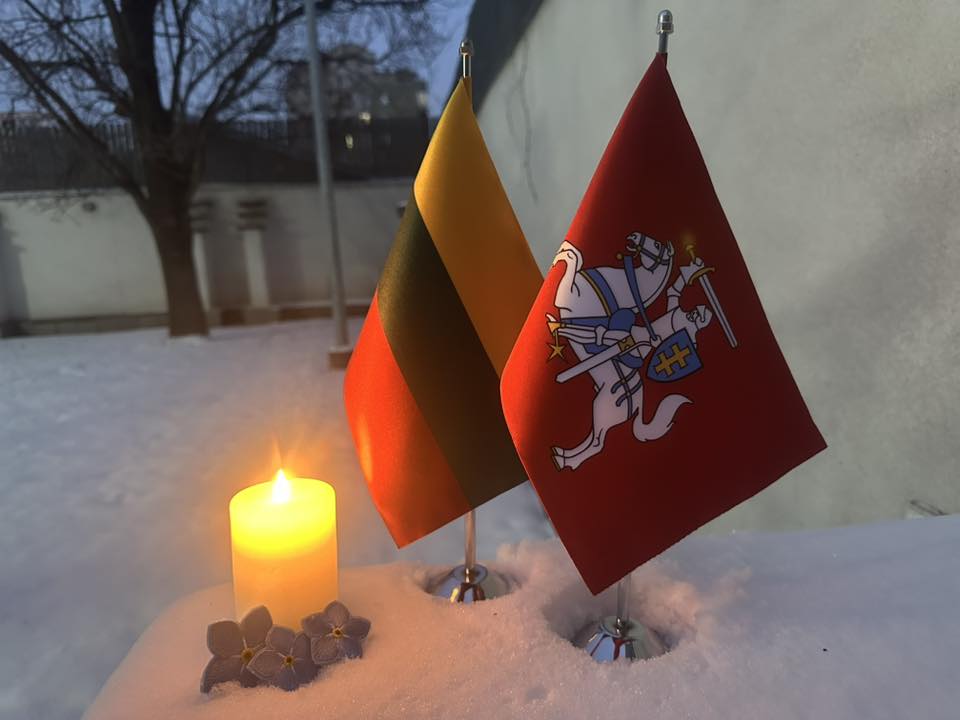
Lithuania marks 35 years since defending right to decide its future
Lithuania is commemorating 35 years since the dramatic events of 13 January 1991, the day when unarmed civilians faced Soviet tanks to defend their freedom and their right to decide their own future. On this occasion, the symbolic “flame of freedom” was lit at the Embassy of Lithuania in Chisinau, as a tribute to the victims and to the courage of the Lithuanian people. Lithuania is now a member state of the European Union, and that winter night forever changed the course of its history.
In a message sent by the Embassy of Lithuania, the deep meaning of the 1991 sacrifice is highlighted:
“The courage of the Defenders of Freedom became a source of inspiration — an inner flame that reminds us that freedom is not a guaranteed given. It is a constant commitment to cherish and defend the opportunities it offers.”
On the night of 13 January 1991, thousands of Lithuanian citizens took to streets to defend state institutions. Fourteen people lost their lives at the Vilnius TV Tower, and hundreds were injured. The spirit of the people could not be broken. People formed human shields, defended the parliament and proved that unity and courage can be stronger than violence.
Vytautas Landsbergis, who at that time was Chairman of the Supreme Council and a central figure in Lithuania’s independence movement, remained in the Parliament building throughout the siege. He later emphasized that the resistance on 13 January was, above all, a decision made by the people, not by politicians.
“13 January remains a powerful reminder of who we are, of the values we fight for, and of why freedom must never be taken for granted. Freedom lives as long as we protect it, cherish it, and pass it on to future generations,” the message of the Lithuanian Embassy also reads.
Annexed to the USSR in 1944, Lithuania was the first union republic to break away from the Soviet empire. On 11 March 1990, after the victory of the Sąjūdis movement in the elections to the Supreme Soviet, Lithuania proclaimed its independence. The Soviet Union tried to suppress the secession through an economic blockade and military interventions, culminating in the attacks of January 1991. Lithuania’s independence was widely recognized after the failure of the coup in Moscow, and the country joined the UN on 17 September 1991.
Lithuania became a member of NATO and the European Union in the spring of 2004.
Moldova was the first state in the world to recognize Lithuania’s independence, on 31 May 1990 — a historic gesture of political courage and solidarity, made even before Moldova proclaimed its own independence. The diplomatic relations between the two states were established on 8 July 1992.
Today, Lithuania is a strong supporter of Moldova’s European path. The bilateral cooperation includes trade exchanges, development assistance — Moldova being among Lithuania’s seven priority states — as well as cultural and community ties. The Moldovan Diaspora in Lithuania is represented by the “Dacia” society, founded in 1989, and more Lithuanian ethnocultural organizations are active in Moldova.
On 16 February, Lithuania celebrates its National Day, a moment of profound historical significance. On this date in 1918, the Council of Lithuania signed the Declaration of Independence, known as the Act of 16 February, through which the restoration of an independent Lithuanian state, founded on democratic principles with its capital in Vilnius, was proclaimed.

 Facebook
 Instagram
 X/Twitter
 Telegram
Austria’s support for Moldova’s European path discussed in Vienna
Moldovan MP says Action and Solidarity Party proposes gradual elimination of tax exemptions for Transnistrian region, creation of convergence fund starting from 2026
VIDEO // Deputy PM for reintegration at negotiations in Tiraspol says country's clear goal reintegration of Transnistrian region into legal space of Moldova
Deputy Prime Minister: Solid partnership between Council of Europe and OSCE enables common and effective response to current challenges
Parliament approved resignation of member of Prosecutor Evaluation Commission
Reintegration of Transnistrian region: speaker about negotiations and Parliament’s plan for convergence fund
Labour and Social Protection Minister expected in Parliament as opposition files simple motion
Mandate of President of Competition Council Plenum ends as of 1 March
Parliament adopts Declaration - four years after Russia’s invasion of Ukraine
Moment of silence in Parliament. MPs honored memory of those who died in armed conflict on Dniester River
Political analyst says consequences of peace agreement could be positive or risky for Moldova
VIDEO // Moldovan government proposes new law due to give citizens more rights in decision‑making process
Moldovan parliament to hold plenary meeting on February 26; interior minister to present report to MPs
Moldovan foreign affairs minister has talks with UN High Commissioner for Human Rights
War in Iran shakes energy markets: Will Moldovans pay more for gas and fuel?
Moldovan Food Safety Agency adjusts control regime for milk imports from Ukraine: reinforced monitoring remains in place only for bulk products
Moldovan–British cooperation discussed in parliament during official visit
Moldovan government seeks balanced solutions to fuel crisis; cabinet's solution economic stability
Moldovan–Japanese agricultural partnership continues: JICA prepares new financing line for Moldovan farmers
Moldovan Ambassador to Israel: Over 15,000 Moldovans in Israel, but only small number request consular assistance
PHOTO // Moldovan wines conquer London: prestigious tasting strengthens presence on UK market
 National Bank of Moldova
Moldovan president participates in national scientific conference on culture of memory
PM meets Head of Norwegian Embassy's Office in Chisinau
Moldovan deputy PM for reintegration participates in events of commemoration for heroes dead at Transnistria War
Moldovan PM says peace fragile, all share responsibility to protect it
President - 34 years after war on Dniester: In the name of those who fell and fought, we commit to keeping the flame of freedom alive. Every day

Conflicts in Middle East: Foreign Ministry has not received requests for assistance from citizens of the Republic of Moldova
Over 2,300 digital medical certificates issued on very first day after launch
VIDEO // Republic of Moldova marks four years since submitting application for European Union membership
Over 95% of newborns in Moldova tested free of charge for hearing loss detection
PHOTO // Stories of sacrifice: files on fallen heroes of Dniester War preserved at Ștefan cel Mare Academy of Ministry of Internal Affairs
Moldovan president participates in national scientific conference on culture of memory
VIDEO // Discover Moldova with #MOLDPRES: cultural tourism, art of eggs' decorating in authentic experience at Aievea – handicraft house in Ciniseuti
Moldovan-Romanian bilateral cooperation strengthened through new diplomatic mandate: Ambassador of Moldova presented copies of accreditation letters in Bucharest
PM meets Head of Norwegian Embassy's Office in Chisinau
Moldovan deputy PM for reintegration participates in events of commemoration for heroes dead at Transnistria War
Moldova’s agricultural sector grows: total output up by almost 14 per cent in 2025
Road, railway, logistics projects discussed with delegation of Greece in Chisinau
IMF confirms reliability of National Bank of Moldova, effectiveness of its monetary policies
PHOTO GALLERY // Day of Remembrance and Gratitude through the lens of MOLDPRES: tribute to heroes who died for Moldova's Independence
Parliament speaker warns people who defy authorities of Moldova may lose citizenship
Moldovan PM says peace fragile, all share responsibility to protect it
Receive the latest news directly to your email

Receive the latest news directly to your email