
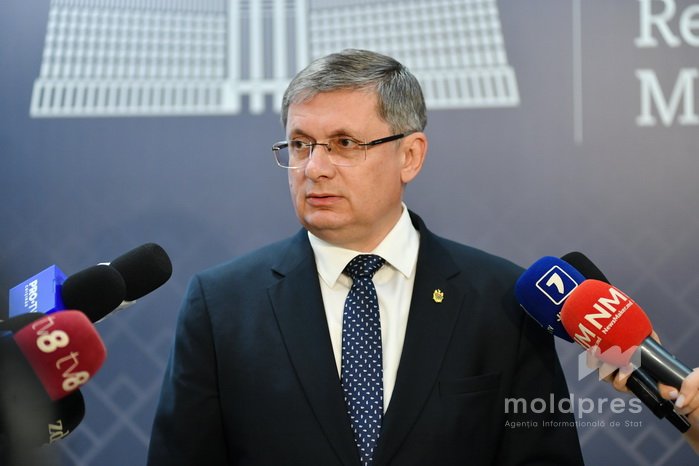
Moldovan parliament speaker, after Putin’s decree, says Russia wants to make up for losses on front
Parliament Speaker Igor Grosu has criticized the decision of the Russian Federation to facilitate the granting of Russian citizenship to residents of the Transnistrian region. He said that Moscow was trying to cover the shortage of manpower for the war in Ukraine and to send an electoral message ahead of the elections announced in Russia. Igor Grosu issued a call to citizens of the Transnistrian region not to allow themselves to be manipulated.

“The decision of the Russian Federation? They are in a massive manpower crisis and I am addressing our citizens on the left bank of Dniester: do not let yourselves be lured and deceived by a dictator. He has nothing to do with you. He simply wants to make up for what he lacks on the front. You can see how many losses there are and how many wounded the hospitals in Russia are taking in. Plus, it is also an electoral move, in the context of the so‑called elections that will take place on the left bank of the Dniester and in Russia in next autumn,” Igor Grosu said.

Asked whether the decree signed by Vladimir Putin could represent a pretext for a possible military intervention, Igor Grosu rejected this hypothesis.

“No, I don’t think so. Again, that law under which they intervened on behalf of some citizens in Russia already existed before. It is more of a message to supporters, for domestic consumption, because nothing else can help them,” the speaker noted.

At the same time, the parliament speaker mocked statements by Russian diplomacy regarding the allegedly high interest in Russian citizenship in the Transnistrian region.

“There is a queue, but no one sees it. Fairy tales about dragons. Obviously, everyone who thinks critically is looking toward the European Union and toward Moldova, not toward war and the Russian Federation,” Grosu said.

Igor Grosu also rejected claims that the simplified procedure for getting  documents for residents of the Transnistrian region would represent a threat to the national security of Moldova. The official described as false the statements of the Tiraspol leader, according to which about 10,000 residents of the region supposedly cannot obtain Moldovan documents.

“The vast majority of our citizens on the left bank of Dniester are documented, they have ID cards and passports. Some even have Romanian, Bulgarian and Russian documents,” Igor Grosu said.

The statements come after Russian Foreign Ministry’s spokesperson Maria Zakharova warned that any “aggression” against Russian citizens of Transnistria would receive “a prompt and adequate response” on behalf of the Russian Federation.

Commenting on the decree recently signed by Vladimir Putin on facilitating the granting of Russian citizenship to residents of the Transnistrian region, Maria Zakharova claimed that the measure was taken in response to requests from the region’s population and to alleged “pressure” exerted by Moldova and Ukraine on Tiraspol.

President Maia Sandu said that the measure was part of Moscow’s tactics to put pressure on Chisinau and suggested that Russia may need more people for the war in Ukraine.

“The Kremlin regime does not value human life and we have seen this, including in relation to its own citizens. We know that Russia is trying to attract people from other countries to fight in Ukraine, but citizens on the left bank of Dniester do not want this. At the beginning of the war, many young people from there moved to the right bank of the Dniester, under the control of the constitutional authorities, precisely because they were afraid that Russia would send them to war. They do not want to be sent into a brutal war. Everyone wants to live in peace,” Maia Sandu said.

Maia Sandu specified that the Transnistrian region continued to represent a security problem for Moldova, given that Russia is illegally maintaining its troops on the country’s territory. The head of state stressed that the withdrawal of Russian soldiers was in the interest of Moldova, Ukraine and the European Union. The president expressed hope that there would be a geopolitical opportunity for the peaceful settlement of the conflict on the left bank of Dniester, reiterating the commitment of the Moldovan authorities to maintaining stability and security in the region.
 Facebook
 Instagram
 X/Twitter
 Telegram
New local elections. Over 10,400 citizens voted by 12:00
Citizens expected at polls to participate in new local elections and local referendums
President of Estonia after meeting with Moldovan President: Moldova belongs to Europe. We greatly appreciate your progress on this path
DOC // Russia intends to grant citizenship to residents of Transnistrian region
PHOTO, VIDEO // Head of State welcomed by Estonian President in Tallinn
VIDEO // Citizens’ Assembly on local public administration reform held in Chișinău
PHOTO GALLERY // Chisinau, capital of European diplomacy: images from Council of Europe's meeting
LIVE VIDEO, TEXT // Ministerial Session of Committee of Ministers of Council of Europe opened in Chișinău
Moldovan, Czech foreign affairs ministers discuss cooperation, support for Moldova's European agenda in Chisinau
Moldovan foreign affairs minister, Monaco's diplomacy head discuss bilateral cooperation, Council of Europe's priorities
VIDEO // Deputy PM comments on Moldova holding presidency of Council of Europe's Committee of Ministers
Secretary General of Council of Europe: “In a time of geopolitical tensions, Europe needs responsibility and accountability”
Monaco assumes presidency of Committee of Ministers of Council of Europe for the first time
PHOTO // Moldova signs new legal instruments of Council of Europe
Moldovan foreign affairs minister has meeting with Chinese counterpart; facilitating access of domestic products to Chinese market on agenda
EU accession negotiations could be opened in next June; parliament speaker says Moldova, Ukraine deserve this step
Moldovan parliament speaker, after Putin’s decree, says Russia wants to make up for losses on front
VIDEO // Opposition walks out session hall at today's parliament meeting; Moldovan parliament speaker says not to tolerate insults, degrading behavior
Moldovan parliament speaker rejects accusations by Tiraspol separatist regime on alleged interference with “so-called presidential elections”
Moldovan parliament speaker says agreement with IMF important indicator for international partners
Meteorologists issue Yellow Code warning for atmospheric instability in Moldova
 National Bank of Moldova
Participation of Deputy Prime Minister for Reintegration in OSCE Permanent Council Meeting
Prime Minister at anniversary of National Confederation of Employers
Moldova, IMF reach agreement on new three-year cooperation programme
Moldovan president on working visit to the Netherlands: deepening bilateral partnership, support for EU accession
Projects implemented with support of European Investment Bank evaluated during meeting at government

DOC // Activity of zoos to be regulated by new law
DOC // Particip.gov.md platform to be modernized to ensure easier access to information on draft decisions proposed by authorities
BITEI Festival 2026 opens in Chisinau; event's programme
Adopted in final reading: From 1 June, day laborers to be registered electronically
Wheat export requirements from Moldova to Indonesia to be amended starting 1 June
Parliament simplifies financial reporting for enterprises
VIDEO // CSP approved three interim appointments to leadership positions within Prosecutor’s Office
Moldova's ambassador to Kazakhstan presented copies of letters of credence
Prime Minister on World Day for Cultural Diversity: Only through unity, dialogue and mutual understanding can we build European, modern and united Moldova
President at Globsec Forum in Prague
DOC // Condominiums to face new administration and voting rules
Orthodox Christians celebrate Ascension of the Lord
Two bomb alerts in single night at Chișinău Airport
Moldovan energy minister demands compliance with completion deadline for works at Chisinau Electric Substation
IMF says new programme with Moldova to help advance reforms aimed at backing more sustainable economic growth
Tourism integrated into state’s economic policies in Moldova; sector moves to Economic Development and Digitalization Ministry
Receive the latest news directly to your email

Receive the latest news directly to your email