
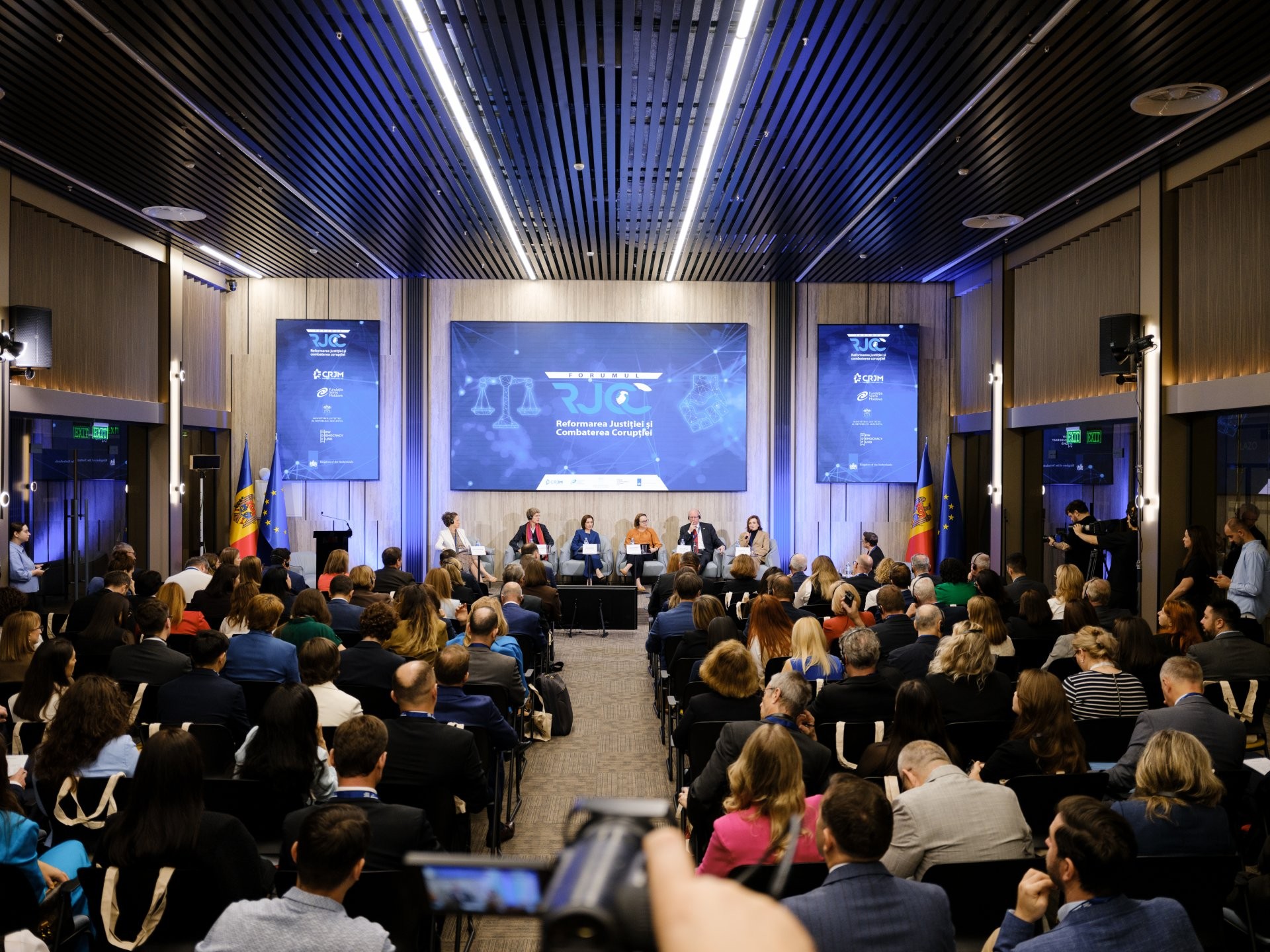
President at Forum on justice reform and fighting corruption: Building rule of law most complicated commitment in EU accession program
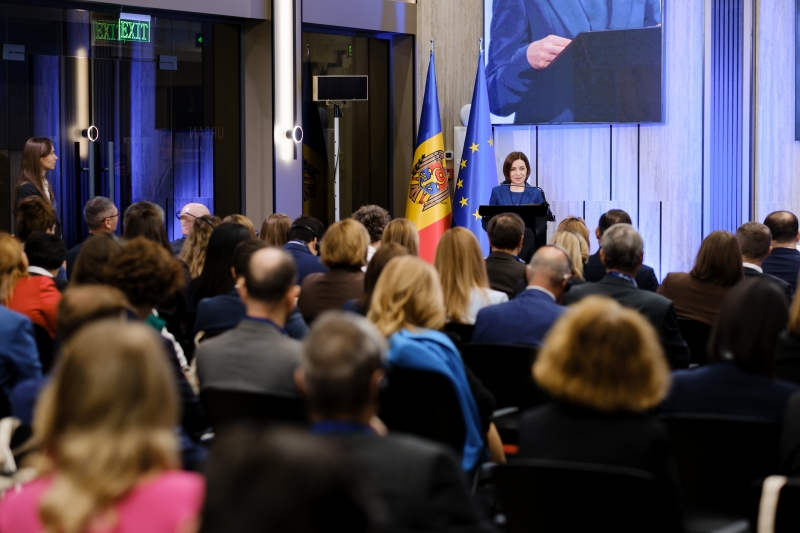
Justice reform, external evaluation of judges and prosecutors and consolidation of the rule of law were the main topics addressed by President of the Republic of Moldova Maia Sandu in her speech delivered today at the opening of the eighth edition of the Justice Reform and Fighting Corruption Forum. The head of state spoke about developments in the system since 2019, the difficulties of the reform process, and the Republic of Moldova’s commitments on its European path.

Maia Sandu recalled that she attended the first edition of the forum in 2019 as prime minister and described the state of the justice system at that time.


“We were at a time when Moldova had just freed itself from the oligarchic regime, a regime that, in addition to many other institutions, had held the justice system captive for many years. At that time, the justice system was known mainly for having illegally annulled the results of the 2018 Chișinău elections, for having stood by indifferently or helplessly as the largest corruption and money-laundering schemes in the history of this country unfolded, and for the fact that some representatives even protected corrupt groups. In short, injustice was in charge, while citizens’ trust in the justice system was negligible,” the president stated.


The head of state said that in 2019 she hoped that removing political control over the justice system would, on its own, lead to the transformation of the system and the promotion of people of integrity.


“I remember that at the time I called on people in the system who had issued illegal and abusive decisions to leave voluntarily. I hoped that once it was removed from the control of corrupt politicians, the justice system would rid itself of harmful practices, cleanse itself, and bring forward people of integrity and value. I hoped in vain; things did not happen on their own,” Maia Sandu said.


In this context, the president explained that in 2021 she declared corruption a major threat to state security and discussions were launched on the external integrity evaluation of the judicial system.


“So, two years later, in 2021, I declared corruption a major threat to state security and began discussions on external evaluation as the main element for eliminating corruption from the justice system. This was followed by a lengthy consultation process with the Venice Commission and European institutions, which found it difficult to imagine that there could be corruption within the justice system and had difficulty understanding why external intervention was necessary when self-governing institutions existed,” the head of state said.


According to Maia Sandu, the external evaluation process was difficult within the system as well, including because of reservations about external intervention.


“It was, and still is, a difficult process internally because, even though many honest people in the system whom I spoke with at the time acknowledged that they could not change things from within, the prospect of an external evaluation was not welcomed enthusiastically even by them—not even by them,” the president noted.


Maia Sandu said that the external evaluation of judges and prosecutors had been ongoing for several years and had not yet been completed. She noted that the process had advanced further in the case of judges, while the evaluation of prosecutors was facing greater delays.


“The external evaluation has already been underway for several years, much longer than we would have wanted, and we are still not at the end. We have made more progress in evaluating judges and are facing a greater delay in evaluating prosecutors. We have all seen that vetting is not perfect, but there is no better process,” Maia Sandu said.


The president acknowledged that the reform process was creating difficulties for the functioning of the system, including by increasing the number of vacant positions and the workload of employees who remained in office.


“We make mistakes, we learn, we amend laws and procedures, and we move forward. Because of the reform, we have many vacant positions, as some representatives of the system do not want to undergo this evaluation, while others fail to prove their integrity. This increases the workload of the people who have remained in the system. That is why we are carrying out the reform gradually, so as to ensure that the system remains functional,” the head of state explained.


She also drew attention to delays in reforming the National Institute of Justice, the institution responsible for training future judges and prosecutors.


“We must acknowledge that we delayed the reform of the National Institute of Justice, which we truly began only a year ago, if I am not mistaken. If we had done it earlier, we would have more well-trained and honest young people today who could join the system and replace those who are leaving,” Maia Sandu said.


The president noted that, despite the difficulties, the first results of the reforms could be seen in the justice system. She referred to the renewal of the Superior Council of Magistracy and the Superior Council of Prosecutors, as well as their respective colleges, following the integrity evaluation of their members.


“But despite all the frustrations, complications, and delays, I believe we can say that we are seeing the first results of our joint efforts. The SCM and the SCP have been renewed after their members passed the integrity test, as have the colleges. The reform of the Supreme Court of Justice is underway,” the head of state said.


Maia Sandu addressed people who wished to become members of the Supreme Court of Justice but were waiting for the completion of the external evaluation.


“I have a message for these people: do not wait; submit your applications for evaluation now. It would not be fair to have a Supreme Court of Justice in which some members have passed the integrity test and others have not. So I confirm that the evaluation will continue until the last member of the Supreme Court of Justice is appointed,” Maia Sandu stated.


According to the president, a significant number of judges and prosecutors who had been mentioned over time in investigative reports were no longer active in the system.


“Even though the external evaluation has not yet been completed, we can see that many of the judges and prosecutors who, over time, were frequent subjects of investigative articles are no longer in the system today,” the head of state said.


In her speech, Maia Sandu spoke about amending legislation to facilitate the examination of cases and limit situations in which criminal proceedings are affected by the expiry of limitation periods.


“We have also managed to significantly improve the legislation. It has been simplified so that cases can be examined without delay. The method of calculating the limitation period was amended in order to limit abuses through which many offenders were released. The possibility of recovering assets and money was introduced, and we have achieved some results in this regard,” the president said.


The head of state argued that the work of law-enforcement institutions had produced results in recent years, including through an increase in the number of high-level corruption cases being handled.


“As a result, I believe we are seeing concrete results: an increase in the number of major corruption cases that are finally being investigated. We are seeing many hearings and concrete plans,” Maia Sandu noted.


At the same time, she stressed that the system continued to face a large backlog of cases and that solutions were needed to reduce it.


“There is still a great deal of work to be done because many cases accumulated in the past are still awaiting examination. We know that this workload is very heavy for people who work honestly. We are looking for solutions, but we must acknowledge that we have reached this situation because of the things we failed to do properly in the justice system in the past,” the president said.


Maia Sandu noted that the National Institute of Justice played an important role in training new generations of professionals and attracting law-school graduates to the system.


“I have already mentioned the efforts being made to train judges and prosecutors at the National Institute of Justice, to attract the best graduates from law schools, and to train them properly,” the head of state said.


She added that integrity standards had been introduced at the institution for trainees, trainers, and examination committees.


“Integrity standards have been introduced here for trainees, trainers, and examination committees, and I have high hopes for the efforts being made by the National Institute of Justice together with other institutions to prepare new generations of prosecutors and judges,” Maia Sandu stated.


The president said that Moldova’s justice system had evolved compared with 2019, also pointing to changes in citizens’ trust in the justice system.


“I want to say that today we can confidently state that the justice system, with all its problems, looks much better today than it did in 2019, when we discussed these matters at the first edition of this forum. This is also confirmed by opinion polls. People’s trust in the justice system is growing, even though they wanted things to change much faster,” Maia Sandu said.


The head of state noted that the reforms were being carried out in coordination with the European Union, especially after Moldova submitted its EU membership application in March 2022.


“Today, we are carrying out changes in the justice system in close coordination with the European Union. Especially since the submission of the accession application in March 2022, the European Union has been closely monitoring absolutely all the decisions, policies, and actions we undertake in this area,” the president stated.


Maia Sandu stressed that justice reform was one of the most difficult and important components of the European Union accession process.


“Building the rule of law is the greatest and most complicated commitment in the accession program, and I believe it is the area where we have the most work to do. We have managed to open accession negotiations on the first cluster of chapters, and I want to thank all the institutions, especially the Ministry of Justice, and all the people in these institutions who work day and night—and I am not exaggerating here, some of them work day and night—so that we can fulfill our commitments and move on to the next stages on the path to European integration,” Maia Sandu said.


She added that the results of the reform had to be maintained and improved over the long term.


“I spoke earlier about the positive results of recent years, but these results must be sustainable—not only in 2025 or 2026, but throughout the entire accession period and, of course, after accession. These results must be maintained and improved. The track record is a very important evaluation criterion for our European partners,” the president noted.


In the final part of her speech, Maia Sandu spoke about the need for corruption cases to be thoroughly investigated, supported by evidence, and concluded with final judgments when guilt was proven.


“We must demonstrate that all cases are thoroughly investigated, that the files are supported by serious evidence, and that when these cases reach court and guilt is proven, final convictions are issued,” the head of state said.


She described justice reform as the Republic of Moldova’s greatest domestic challenge and highlighted the link between the functioning of institutions and the protection of the country in the context of external challenges.


“Throughout this complicated process of internal transformation, when I am asked what the Republic of Moldova’s greatest domestic challenge is, I say that it is justice reform. But in addition to the domestic challenges, we also face external challenges. The hybrid war may not be something new, but it is something we have become more aware of in recent years, and protecting our country from this hybrid war depends to a great extent on how our institutions function,” Maia Sandu stated.


Referring to interference in electoral processes, the president mentioned the illegal financing of political parties, attempts to buy votes, and political corruption.


“Based on what we have seen in at least the latest elections, interference took place through the illegal financing of political parties, attempts to buy votes, and political corruption. All these elements can be countered only by a strong rule-of-law state,” the head of state said.


Maia Sandu stressed that the Republic of Moldova faced additional risks because of its proximity to the war in Ukraine.


“These challenges will continue. They do not concern only the Republic of Moldova, but because we are close to the war in Ukraine and close to the aggressors, we are obviously much more exposed. It is our duty to do everything possible to defend the independence and sovereignty of the Republic of Moldova and to ensure that our citizens are safe,” the president stated.


In conclusion, Maia Sandu thanked the people in the law-enforcement institutions who contributed to implementing the reforms and called for greater confidence in the goal of an independent judicial system.


“I want us to have confidence in our efforts, and I want us to have confidence in our ability to reach our ultimate goal: a rule-of-law state and an independent justice system, knowing that independence entails integrity and responsibility,” Maia Sandu concluded.


Senior state officials, ambassadors, representatives of the judiciary, and civil society experts gathered today in Chișinău for the eighth edition of the Justice Reform and Fighting Corruption Forum to discuss the future of Moldova’s legal system in the new European context.
 Facebook
 Instagram
 X/Twitter
 Telegram
Speaker: Elections in Gagauzia must be fair
Moldovan lawmakers held minute of silence in memory of victims of 11 September 2001 attacks
Moldovan Speaker to visit Budapest to persuade Hungarian authorities to support opening of EU negotiation clusters
Speaker on Local Public Administration Reform: Moldova’s new administrative map to have fewer than 10 regions
Deputy Prime Minister in Sofia: Bulgaria - reliable partner of Moldova and supporter of European path
Speaker on PAS participation in Gagauzia elections: For now, we have no decision
Speaker on Russia’s attack on Starokazacie, near Moldova’s border: It was deliberate. Civilian location was attacked
Moldovan foreign affairs minister has meeting with President of Bulgaria
VIDEO // Changes made to leadership of parliamentary commissions of Moldova
Moldovan PM announces simplified procedures for entrepreneurs, reform of inspections; about 80 permits might be eliminated or simplified
Moldovan MPs to convene at plenary meeting on September 10; agenda includes budget, energy security, EU legislation
Moldova, Israel strengthen cooperation in tourism
European Commissioner for Equality to pay first official visit to Moldova
Moldova withdraws Commonwealth of Independent States Agreement on combating human trafficking
Natural gas prices on European exchange continue to rise; energy minister says international energy crises directly affect Moldova
EU Ambassador: EU remains firmly committed to supporting justice reform in Moldova
President at Forum on justice reform and fighting corruption: Building rule of law most complicated commitment in EU accession program
Government approves ratification of agreement on construction of bridge over Prut River and first highway section in Moldova
Republic of Moldova to receive €4.3 million grant to strengthen capabilities of National Army
Energy communities – new legal form of organization for everyone who produces, consumes, stores energy together
President at Justice Reform and Combating Corruption Forum: Judicial independence requires integrity and accountability
 National Bank of Moldova
Investments in energy efficiency of public buildings exceeded €348 million in 2019–2025
Agreement between Moldova and Romania to continue construction of Ungheni–Ungheni bridge and modernize road infrastructure
Republic of Moldova to receive €4.3 million grant to strengthen capabilities of National Army
Energy communities – new legal form of organization for everyone who produces, consumes, stores energy together
President at Justice Reform and Combating Corruption Forum: Judicial independence requires integrity and accountability

Moldova to launch e-Consulate system, to modernize delivery of consular services for Diaspora citizens
Special access measures at Chișinău Airport remain in effect by 17 September
VIDEO // Justice reform and fight against corruption - focus of discussions at international forum in Chișinău
Moldovan Railways state enterprise to be reorganized by late 2026
Investments of 326 million lei to modernize heating systems in Chișinău and 17 million euros for those in Bălți
Modernization works for district heating systems of Chisinau, Balti cities to be declared projects of national public utility
Ministry of Economic Development and Digitalization has new state secretary
Government appoints new directors at SFS, CNAM, APP, AIPA
Government announces new appointments to State Tax Service, APP, CNAM, AIPA
European Parliament approves temporary trade liberalization measures for Armenian products
Open Government Action Plan 2026–2028: Parliament Secretariat and civil society discussed future commitments
Companies from both banks of Dniester explore Romanian market to identify new opportunities for business expansion
ARMENPRESS // EUSR Grono: I do not contest past Armenian presence, rich cultural footprint in Karabakh
Moldovan parliament speaker meets Slovenian president, other high-ranking officials in Ljubljana
Moldovan deputy PM for reintegration pays working visit to Stefan Voda district
Moldova's development priorities, United Nations' support discussed at Government–UN Joint Coordination Committee's meeting
Receive the latest news directly to your email

Receive the latest news directly to your email