
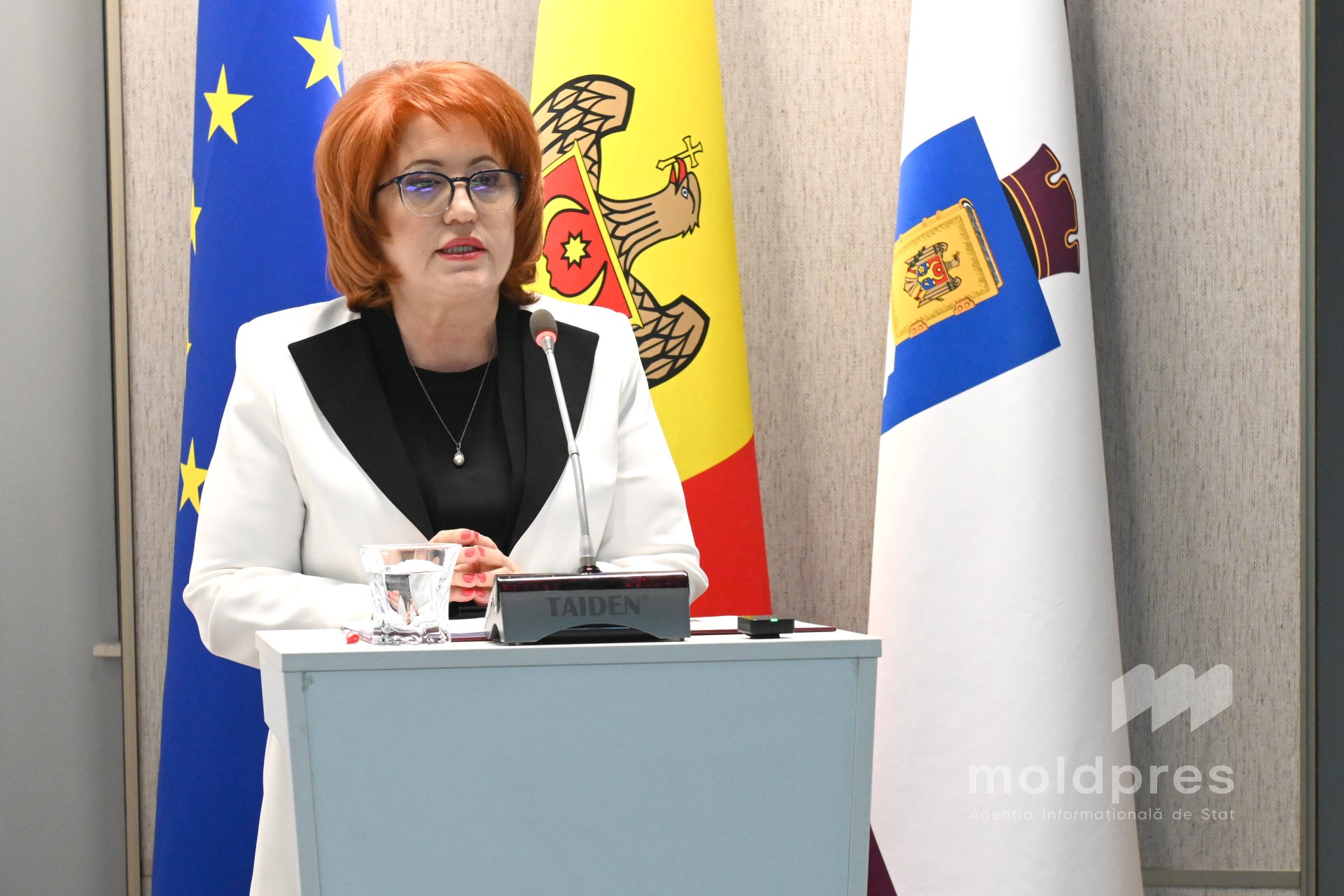
Constitutional Court President at opening of 2026 Judicial Year: As long as constitutional review functions freely and independently, democratic balance in country remains protected
In a regional and international context marked by uncertainty, geopolitical pressures and accelerated digital transformations, constitutional jurisdictions are called upon to protect not only norms, but the very substance of the democratic order. Thus, democracy is not limited to electoral mechanisms – it entails pluralism, free debate, protection of minorities and effective judicial review. This message was delivered today by the President of the Constitutional Court (CC), Domnica Manole, at the opening event of the 2026 Judicial Year.

The President of the High Court underlined that 2025 was a year of normative and institutional consolidation, and the actions carried out confirm that the chosen direction is aligned with European standards of independence and efficiency of constitutional justice.


“The opening of the new judicial year is not a mere ceremonial exercise, but an act of transparency, a moment of reflection and a solemn reaffirmation of the independence of constitutional justice. This initiative falls within the established practice of major European courts, for which the beginning of the judicial year is an opportunity for assessment, reflection and strategic determination. In a genuine rule-of-law state, constitutional justice does not function in isolation; it engages in dialogue with society, with the other branches of state power, with European courts, with the academic community. The year 2025 was one of normative and institutional consolidation. The entry into force of the new law on the Constitutional Court and the adoption of the Rules of Procedure have strengthened the functional autonomy of the institution and clarified the stages of examining referrals. The validation of this reform by the favourable opinion of the Venice Commission confirms that the chosen direction is aligned with European standards of independence and efficiency of constitutional justice,” Domnica Manole stressed.


She reiterated that the High Court does not govern and does not legislate – the Court reviews, interprets and draws boundaries, and this delimitation, sometimes uncomfortable, is essential for maintaining the separation of powers in the state.


“Every judgment delivered is more than a specific legal solution; it is an intervention in the architecture of constitutional balance. The current year will bring additional challenges. The development of digital technologies, the impact of artificial intelligence on the information space, and the risks of disinformation and polarization of society raise new questions for constitutional law. The Court must remain faithful to established principles, yet sufficiently flexible to interpret the Constitution as a living instrument, adapted to contemporary realities. In this regard, dialogue with European courts is essential. Strengthening the rule of law requires a joint effort, based on mutual respect and acknowledgment of constitutional limits,” stated Domnica Manole.


The President of the CC mentioned that in 2026 the institution aims to intensify institutional transparency, develop public communication and deepen international cooperation.


“The European conference that we are organizing in April, dedicated to the ethics of ideas in the context of digitalization and artificial intelligence, will provide a platform for reflection on how constitutional jurisdictions can protect pluralism without compromising freedom of expression. Constitutional justice is not a court of popularity; it is a court of principle. The independence of the Court is not a privilege of judges; it is a guarantee for citizens that their rights do not depend on passing political circumstances. The supremacy of the Constitution remains our constant point of reference. We enter this new judicial year with confidence, but also with lucidity. Confidence in the normative force of the Constitution, lucidity regarding the complexity of current challenges. As long as constitutional review functions freely and independently, the democratic balance in the country remains protected,” added Domnica Manole.


Present at the event, Prime Minister Alexandru Muntean stated that, since ancient times, constitutional courts have become the guardians of modern democracy, called upon to maintain the balance between powers and to protect citizens’ rights even in the most difficult moments.


“The Republic of Moldova embraced this idea 31 years ago, with the creation of the Constitutional Court. If we look through the lens of history, we are still a young democracy, but these years have brought challenges for several generations: political crises, turning points and decisions that have defined the direction of our state. Thus, although young in institutional age, we have become a society with experience. It was not the years that defined our maturity, but the way we chose to defend our democracy when our country was put to the test. The Constitution does not defend itself. Its strength lies not only in words, but in independent institutions that respect its spirit and limits,” said Alexandru Munteanu.


The official emphasized that the Republic of Moldova has gone through moments in which democratic balance was put to the test, and the experience of the captured state showed how fragile democracy can become when institutions lose their independence.


“We have learned that the supreme law of the state becomes strong not through declarations, but through the responsibility to respect legal norms, even when it is very difficult. In this regard, the Constitutional Court remains one of the pillars that protects democratic balance and citizens’ rights. The Constitution is a living organism that evolves together with society. The year 2024 became a milestone for our constitutional and European path, when citizens decided to enshrine in the supreme law the objective of integration into the European Union. Through this democratic choice, the Republic of Moldova clearly affirmed its strategic direction and strengthened the legal foundations of the accession process, at a defining moment for the future of our country,” stated Alexandru Munteanu.


The official noted that, in recent years, the regional context, marked by the war in Ukraine, has reminded us how fragile freedom and security can become when law is challenged by brutal force.


“In such moments, constitutional institutions become anchors that preserve sovereignty and democratic order. In order to protect democracy and human rights, the Government has the responsibility to turn written rights into everyday realities. Thirty-one years after the creation of the Constitutional Court, the Republic of Moldova remains a democracy in consolidation, but one that has clearly defined its European destiny even in the text of the Constitution. Democracy is not a permanent given; it lives through respect for the law and through the responsibility of the institutions that protect it. As long as the Constitution remains alive in the decisions of institutions and in people’s trust, the Republic of Moldova will continue to move forward with dignity, clarity and courage,” emphasized Alexandru Munteanu.


The Constitutional Court of the Republic of Moldova was founded on 23 February 1995, marking a crucial step in establishing the rule of law, its main role being to guarantee the supremacy of the Constitution. It is the only authority of constitutional jurisdiction, independent from any other public authority, and ensures the separation of powers in the state.

Last year, the CC delivered 16 judgments, adopted 172 decisions of inadmissibility and handled a significant number of referrals, most of them exceptions of unconstitutionality.
 Facebook
 Instagram
 X/Twitter
 Telegram
Republic of Moldova and Poland to cooperate in defense
Prime Minister invited citizens to attend events on Europe Day
Ministry of Finance has new State Secretary
EU–Moldova Parliamentary Association Committee calls for opening accession negotiations on all chapters
Moldovan parliament speaker in Copenhagen says EU candidate states to create common platform for parliamentary dialogue
Mihai Isac: Moldova participated in ECP Summit in Yerevan as state at heart of EU enlargement talks
Meeting of Cooperation Committee between Moldova and North Carolina held in Chișinău: progress in implementing joint projects and new priority areas
European Commission Vice-President to pay official visit to Chișinău
PHOTO // Deputy Prime Minister meets with North Carolina Secretary of State
Amendments to vetting laws analyzed by Superior Council of Prosecutors and Council of Europe experts
Moldova strengthens European image: high standard at Council of Europe
MEP says Moldova resisted Russian pressure, gaining increasing support in European Union
Moldova’s EU accession process on agenda of EPC Summit's discussions; Romanian president: “We will have an answer by end of June”
European Parliament member says Moldova continues to take concrete steps towards EU accession, political support for this goal stays strong
VIDEO // Moldovan foreign affairs minister comments on case involving former ambassador to India
Kaja Kallas on May 9: We all have different pasts, but we must focus on our common future. That is what Europe Day means
Head of State: Goal remains same. Moldova aims to sign EU accession treaty by 2028
Local councils in Moldova approved 451 decisions on voluntary amalgamation
EuroQuiz Moldova 2026 Grand Final held in Chișinău
Silver and bronze medals for students from Moldova at Balkan Mathematical Olympiad
Foreign Ministry condemns unauthorized overflight of national airspace by unmanned aircraft
 National Bank of Moldova
Reforms, security, Moldova’s European path on agenda of meeting between Moldovan president and European Commission's vice-president
Moldovan head of state to host president of Cyprus in Chisinau on Europe Day
Local councils in Moldova approved 451 decisions on voluntary amalgamation
Speech by President of the Republic of Moldova at joint press conference with EU High Representative for Foreign Affairs and Security Policy
Moldovan PM has meeting with businesspeople from Balti

EU may increase financial support for Moldova in security sector
President: Moldova’s accession to EU to be act of strategic coherence for entire Union
Case of activist Ghenadie Ciorba reaches ECHR: allegations of unlawful detention and persecution for criticizing Tiraspol
European Commission Vice-President: Transnistrian region will not be obstacle to European future of Moldova
Speech by President of the Republic of Moldova at joint press conference with EU High Representative for Foreign Affairs and Security Policy
Drone found in airspace of the Republic of Moldova
VIDEO // President welcomes visit to Chișinău of European Commission Vice-President on eve of Europe Day
EU official in Chișinău: Civil society plays key role in strengthening democracy
Parliament appointed new member to ANRE Board of Directors
ANSP: Risk of hantavirus infection in Moldova remains low
Parliament marks Museum Night with special program for public
Moldova inaugurates first national pavilion at Venice Art Biennale
European Commission Vice-President welcomes Moldova’s progress in aligning with EU’s foreign, security policy
VIDEO // Governmental investments in Balti; Moldovan PM says ongoing projects mean better conditions for citizens, security in future
Moldovan PM has meeting with businesspeople from Balti
Moldovan PM in Balti says government’s success possible only through close cooperation with local authorities
Receive the latest news directly to your email

Receive the latest news directly to your email