
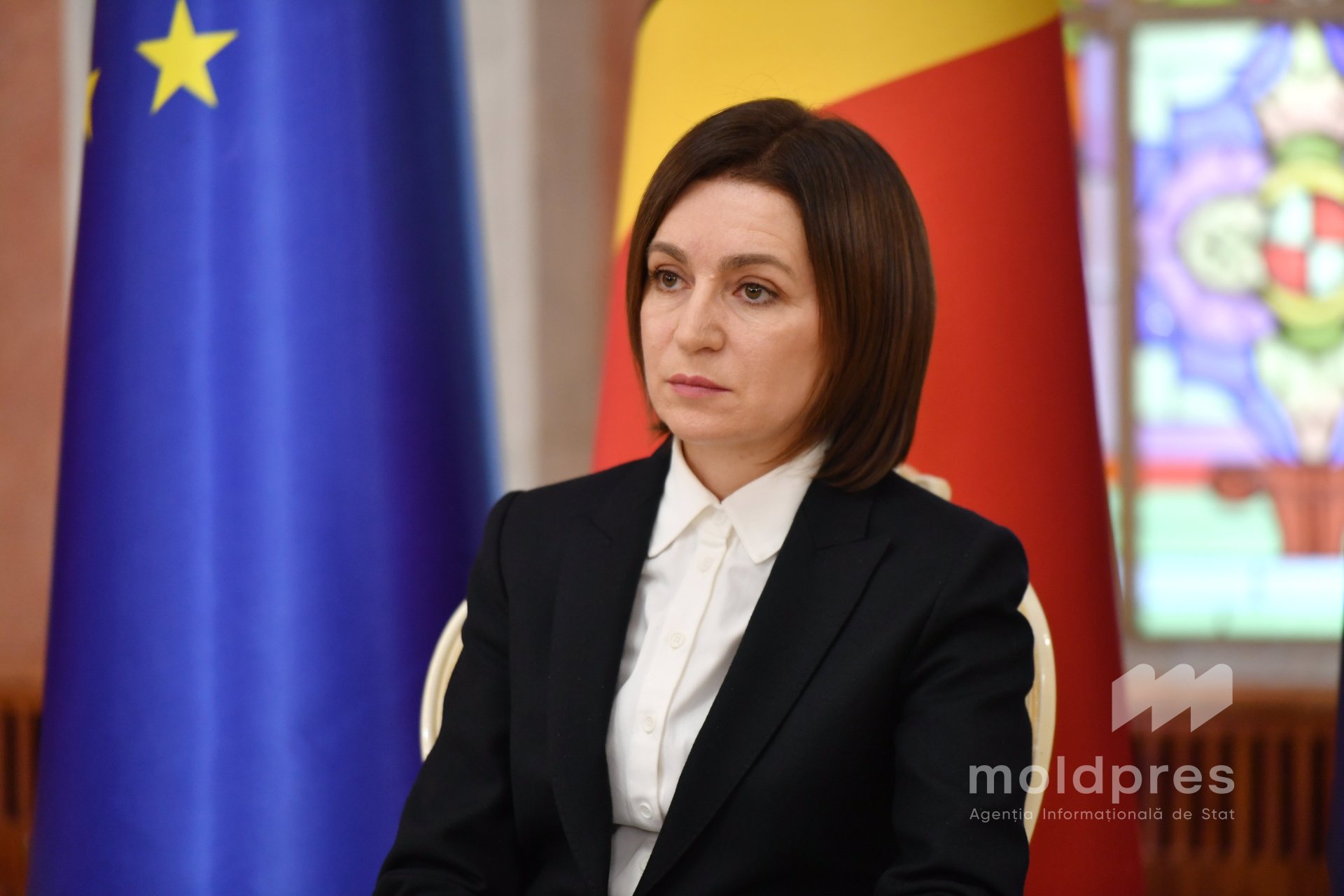
Moldovan president at Munich Conference says cognitive warfare most dangerous threat to democracies
The cognitive warfare is the most dangerous threat to our democracies, and the states in the region must come up with common solutions to counter its effects. President Maia Sandu has made statements to this effect, in the context of the Munich Security Conference. The head of state warned that Russia would not give up its efforts to intervene and try to take control over the states in the region. Under these circumstances, Maia Sandu said that Moldova must use the window of opportunity offered on its European path and take concrete steps towards closer alignment with the European Union.

Maia Sandu warned that hybrid attacks represented a threat not only to small countries, such as Moldova, but also to larger states with stronger institutions.

“The Munich Security Conference is an important event for regional security. Moldova faces serious security problems, and not only Moldova, our entire region, but especially us. For small states, such conferences represent an opportunity, as  here you can meet many people in a short time, here you have the chance to speak on stage about problems. I spoke about the hybrid attacks against Moldova at the last elections. I tried to explain to others that these attacks do not target only small countries like Moldova, but also larger, more powerful countries, with stronger institutions. And in particular, I believe that cognitive warfare is the most dangerous for our democracies. That is why, we should be aware of these things and see what common solutions we can apply,” Maia Sandu said in an interview for Explicativ.com.

The head of state also said that hybrid attacks and cognitive warfare would continue, given that “Russia will not give up its efforts to intervene and try to take control over the states in the region by influencing elections.” Therefore, it is important for states to identify common solutions in the process of combating hybrid attacks, Maia Sandu said.

“We must be aware that, even if the peace agreement turns out to be a good one for Ukraine, Russia will in any case not give up its efforts to intervene, to influence, to try to take control over the states in the region and beyond, because what Russia is doing also in other countries is trying to influence elections, so that pro-Russian politicians come to power. When there are pro-Russian politicians in power in various countries, it is easier for Russia to pursue its interests. That is why, we must prepare for the fact that this cognitive warfare and, in general, hybrid warfare will be a long-term problem, and perhaps we should build a coalition of will also on the issue of how we withstand the hybrid attacks of the Russian Federation, because in either scenario these attacks will continue,” the president of Moldova stressed.

Maia Sandu underlined that, for Moldova, “the risks arising from the aggression of the Russian Federation are growing,” and our country must use the window of opportunity on its European path to take swift steps towards the EU.

“I have always openly supported the fact that European integration is the best solution for Moldova. I believe that now there is a window of opportunity and that by 2028 we must take serious steps. At home we are working, because it is a merit-based process and we have commitments to fulfill, in order to approach EU standards. (...) And at the same time, it is important to deliver not only in terms of reforms, but also through concrete steps, so that in a few years, when the next pro-European politicians go to the citizens, they can show them what progress has been made – and not only progress on implementing reforms, but also the concrete steps we have taken to get closer to the EU. If this does not happen, then the Russian Federation will be in a better position to exploit this situation and will try to turn Moldova away from its chosen path,” Maia Sandu warned.

President Maia Sandu on February 13-14 participated in the Munich Security Conference, one of the most important international forums dedicated to global security. On the margins of the conference, the head of state had bilateral meetings with more counterparts and high-level officials. The sides discussed issues related to the regional situation, cooperation in the field of security and support for our country’s accession to the European Union.

This year, the Conference brought together nearly 50 heads of state and government, as well as leaders of major international organizations. The meeting’s agenda included discussions on global instability, the challenges facing the rules-based international order, European security and defense, the future of the transatlantic relationship, the revitalization of multilateralism, regional conflicts and the security implications of technological advances.
 Facebook
 Instagram
 X/Twitter
 Telegram
Moldovan foreign affairs minister meets NATO Deputy Secretary General; regional security developments on agenda
Parliament speaker, at Moldova Security Forum 2026, says Moldova must be able to defend its neutrality, sovereignty, European future
Moldovan parliament votes on new structure, personnel strength of National Army
Moldovan Foreign Affairs Ministry rejects claims made by Russia’s representative to OSCE on alleged “militarization” of Moldova: “They are false and unfounded”
Moldova Security Forum 2026 // U.S. Ambassador to Chisinau says decisions taken today to define decades to come
VIDEO // New U.S. Ambassador to Moldova: trade, investments, regional security among mandate's priorities
Parliament to review structure and personnel strength of National Army in closed session
VIDEO // President at Moldova Security Forum 2026: Russia is trying to test our limits, but every time we have managed to cope. In European family, we will be even stronger
Foreign Minister at Security Forum: Moldova is stronger and more resilient than a few years ago
Moldova Security Forum 2026 // Head of NATO Liaison Office in Chișinău: Moldova on front line of protecting democracy and sovereignty
Moldova, Turkey strengthen economic cooperation; trade reaches 638.7 million dollars
United States, Moldova strengthen cooperation on cybersecurity
VIDEO // Deputy PM for reintegration says Moldova's advancement along European integration path to create sustainable, much more attractive framework for country's reintegration
Moldovan foreign affairs minister meets new Ambassador of the Netherlands; EU integration developments on agenda
Moldova must strengthen air defense, create conditions for drone production; Moldovan parliament speaker: “We must seek solutions”
Moldova to open EU negotiations for clusters 2 – Internal Market, 3 – Competitiveness and Inclusive Growth
Vocational technical education of Moldova to be modernized with EU's support; Moldovan president: “An example of the benefits brought by the European path”
Moldovan PM has meeting with representatives of construction companies
Moldovan president, Irish PM discuss EU accession negotiations, bilateral relations by phone
Investments in training specialists; PM says well-learned trades bring better salaries in Moldova
VIDEO // Moldagrotech, Farmer 2026 exhibitions of Moldova to showcase solutions for improving agricultural efficiency
 National Bank of Moldova
Moldovan PM has meeting with representatives of construction companies
Moldovan president, Irish PM discuss EU accession negotiations, bilateral relations by phone
Moldovan parliament speaker, ambassadors of Norway, Turkey discuss Moldova’s relations with two countries
Prime Minister discussed issues with milk producers and processors in Glodeni and Rîșcani
Moldovan president, U.S. senator discuss Moldovan-American cooperation, Moldova’s role in regional security

Boxer Alexandru-Achile Buhaniuc wins silver medal at European U17 Boxing Championships
PHOTO GALLERY // Farmer from Briceni modernizes farm and prepares new investments in fruit growing
Government launches Moldova Prepared Program to train citizens to cope with crisis situations
PHOTO // Mural inspired by Moldovan hora tradition unveiled in Italian town
PHOTO // Vadul Rașcov bell tower restored with EU and UNDP support
Director of Center for Contemporary Art dies in accident in Vaslui county
Prime Minister discussed issues with milk producers and processors in Glodeni and Rîșcani
Ministry of Education honors participants with best results at Great National Dictation
MFA: Moldovan citizens not among victims of attack on airport in Riyadh, Saudi Arabia
Drone detected in Anenii Noi district
VIDEO // Leova water intake station operating normally
Moldovan citizens to receive energy compensation this cold season as well
VIDEO // Moldova could import natural gas from Ukraine
VIDEO // Prime Minister: Moldova must invest in country’s security and strengthen capabilities of National Army, despite limited budgetary resources
Drone unauthorizedly flew over national airspace and exploded in Anenii Noi district
VIDEO // President: Priority for Moldova in defense is improving air defense
Receive the latest news directly to your email

Receive the latest news directly to your email