
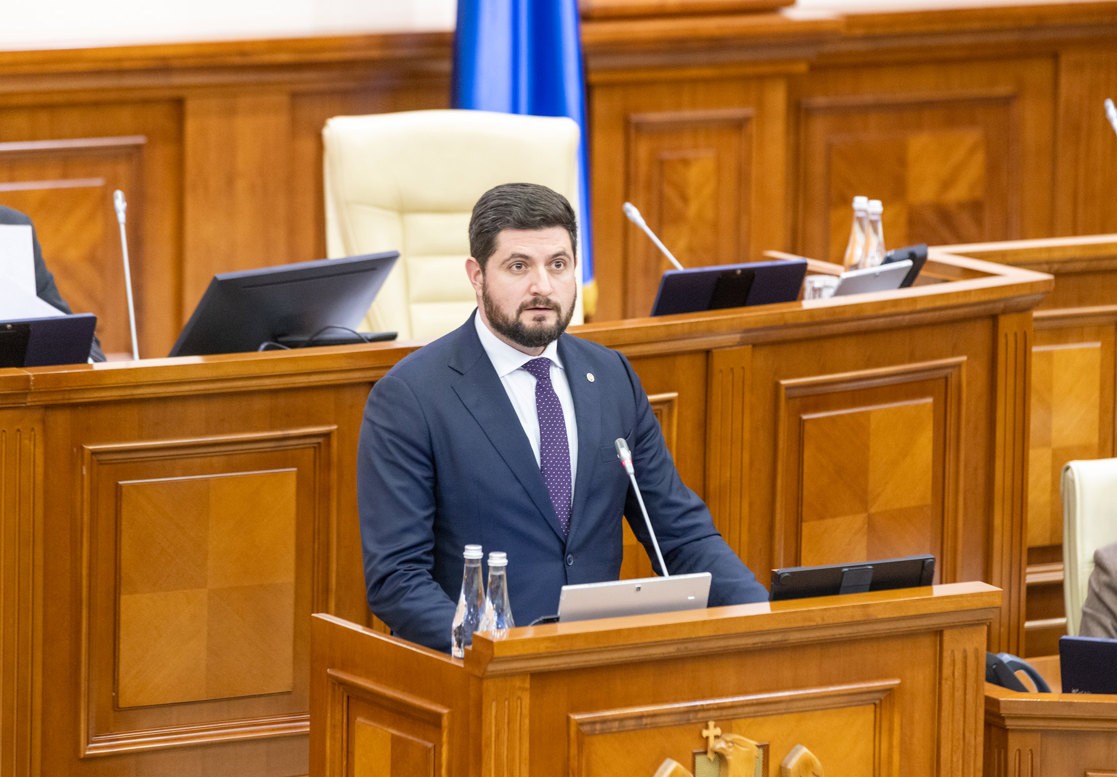
Moldovan energy minister in parliament says country reaches stage of maturity, after years in which energy system was fragile, dependent, vulnerable to political blackmail
We have reached a stage of maturity, after years in which the energy system was fragile, dependent and vulnerable to political blackmail. Today, the state has tools, options and the capacity to react quickly in crisis situations. At the same time, major investment programmes are being implemented in infrastructure, energy efficiency and renewable sources. Energy Minister Dorin Junghietu has made statements to this effect, who today presented a report in parliament on the latest developments in the energy sector, in the context of the examination of the simple motion against the state’s policies in this sector.

The report was presented exactly on the day when Dorin Junghietu marked one year since taking office as energy minister. The official noted that it was a year in which “concrete steps were taken to enhance the level of our country’s energy independence, a year in which we chose responsible, not populist solutions, a year in which we preferred stability instead of political spectacle.”

The minister noted that, in recent years, Moldova had faced a succession of crises in the energy sector, each one being amplified by external factors and energy has been used as a political weapon.

“A difficult year in a context in which Moldova faced not one energy crisis, but a succession of crises, each amplified by external factors that we do not control, but for which we must be prepared. However, the most complicated factor we try to deal with every day is public disinformation and manipulation,” Dorin Junghietu said from the parliament rostrum.

According to him, energy, especially gas, has been used as a political weapon. “Let us not forget a simple fact based on data by the National Statistics Bureau (BNS): the share of natural gas in final energy consumption is about 16 per cent. Nevertheless, there is a deliberate attempt to create a perception of generalized catastrophe, in order to generate panic and social discontent. These risks have been significantly aggravated by the Russian Federation’s bombardments of Ukraine’s energy infrastructure. These attacks do not affect only Ukraine. They have direct consequences for the energy security of Moldova and for stability throughout the region,” the minister said.

The official also referred to the power outage on January 31, this year, which, according to him, was “the direct effect of the war waged by the Russian Federation against the energy infrastructure of Ukraine.” In the context, Junghietu underlined the importance of interconnections with Romania for strengthening the country’s energy independence.

“On 31 January 2026, Moldova found itself in a partial blackout as a result of the loss of connections on segments of power lines on the territory of Ukraine. The automatic protection system was triggered and disconnected the electricity supply. The frequency in the national power system dropped to 48 Hz, which led to the activation of protections and to the interruption of power supply throughout the country. It is important to state clearly: this was not an internal failure, but the direct effect of the war waged by the Russian Federation against the energy infrastructure of Ukraine,” said Dorin Junghietu.

To remedy the situation on the day of the blackout, until the Vulcanesti–MGRES (Kuchurgan power station) line segment was reconnected, about 205 MW of electricity were imported from Romania via the 110 kV interconnections, in island mode, and another 320 MW were transited from Romania via an alternative route, Dorin Junghietu said. He added that, just one day after this incident, Moldova had managed to cover practically 94 per cent of its electricity consumption from domestic sources, renewables and cogeneration power plants.

“This episode showed unequivocally how important the interconnections with Romania are, and why we insist on strategic projects, such as the Balti–Suceava line, Straseni–Gutinas and, of course, Vulcanesti–Chișinău. The four 110 kV power lines Stanca–Costesti, Tutora–Ungheni, Husi–Cioara and Falciu–Gotesti, used temporarily to prevent the outbreak of an energy crisis, were activated last year for the first time after many years,” added Dorin Junghietu.

In the same context, the minister stressed that the Vulcanesti–Chisinau Line was “a strategic project in a system in which no investments were made for 30 years.” According to him, the actual works on the power line were completed in November 2025 and the project is currently in its finalization phase, which includes testing works.

“There were some delays caused by weather conditions. There are also some delays in the deliveries of equipment to the substations, but the project moves forward every day. Yet, where were today’s critics when this line was blocked for years? Why were no interconnections to the West built over three decades? Who deliberately kept Moldova energetically isolated? In the Ministry’s archives, we found correspondence between the former Ministry of Energy, the Government and Russian companies, activity plans and various documents according to which the Balti–Suceava line was supposed to be built back in 2005. When these documents are declassified, we will all see that the dignitaries of that time preferred to be accommodating to Russia, convincing themselves that dependence on a single energy supplier was simpler and safer for Moldova and that discussions about transferring a long list of Moldovan energy and industrial enterprises to Gazprom in exchange for the so‑called gas debt were quite real. A number of state enterprises could have ended up in the hands of the Russian concern that for years poured in cheap gas, but extremely expensive politically, with humiliation, with pressure and with constant uncertainty about the future of the next day,” the minister stated.

The official also referred to current risks in the energy sector. “There is a major technical risk – the insufficiency of Net Transfer Capacity, the so‑called NTC. Following the bombardments of Ukraine’s energy infrastructure, the transfer capacity on the Ukraine–Moldova block is used to the maximum, so the possibility of additional relocation is reduced. This means that, in certain hourly intervals, we cannot import enough energy on commercial terms, in order to fully cover the country’s domestic consumption. In such situations, Moldova is forced to resort to emergency energy from Romania, in order to maintain system stability and continuity of supply to end consumers. This is not a hypothetical scenario, but a real vulnerability of the system generated by the regional security context and the physical limitations of the grid,” said Dorin Junghietu.

The minister stressed that Romania’s support had helped Moldova overcome the crises caused by the Russian Federation and strengthened the country’s energy security.

The minister also referred to tariffs for energy resources.

“The fact that the majority of consumers choose to remain with the supplier applying regulated tariffs demonstrates one simple fact: tariffs are at the correct level. There has been much discussion about tariffs’ adjustments and about the famous deviations. Financial deviations represent the differences between the real import cost of gas and the cost estimated and applied in the tariff. These deviations can be positive or negative. They are always passed on to consumers through future tariff adjustments. Today, the natural gas tariff is about 2.15 lei lower than the previous one approved back in November 2024. Energocom accumulated positive deviations in 2025–2026, and they are being returned to consumers via lower prices. For this heating season alone, almost 400 million lei has been saved for families of Moldova and for businesses. This shows that the gas procurement strategy has proven to be efficient,” Junghietu said.

The minister added that ANRE adjusts tariffs both upward and downward. “What do we want? A weekly tariff adjustment? That would lead us to tariff chaos and citizens would be the ones to suffer,” the official noted.

Dorin Junghietu also justified the decision regarding requests to apply gas tariffs retroactively, noting that there is a fundamental legal principle according to which the law acts only for the future.

“Such a decision would generate significant negative deviations, which would subsequently inevitably lead to an even more pronounced tariff increase. We have gone through such practices before, including in 2018 and 2022, and the effects were severe for citizens and for the economy,” the minister emphasized.

Dorin Junghietu also challenged the myth of “cheap gas.” “As for cheap gas, the myth of cheap gas under the contract with Gazprom. That gas was never cheap. It was calculated using a formula based on the average sales prices of Gazprom in Europe in the previous year, including transportation. It was still a market price. No advantage, no special discount for Moldova,” he argued.

At the same time, the minister said that the Iasi–Ungheni–Chisinau gas pipeline is currently operating at full capacity and represents the foundation of the country’s security in the gas sector. Moreover, the integration of Moldova into the vertical gas corridor gives us access to alternative sources from the Caspian region and to cheap gas from Greece and even from the United States, from where we imported about 40 million cubic meters of gas in 2024.

“The fact that Moldova was among the first states to use this corridor confirms once again our seriousness as a regional partner. The diversification of gas sources was not only an economic measure, but one of energy security. Without this diversification, today we would not be discussing prices, but whether we have gas in the stove or even in the thermal power plants. The examples from early 2025, when Gazprom refused to observe contractual conditions, are still very fresh,” Junghietu said.

As for the dissatisfaction with gas invoices this winter, Minister Junghietu said that they had been determined by the low temperatures recorded, given that “each degree colder outside leads to an increase in energy consumption of about 5 per cent.”

“The invoices have been higher in recent months. Personally, last month, I paid about 700–800 lei more compared to December, and I fully understand the pressure on every family in the country. However, we must also look at the real data. January was significantly colder, with an average temperature of minus 5 degrees, compared to minus 0.6 degrees in December. January was the third coldest month in the last 16 years, and the cold translated directly into higher consumption,” the minister said, reminding that the government provides compensations to citizens to help them pay their energy bills.

At the same time, Dorin Junghietu said that the authorities were working actively on connecting the localities of the Security Zone to the national power system. Thus, in order to connect the localities in the Security Zone to the national grid, Premier Energy Distribution has completed the design and construction works for more backup power lines, including a medium‑voltage line of about 8 km towards Varnita and a section of about 1 km towards Copanca.

“These networks have been tested and are ready to provide backup supply in emergency situations, representing an important step for the energy security of residents,” said Dorin Junghietu.

As far as gas supply for the localities of Roghi, Molovata Noua, Corjova, Cocieri and Varnita is concerned, the construction of two inter‑village gas pipelines with a total length of 34.4 km has been planned, in order to allow their reconnection to the national network. “The procurement procedures for the works have been completed and the winners have been designated. However, the works could not be started in 2025, due to the lack of coordination and the repeated refusal of LLC ‘Tiraspoltransgaz’ to sign the necessary cooperation agreement,” Junghietu said.

Referring to the oil sector, Minister Dorin Junghietu said that speeding up the adoption of the law on petroleum product stocks is an absolute priority.

“This law will allow for the gradual introduction, by 2030, of the obligation to store petroleum products at the level of 90 days of average daily imports, in line with European standards. Starting from 2026, Moldova must create stocks of over 200,000 tons of oil products, in order to ensure supply in the event of external shocks. This obligation of managing and monitoring stocks will rest with a state institution. Without this law, our vulnerability remains extremely high,” the energy minister specified.

The parliament today considers a simple motion on the state’s policy in the energy sector, energy security in relation to the need to protect consumers and tariff stability. After the report presented by Minister Dorin Junghietu, the official answered MPs’ questions, to be followed by speeches and the voting procedure.
 Facebook
 Instagram
 X/Twitter
 Telegram
Direct flights from Chișinău to Korea
Facilities for Moldovans returning to live at home: Government-approved decision
Moldelectrica enterprise to be reorganized
Moldova and Korea strengthen bilateral economic cooperation: agreement signed in Chișinău
VIDEO // Work continues on Moldova's largest water main: central region’s water supply project moves forward
All consumers affected by 15–16 February glaze ice reconnected to power grid
New opportunities for entrepreneurs from Moldova, Ukraine: business school to be opened in Chisinau
Moldovan parliament speaker says leadership aims to repair three thousand km of roads by 2029
Constanta port of Romania to take over Giurgiulesti International Free Port
PM visits Made in Moldova Exhibition
National Bank of Moldova says country's economy exits stagnation zone, with 5.2 per cent GDP's growth in third quarter of 2025
Finance minister announces timing of next disbursement under Growth Plan for Moldova
Farmers can apply for grants of up to 1 million dollars: Ministry of Agriculture launches AGGRI 2026 call
There comes time in life when you must return and contribute to country’s economic growth - deputy premier says
Moldovan parliament speaker says reform of local public administration must be carried out in next autumn, there is no time to wait
Moldovan energy minister in parliament says country reaches stage of maturity, after years in which energy system was fragile, dependent, vulnerable to political blackmail
Mayors of Moldova directly Involved in EU accession: launch of Local Ambassadors Network
Moldovan prosecutor to be reevaluated: Superior Council of Prosecutors rejects Vetting Commission’s negative report
Moldovan parliament speaker talks about former president of Gagauzia's people's assembly
Moldovan PM meets Ambassador of Japan
Moldova's National Public Health Agency confirms imported case of monkeypox: infected person under medical supervision
 National Bank of Moldova
Moldovan PM visits kindergarten in commune of Chisinau municipality
Revocation of Moldovan president's Decree No. 418-IX from April 11, 2022, on granting of pardon
Moldovan PM meets Ambassador of Japan
Prime Minister in talks with 16 mayors of Chişinău suburbs
Moldovan PM, Ambassador of Cyprus discuss European path of Moldova

Arrest warrant for former leader of Moldovan Democratic Party extended by another 30 days
MOLDPRES INTERVIEW // Rector of University from Romanian city says if someone overturns your history, national identity, it means you don’t have enough knowledge
Investors can submit bids for construction of large wind power plants including storage systems
Prime Minister in talks with 16 mayors of Chişinău suburbs
Government earmarked over 185 million lei for projects in capital’s suburbs
Electricity from storage systems reflected for first time in national energy system
Over 25,000 old home appliances recycled in 2025 through EcoVoucher Program
Deputy Prime Minister meets with new Ambassador of Cyprus
New member of Board of Directors of Deposit Guarantee Fund appointed today
VIDEO // Moldova opens gas market and abandons monopoly model: companies can choose own supplier as liberalization reshapes economy
Chisinau-based Eugen Doga International Airport operates as normal, as difficult weather conditions overcome
Fewer companies required to pay VAT: VAT registration threshold raised to 1.7 million lei
Parliamentary opposition submits simple motion against Ministry of Defence policies
PHOTO GALLERY // Dialogues on energy: images from Gas Market Liberalization Forum
VIDEO // Roadmen worked around clock across country: over 200 machines and thousands of tons of anti-skid material used following snowfall and blizzard
Romania approves construction of new bridge over Prut, Albita–Leuseni
Receive the latest news directly to your email

Receive the latest news directly to your email