
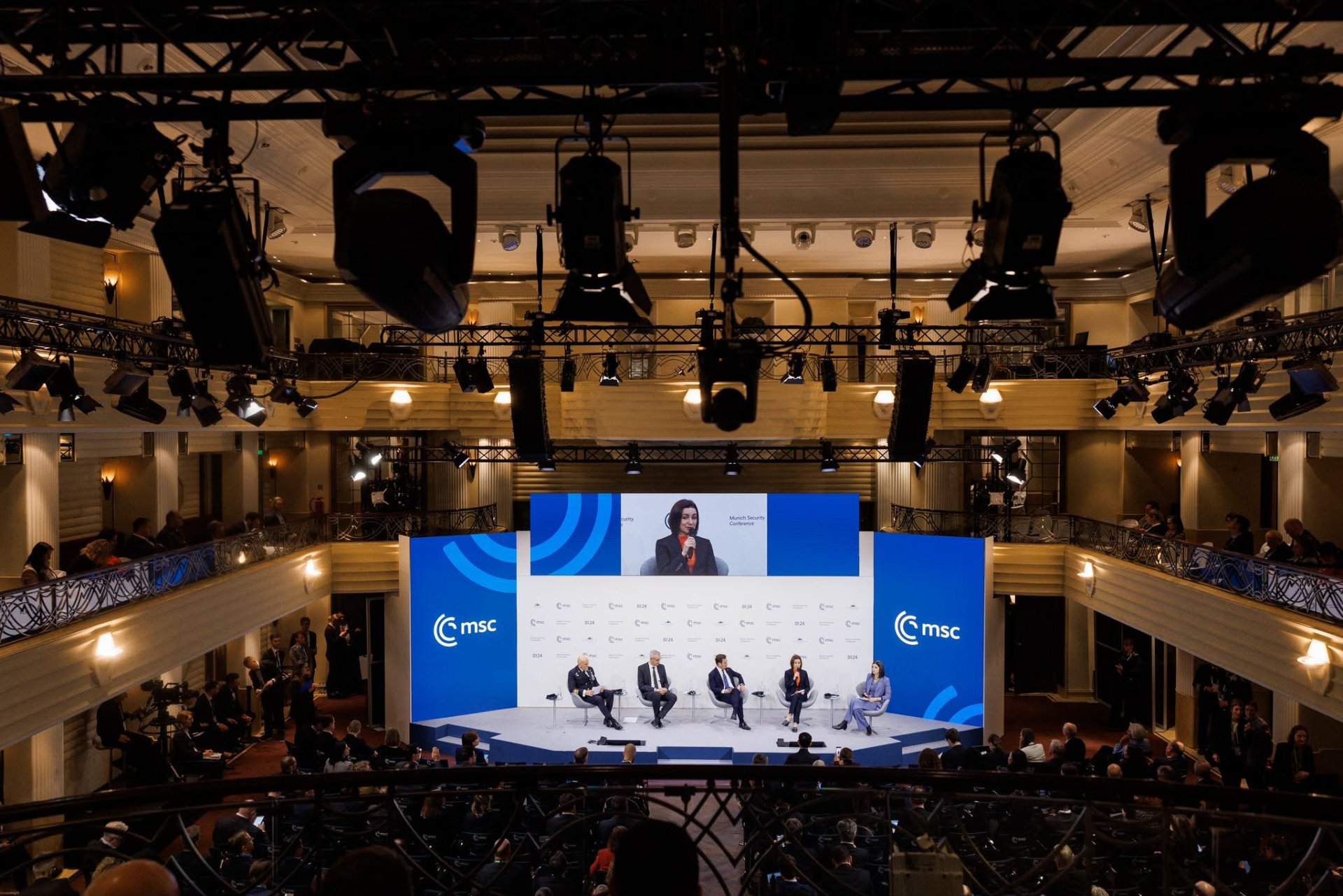
Moldovan president condemns Russia’s attacks, threats at Munich Security Conference
Russia’s narrative in the case of Moldova has been that we are a small country, a weak state with institutions that are not capable of protecting citizens and delivering results. In the meantime, the country has strengthened its resilience, there has been a whole-of-society and whole-of-government approach, and this has helped us. We are aware that we must be part of the EU, if we want to preserve our democracy. Now there is this opportunity and we must use it. President Maia Sandu made statements to this effect at the Munich Security Conference.

During a discussion on preventing and combating hybrid threats, the head of state spoke referred to the attacks launched by the Russian Federation and its attempts to block the European path of Moldova.

“Russia is trying to portray us as a corrupt leadership, saying that choosing the EU is a bad option, that the EU is not for us, because it has different values or does not respect traditional ones. In the end, if you do not vote for people who support Russia, then what is happening in Ukraine will also happen in Moldova. Of course, the economic situation, affected by the war in Ukraine, has not been good, and this has been used by the Kremlin. When the standard of living does not improve, it is easier for Russia to spread these beliefs,” Maia Sandu said.

The official underlined that, on the day of last year’s parliamentary elections, the website of the Central Electoral Commission (CEC) had been attacked one billion times in an attempt to block it, which would have discredited the vote.

“In Moldova, election results can be seen in a very short time. Thus, two to three hours after the end of the vote, we already know the choices of the citizens. Imagine if last year, when we had parliamentary elections, at some point the CEC website had crashed and people had believed the narratives spread by Russia, such as that the election results were fake,” Maia Sandu noted.

She referred to the multiple attempts at information manipulation propagated by the Kremlin during the parliamentary elections of last autumn.

“Information manipulation was the most dangerous for citizens. Online, just a single group with 100 or 90 TikTok accounts produced thousands of videos that gathered 35 million views in a country of 2.4 million people. The most serious thing is that there were many such examples,” the president said.

Maia Sandu also presented the situation regarding the illegal financing of pro-Russian parties, behind which stand actors from the Russian Federation.

“Starting from 2023, Russia has created 10 new political parties, in addition to those that already existed, and then tried to bribe voters. It was difficult to trace the money, because they used cryptocurrencies and unofficial channels. We have estimates that Russia spent last year approximately 2 per cent of our country’s GDP to influence the elections. Then there were destabilization activities: paid protests, sabotage and many others. These were the main elements, but I believe that for many countries, information manipulation is the most dangerous part in relation to preserving democracy,” the official noted.

In the context, to counter Russia’s attempts, the Moldovan authorities have enhanced institutional resilience.

“We had a whole-of-society and whole-of-government approach, and this helped us. It is necessary for us to be part of the EU, if we want to preserve our democracy. Now there is this opportunity, which we must use. Otherwise, uncertainty leads to vulnerability and Russia can very effectively exploit this vulnerability. In the EU accession process, we are evaluated based on merits and achievements. Moldova is doing everything possible, but we also hope that EU member states and European institutions will support our country’s integration into the EU,” Maia Sandu concluded.

President Maia Sandu on February 13-14 is taking part in the Munich Security Conference, one of the most important international forums dedicated to global security. On the sidelines of the conference, the head of state will hold bilateral meetings with more counterparts and high-ranking officials. The sides will discuss topics related to the regional situation, security cooperation and support for Moldova’s accession to the European Union.

This year, the Conference brings together almost 50 heads of state and government, as well as leaders of major international organizations. The meeting’s agenda includes discussions on global instability, the challenges facing the rules-based international order, European security and defence, the future of the transatlantic relationship, the revitalization of multilateralism, regional conflicts and the security implications of technological advances.
 Facebook
 Instagram
 X/Twitter
 Telegram
Moldovan expert says Moldova becomes strategic constant in Romania
Romania supports Moldova's economic integration; Romanian president says Romania to continue to support Moldova's integration into European Union, integration of two economies
Prime Minister at The Economist conference on accelerating EU accession process: Moldova moves forward despite challenges
PAS to have new MP in Parliament
Ben Gurion Airport in Tel Aviv remains closed until 16 April
National airspace overflown by Shahed drone
Perspectives on Moldova's European integration: experts says joint declaration announced today by officials from seven states good political signal
European Union member states' MPs call for speeding up EU accession talks with Moldova; declaration to this effect signed in Chisinau
Moldovan president to meet Moldovans living in Ireland
PHOTO // Republic of Moldova opened Honorary Consulate in Almaty, Kazakhstan
President on 108 years since Union of Bessarabia with Romania
Prime Minister conveys message on anniversary of Bessarabia's Union with Romania
Speaker - 108 years after Union of Bessarabia with Romania
PHOTO // Moldovan foreign affairs minister meets Romanian senators
New oil slicks on Dniester River; Moldovan authorities order reinforcement, expansion of anti-pollution barriers
New wave of oil products' slicks detected on Dniester River; authorities convene for emergency meeting
Moldovan PM participates in awards ceremony recognizing rescuers' achievements
Large wind farms with energy storage systems to be built in Moldova: 16 bids submitted in tender
Environmental protection experts from two banks of Dniester hold new working meeting
Moldovan Central Electoral Commission accredits 14 national observers to monitor new local elections, local referendums
New milestone for green energy: Moldova surpassed 1 Gigawatt of installed renewable energy capacity
 National Bank of Moldova
Moldovan authorities step up prevention, response measures on Dniester, amid anticipated new pollution wave
Moldovan PM participates in awards ceremony recognizing rescuers' achievements
Environmental protection experts from two banks of Dniester hold new working meeting
Moldovan deputy PM has meeting with Ambassador of Germany
President met with U.S. Senator

President met with U.S. Senator
PAS faction to have new MP
VIDEO // Single institution to manage Moldova’s forests
CNMC: Eenergy sector remains fragile, ending state of emergency requires caution
Foreign Ministry: We condemn violation of airspace. Such actions endanger citizens’ security
Support for export promotion: 16 business associations to receive 14.6 million lei through Bridge Export Program
Over 20 media projects to get funding from media subsidy fund
Shahed drone illegally flew over airspace of Moldova
Over 25,000 residents from left bank of Dniester commute daily to right bank, Deputy Prime Minister for Reintegration says
BTA: Bulgarian Literature Has Become Increasingly Visible on International Stage - Deputy Culture Minister Stoyanov
Simple motion on public policies implemented by Ministry of Labour and Social Protection failed
Proposals for improving efficiency of ministries discussed at roundtable
PHOTO GALLERY // Premiere at Mihai Eminescu National Theater: “Intrigue and Love,” directed by Alexandru Cozub
Moldova to sign social security agreements with Quebec (Canada), Albania, Croatia and Ireland
Around 622,000 vulnerable families receive energy compensation
Prime Minister visited agricultural business in Unguri village, Ocnița district
Receive the latest news directly to your email

Receive the latest news directly to your email