
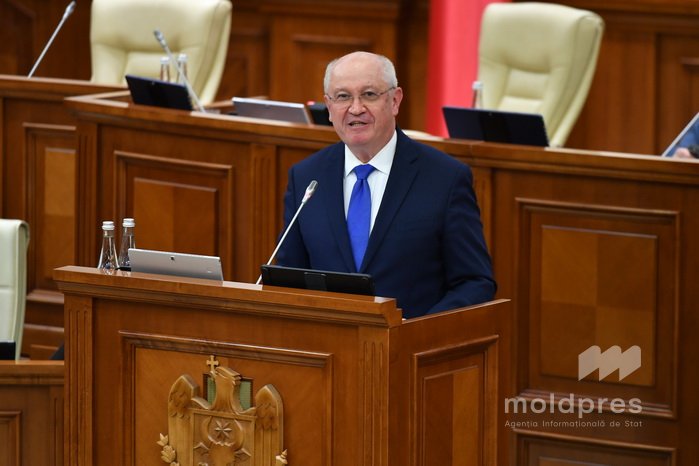
Prime Minister in Parliament: State of emergency in energy sector achieved goal. Government will continue risk management through mechanisms of state of alert
The state of emergency in the energy sector has achieved its goal – we have overcome the acute phase of the crisis, but the risks have not disappeared. Thus, the Government will continue to manage them through the mechanisms of the state of alert – which allow us to intervene rapidly, monitor stocks on a daily basis and protect vital consumers, as long as regional volatility persists. The statement was made today by Prime Minister Alexandru Munteanu, who presented in the plenary of Parliament the actions taken during the state of emergency in the energy sector and requested the termination of this measure.

The official highlighted that on April 25 it will be one month since the state of emergency was introduced, at a time when the Republic of Moldova was facing two major risks simultaneously: pressure on the power system and disruptions on the fuel market.

“Back then we promised two things: that we would act firmly and that we would be transparent, and that we would not maintain the state of emergency one day longer than necessary. We kept this commitment. The state of emergency was not a whim. It was a carefully considered decision, not one taken in haste. It was a decision of responsibility at an important and critical moment. After the March 23 attacks on Ukraine’s energy infrastructure, the Vulcănești–Isaccea line became unavailable. Imports on this route dropped to zero. The system faced a deficit of almost 400 MW. At the same time, diesel stocks had fallen to a critical level of seven days of consumption. Under these conditions, the tools available under the state of alert were no longer sufficient to intervene rapidly on the market,” said Alexandru Munteanu.

The official noted that the actions taken made it possible to avoid uncontrolled disconnections, maintain supply to vital consumers and ensure system balance under deficit conditions.

“Isaccea–Vulcănești line was brought back into operation in just five days – through accelerated procedures and the use of available equipment in emergency mode. Under normal conditions, this work would have taken weeks or even possibly months. We covered consumption through commercial purchases. Over 81,000 MWh of electricity were procured, at an average price of approximately 136 euros/MWh. Without these commercial purchases, the energy would have been bought in emergency mode, at prices at least twice as high as the mentioned price. Thus, additional costs were reduced to about 800,000 euros, compared to an estimated scenario of 1.6 million euros,” the official remarked.

With regard to the fuel market, Alexandru Munteanu stressed that, thanks to the measures implemented, a fuel shortage was prevented.

“We adjusted the price formation mechanism from 14 to 7 days, to allow import continuity in a highly volatile context. We introduced targeted limits on sales in portable containers – up to 20 liters – to prevent excessive individual storage in barrels or other containers by people who were not buying for current consumption. In parallel, we increased stocks at system level and ensured market supply. We released funds for imports and allowed flexibility in sales, so that filling stations would not run out of product. The result: the market was stabilized and stocks increased. We avoided a major economic impact. A single day of diesel shortage would have meant losses of over 120 million lei,” the prime minister pointed out.

The leadership of the Cabinet of Ministers emphasized that the state of emergency has achieved its purpose, with the acute phase of the crisis being overcome.

“However, the risks have not disappeared. That is why we are coming with a balanced decision. We are exiting the state of emergency, but not the responsibility we bear towards our citizens. The Government is today in front of Parliament exactly as it promised: we are requesting the termination of the state of emergency when conditions allow. Today, these conditions are met. Accordingly, we ask for your support for repealing the state of emergency. In parallel, the Government will continue to apply the necessary measures to protect citizens and the economy,” concluded Alexandru Munteanu.

The state of emergency in the energy sector was declared on March 25, 2026, for a period of 60 days. This was necessary after the main electricity supply line of the Republic of Moldova – the Vulcăneşti–Isaccea line – was disconnected following Russia’s attacks on Ukraine’s civilian energy infrastructure. As a result, an electricity deficit of up to 400 MW was recorded during peak hours.

During the same period, the oil products market was affected by temporary supply disruptions, especially for diesel, against the backdrop of instability in the Middle East.

After the state of emergency is lifted, the Government will introduce a state of alert for a period of 60 days, starting on April 25 this year. This will allow continuous monitoring and rapid interventions to ensure the security of electricity and oil product supplies, depending on how the risks evolve.
 Facebook
 Instagram
 X/Twitter
 Telegram
VIDEO // Deputy PM Deputy at PACE rostrum says Moldova's membership in Council of Europe, EU candidate country status provide state with tools needed to bring it into great European family
EU extends sanctions against persons, entities involved in actions destabilizing Moldova
Moldova, Austria strengthen cooperation for European integration
Moldovan parliament's delegation participates in spring session of Parliamentary Assembly of Council of Europe in Strasbourg
Chisinau to host foreign ministers of 46 Council of Europe member states
Parliament hosts Euronest PA meetings with delegations from EU and Eastern Partnership
Moldova praised at PACE for reforms and democratic resilience
Moldova on frontline of EU enlargement
Moldova concludes term at Council of Europe: Chisinau’s foreign minister to deliver final address to PACE
Moldovan President congratulates Rumen Radev on victory in Bulgaria’s elections
PHOTO // Speaker meets Moldovans in Austria
Speaker pays official visit to Austria
PHOTO // Deputy Prime Minister at Antalya Diplomacy Forum: Moldova has become more resilient, and our commitment to advancing implementation of reforms remains firm
PHOTO // Antalya Diplomacy Forum. Deputy Prime Minister held meetings with ministers from Ukraine, Montenegro and Germany
PHOTO // Deputy Prime Minister at Delphi Economic Forum: Moldova wants to become full-fledged EU member state
Speaker about possible denunciation of Treaty of Friendship and Cooperation with Russia: We should act with caution
Mark Tkaciuk left parliamentary faction of Alternative Bloc
Voted by Parliament: state of emergency in energy sector to end on 25 April
Speaker after Plahotniuc’s conviction: Logically, there must follow other episodes involving other people as well
Speaker on eve of State Flag Day: With this historic flag we are joining great European family
Speaker about possible resignations at Interior Ministry
 National Bank of Moldova
Întrevederea șefei statului cu Președintele Comitetului Economic și Social European, Séamus Boland
Prime Minister’s address in Parliament regarding lifting state of emergency in energy sector
Head of State together with speaker met with representatives of Gagauz Autonomy
Prime Minister attends opening of USA Freedom 250 festival
Moldovan PM participates in opening of USA Freedom 250 festival

Speaker - 40 years after Chernobyl disaster: Catastrophe affected millions of lives, and its echo still resounds across generations
Parliament simplifies mechanism for voluntary amalgamation of localities
Local Public Administration Reform, explained for everyone; Moldovan State Chancellery, State Information Agency MOLDPRES launch explanatory brochure: “Strong Mayoralties, Developed Communities”
VIDEO // Termoelectrica head: Old equipment will be replaced through strategic projects financed by World Bank and EBRD
Moment of silence in Parliament
Head of State together with speaker met with representatives of Gagauz Autonomy
Another 48 projects under Casa Verde program approved for funding
DOC // Youth Capital program with increased budgets and new rules published in Official Journal
Prime Minister attends opening of USA Freedom 250 festival
Chernobyl nuclear disaster commemorated in Chisinau; Ukraine's Ambassador to Moldova says nuclear security once again gaining critical importance
Gold for Moldova: Marin Robu becomes European weightlifting champion
Family from Orhei district of Moldova turns dwelling into energy-efficient house with support from FEERM programme
Moldovan president welcomes EU's support for Ukraine, sanctions against Russia
Deputy chief prosecutor of Moldova's Anticorruption Prosecutor’s Office heard by evaluation commission
Moldovan authorities to launch national plan for safety of journalists
USA Freedom 250 // Moldovan PM says partnership with USA delivers concrete results for Moldova's citizens
Receive the latest news directly to your email

Receive the latest news directly to your email