
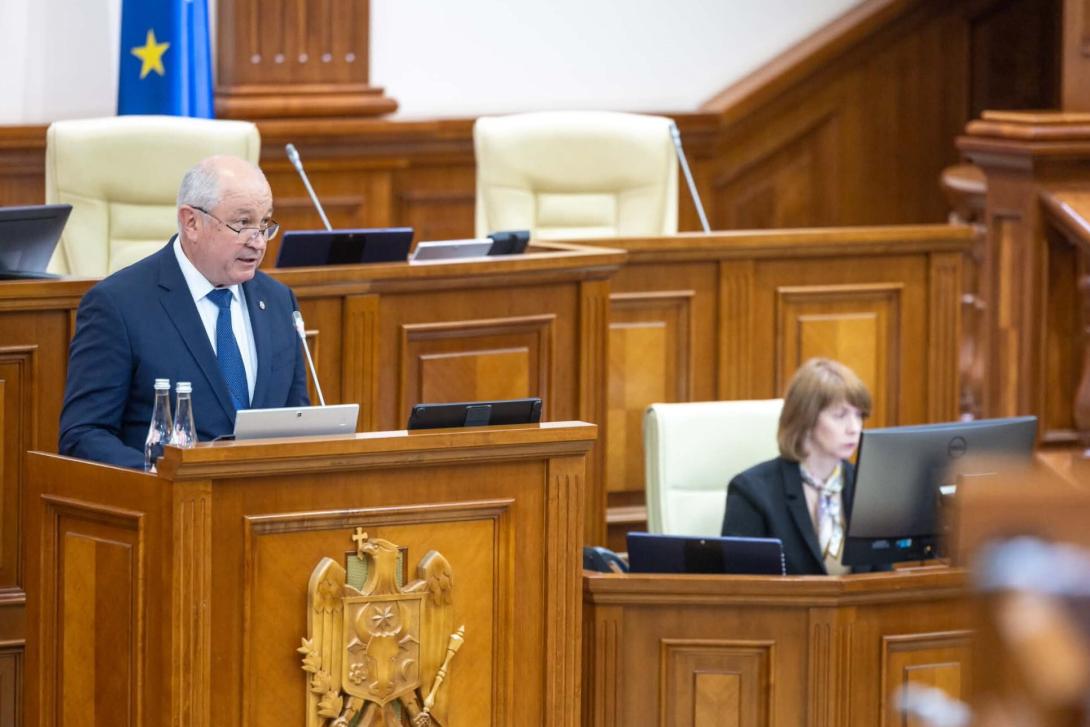
Prime Minister’s address in Parliament regarding lifting state of emergency in energy sector
I stand before you today to present the report on the actions undertaken during the state of emergency in the energy sector and to request the termination of this measure.

On April 25, it will be one month since the state of emergency was introduced. At that time, I promised two things: that we would act firmly and that we would be transparent. And that we would not maintain the state of emergency one day longer than necessary. We have honored this commitment.

The state of emergency was not a whim. It was a carefully considered decision, not one taken in haste. It was a responsible decision, made at an important, critical moment.

At that time, the Republic of Moldova was simultaneously facing two major risks: pressure on the power system and disruptions in the fuel market.

After the March 23 attacks on Ukraine’s energy infrastructure, the Vulcănești–Isaccea line became unavailable. Imports on this route fell to zero. The system faced a deficit of almost 400 MW.

At the same time, diesel stocks had dropped to a critical level of seven days of consumption. The instruments available under the state of alert were no longer sufficient to intervene quickly in the market.

Under these conditions, we intervened. The results are clear.

We prevented uncontrolled outages.

We maintained supply to vital consumers.

We ensured system balance under deficit conditions.

Isaccea–Vulcănești line was brought back into operation in just five days—through accelerated procedures and the use of equipment available in emergency mode. Under normal conditions, this work would have taken weeks and possibly months.

We covered consumption through commercial purchases. Over 81,000 MWh of electricity were purchased, at an average price of approximately 136 euros/MWh. Without these commercial purchases, electricity would have been procured in emergency mode, at prices at least twice as high as the price mentioned.

Thus, additional costs were reduced to about 800,000 euros, compared to an estimated scenario of 1.6 million euros. In the fuel market, we prevented a shortage of fuels.

We adjusted the price formation mechanism from 14 to 7 days, to allow the continuity of imports in a highly volatile context.

We introduced targeted limits on sales in mobile containers—up to 20 liters—in order to prevent excessive individual stockpiling in barrels or other containers by people who were not purchasing for current consumption. In parallel, we increased stocks at the system level and ensured the market’s supply.

We unlocked funds for imports and allowed flexibility in sales, so that stations would not run out of product.

The result: the market was stabilized, and stocks increased. We avoided a major economic impact. A single day of diesel shortage would have meant losses of over 120 million lei.

Therefore, the state of emergency has achieved its purpose. We have overcome the acute phase of the crisis. But the risks have not disappeared. That is why we are putting forward a balanced decision. We are exiting the state of emergency, but not the responsibility we bear toward our citizens.

The Government will continue to manage risks through the mechanisms of the state of alert—which allow us to intervene quickly, to monitor stocks on a daily basis, and to protect vital consumers, as long as regional volatility persists. It is important that we remain vigilant.

The Government stands before Parliament today exactly as it promised: we are requesting the termination of the state of emergency when conditions allow.

Today, these conditions are met. Therefore, we ask for your support to repeal the state of emergency. In parallel, the Government will continue to implement the necessary measures to protect citizens and the economy.
 Facebook
 Instagram
 X/Twitter
 Telegram
Dialogue between Moldova's central and local authorities in Comrat
Head of State at commemoration of victims of 1946–1947 famine: When truth is told, even after decades, it brings justice
President’s message at commemoration event for victims of 1946–1947 famine
Moldovan PM pays tribute to maestro Gheorghe Urschi
Moldova consolidates mechanism for implementing international sanctions with EU's support
Government accelerates development of regional waste management infrastructure
Government Program Youth Capital approved by cabinet
Allocation of housing for participants in Chernobyl disaster response – clearer and fairer process
Increased access to digital educational resources: they will be stored on modern national platform
Moldovan deputy PM for Reintegration has meeting with delegation of Estonia's Foreign Affairs Ministry
April 15 declared National Day of Mourning in Moldova, in connection with funerals of master Gheorghe Urschi
Moldovan president participates in launch of exhibition dedicated to 1903 Pogrom
Moldovan parliament votes: voluntary amalgamation becomes simpler, better funded for development
Deputy Prime Minister meets UNFPA Country Representative and UNDP Resident Representative to Moldova
PHOTO // Deputy Prime Minister at Delphi Economic Forum: Moldova wants to become full-fledged EU member state
Speaker about possible denunciation of Treaty of Friendship and Cooperation with Russia: We should act with caution
Mark Tkaciuk left parliamentary faction of Alternative Bloc
Voted by Parliament: state of emergency in energy sector to end on 25 April
Speaker after Plahotniuc’s conviction: Logically, there must follow other episodes involving other people as well
Speaker on eve of State Flag Day: With this historic flag we are joining great European family
Speaker about possible resignations at Interior Ministry
 National Bank of Moldova
Moldovan president has meeting with President of European Economic and Social Committee
Head of State together with speaker met with representatives of Gagauz Autonomy
Prime Minister attends opening of USA Freedom 250 festival
Moldovan PM participates in opening of USA Freedom 250 festival
Moldovan PM has dialogue with President of European Economic and Social Committee

Speaker - 40 years after Chernobyl disaster: Catastrophe affected millions of lives, and its echo still resounds across generations
Parliament simplifies mechanism for voluntary amalgamation of localities
Local Public Administration Reform, explained for everyone; Moldovan State Chancellery, State Information Agency MOLDPRES launch explanatory brochure: “Strong Mayoralties, Developed Communities”
VIDEO // Termoelectrica head: Old equipment will be replaced through strategic projects financed by World Bank and EBRD
Moment of silence in Parliament
Head of State together with speaker met with representatives of Gagauz Autonomy
Another 48 projects under Casa Verde program approved for funding
DOC // Youth Capital program with increased budgets and new rules published in Official Journal
Prime Minister attends opening of USA Freedom 250 festival
Chernobyl nuclear disaster commemorated in Chisinau; Ukraine's Ambassador to Moldova says nuclear security once again gaining critical importance
Gold for Moldova: Marin Robu becomes European weightlifting champion
Family from Orhei district of Moldova turns dwelling into energy-efficient house with support from FEERM programme
Moldovan president welcomes EU's support for Ukraine, sanctions against Russia
Deputy chief prosecutor of Moldova's Anticorruption Prosecutor’s Office heard by evaluation commission
Moldovan authorities to launch national plan for safety of journalists
USA Freedom 250 // Moldovan PM says partnership with USA delivers concrete results for Moldova's citizens
Receive the latest news directly to your email

Receive the latest news directly to your email