
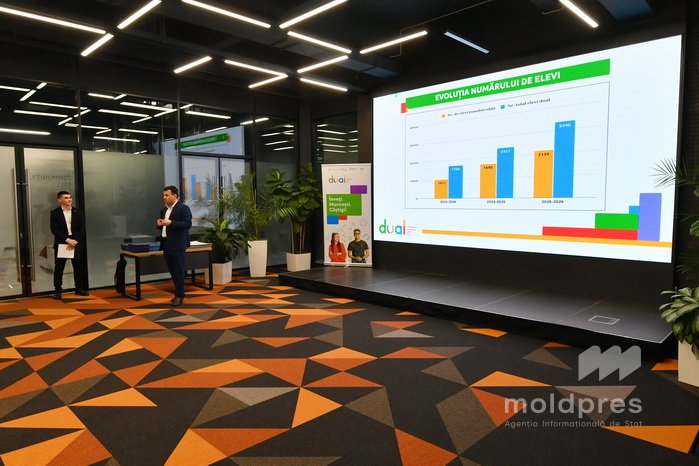
Number of young people admitted to dual education increases in Moldova in recent years
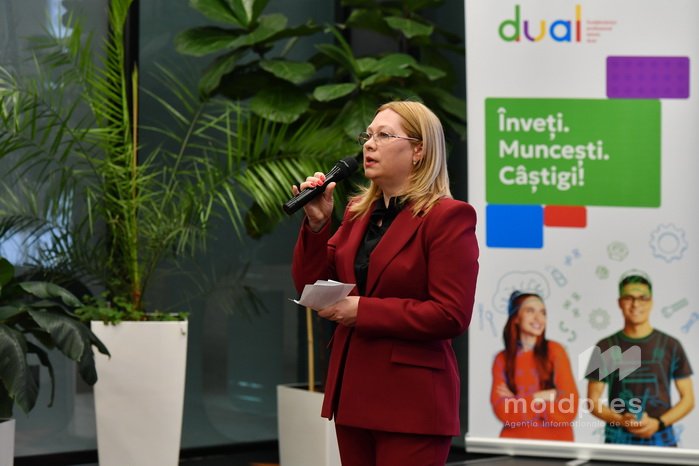
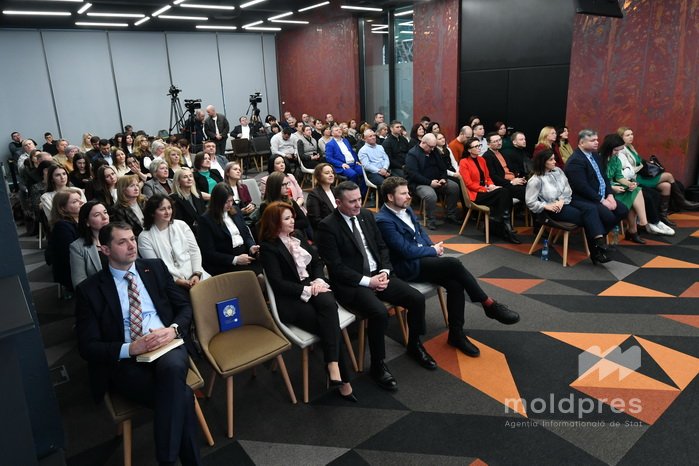
The number of young people admitted to dual education has steadily increased in recent years. The authorities aim to continuously support this form of education through investments and modernization, so that the number of people opting for dual education continues to grow, thus educating highly qualified specialists in line with labour market needs. The information today was presented at the National Conference, Excellence and Partnership in Dual Education, held in Chisinau.
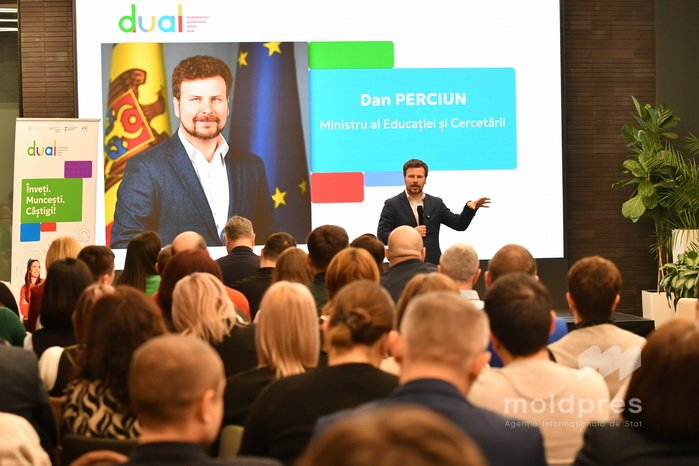
Present at the event, Education and Research Minister Dan Perciun outlined the priorities in the field of dual education.“At the MEC, we place great importance on everything that dual education represents. We have seen an upward trend in this field in recent years. While in 2023, we had about one thousand young people, we later reached 2,200, and this year we aim to improve and break records. We need to exceed 2,500 young people admitted to dual education,” said Dan Perciun.
The minister also stressed that Moldova would benefit from 80 million euros for the modernization of vocational technical education. Part of the financial resources comes from the Growth Plan for Moldova, supported by the European Union. Under the project, 15 vocational technical education institutions will each receive 4 million euros for modernization. At the same time, 20 million euros will be allocated for the renovation of ten student dormitories.
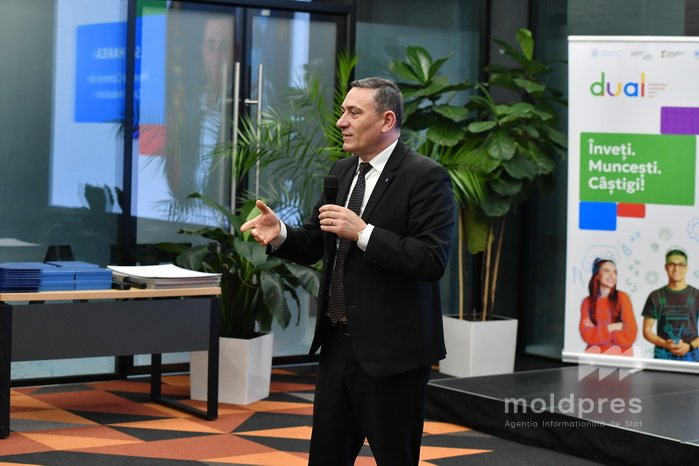
President of the Chamber of Commerce and Industry (CCI) Sergiu Harea noted that the authorities aim, for the coming years, to achieve the goal that 30–40 per cent of young people admitted to vocational education be enrolled in dual programmes.“The CCI’s aim is to create a competitive economy. We can achieve this objective, only if we invest in knowledge, equipment and the workforce. Only then will we be ready to meet competitive challenges on the international market,” said Sergiu Harea.
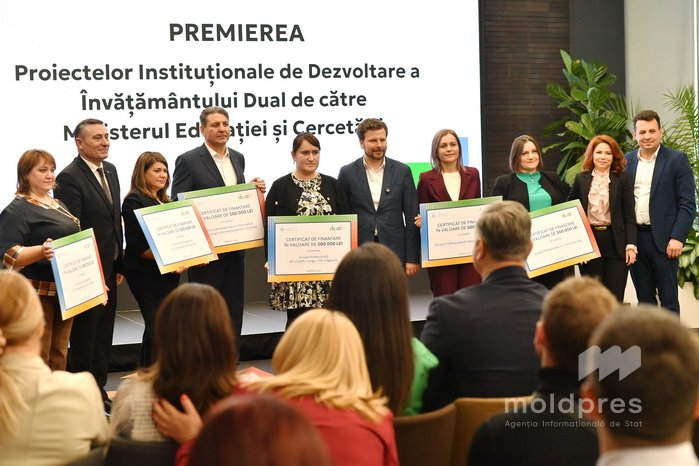
During the National Conference, Excellence and Partnership in Dual Education, six institutions that achieved remarkable results in implementing dual education received grants worth 500,000 lei for additional investments. In addition, five other institutions received grants worth 25,000 euros. The financial support was provided with the assistance of Liechtenstein.
Country Director of the Liechtenstein Development Service – Moldova Nadejda Burciu said that dual education was the most agile way to develop young people’s skills, so that they can keep pace with ongoing economic transformations. Another objective pursued through the implementation of dual education is to give young people the opportunity to build a career in Moldova, as they are often forced to go abroad. At the same time, Nadejda Burciu underlined the need to continue efforts to coordinate and synchronize economic and education policies.Dual education is a special form of training and professional formation in which responsibilities are shared between dual partners – the company (workplace) and the educational institution. Thus, students receive structured practical training at the company, while the theoretical component is acquired at the educational institution.


 Facebook
 Instagram
 X/Twitter
 Telegram
New EU entry rules: Entry/Exit System becomes fully operational as of today
VIDEO // Special measures at border before Easter: authorities promise shorter waiting times
DOC // Moldova setting up advisory committee on international development cooperation and humanitarian assistance
DOC // Government decision on army conscription published in Official Journal
DOC // SIS updates list of persons involved in terrorist activities
Emergency Service 112 strengthens teams for Easter period
VIDEO // EcoContact public association of Moldova launches environmental conflict mediation guide after series of practical sessions in Chisinau, Cahul
Moldovan parliament tightens anti-drug legislation: criminal penalties for online promotion too
Parliament adopts comprehensive reform of environmental institutions
New rules for equipping Ministry of Internal Affairs structures adopted by MPs
PHOTO // President meets Moldovans in Ireland
Moment of silence in Parliament in memory of Mircea Lucescu
Speaker’s Easter greetings to Moldovans everywhere: Easter unites us, wherever we may be
Moldovan driving licenses to be recognized in Ireland
PHOTO // National Army sappers conduct demining missions in Orhei, Chișinău, Cimișlia
AIPA allocated over 53 million lei to farmers in first ten days of April
DOR government programme of Moldova: children, young people from Diaspora can submit participation files till April 22
Local companies can participate in Moldova Presents exhibition, organized in Vaslui, Romania
 National Bank of Moldova
Moldovan president participates in launch of exhibition dedicated to 1903 Pogrom
Moldovan parliament votes: voluntary amalgamation becomes simpler, better funded for development
Deputy Prime Minister meets UNFPA Country Representative and UNDP Resident Representative to Moldova
Moldovan president, on visit to Dublin, says Ireland’s transformation after EU accession model for Moldova’s European future
President Maia Sandu’s speech at the joint press conference with the Prime Minister of Ireland, Micheál Martin

Moldovan PM conveys message on Easter
VIDEO // Moldovan parliament speaker says may Light of Resurrection brings us peace, courage, new hope
Moldovan president congratulates citizens on Resurrection of the Lord
Orthodox Christians celebrate Holy Easter; Orthodox priest says peace should be sought in hearts, Light of Resurrection should be shared with everyone”
Holy Light from Jerusalem brought to Moldova
Over 200 young people of Moldova launch or expand businesses through European Union-funded project
PHOTO GALLERY // Old Orhei on Easter Eve
Direct train from Kyiv to Chisinau Airport launched in test mode
VIDEO // Moldovan government's secretary general says Easter fills villages, all Moldova with life, warmth
Ungheni municipality, 18 other settlements unite in voluntary amalgamation; Ungheni mayor says largest cluster in Moldova takes shape
Bomb threat reported at Chisinau Airport proves to be hoax; terminal resumes operations
Moldovan health specialists recommend rational consumption of food products during Easter holidays
Moldovan president participates in launch of exhibition dedicated to 1903 Pogrom
Bomb threat at Chisinau Airport; passengers, airport staff evacuated
Moldova's National Alternative Movement Party withdraws from Alternative Bloc, remains in parliamentary faction
Japan reconfirms status of strategic partner for development of Moldova's agricultural sector
Receive the latest news directly to your email

Receive the latest news directly to your email