
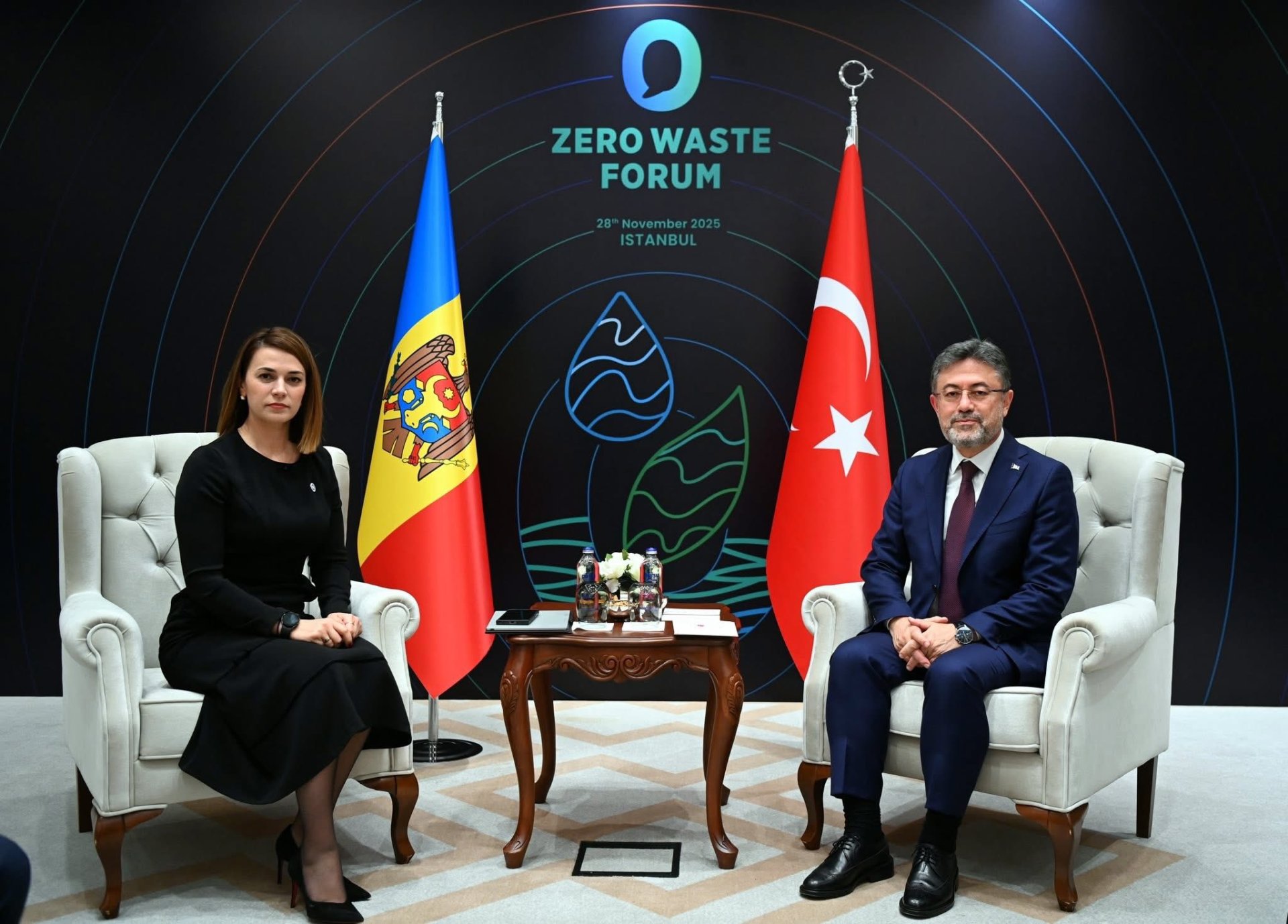
Agriculture minister in Istanbul: Moldova supports Zero Waste goal and investments in sustainable food systems
Minister of Agriculture and Food Industry Ludmila Catlabuga is in Istanbul to attend a high-level meeting - Preventing food and water waste – protecting our future, an international forum focused on finding solutions to reduce food loss and responsibly manage natural resources.

During the meeting, the minister stated that the Republic of Moldova is fully aligned with the objectives of the global Zero Waste initiative and the 2030 Agenda for Sustainable Development, emphasizing the country's commitment to strengthening resilient and efficient food systems.


"The Republic of Moldova is working to strengthen sustainable food systems, with a focus on reducing post-harvest losses. Agriculture remains a pillar for the national economy and rural community development, and in this regard, the Government is investing in modernized storage spaces, digital monitoring systems, and refrigeration infrastructure. These measures allow farmers to keep products in optimal conditions, reduce losses, and ensure the delivery of high-quality food to consumers," said Ludmila Catlabuga.


The official also remarked the importance of efficient water resource management, noting the modernization of irrigation systems, implementation of water-saving technologies, and advanced hydrological monitoring.


"The Republic of Moldova is updating national policies and regulations to support the transition to sustainable production and consumption models," the minister added, emphasizing the role of education and public awareness in reducing food waste.


During the event, Ludmila Catlabuga met with Ibrahim Yumaklı, Minister of Agriculture and Forestry from Turkey. Discussions focused on combating food waste, efficient water use, and promoting sustainable agricultural practices in line with current international objectives, as well as developing bilateral cooperation through experience exchange and joint projects.

The meeting in Istanbul represents an important moment for the Republic of Moldova in promoting agricultural sustainability policies and strengthening international partnerships geared towards protecting resources for future generations.

The global Zero Waste initiative is an essential concept in transitioning towards a sustainable economic model where resources are used efficiently and the amount of waste generated is significantly reduced. This approach seeks to keep produced and consumed materials in the economic cycle for as long as possible, preventing them from quickly becoming waste, thereby minimizing environmental impact. Zero Waste is based on several clear principles: waste prevention from the production stage, reusing and repairing goods before they are discarded, recycling materials to repurpose them, and composting organic waste so it becomes a resource again. The concept extends beyond waste management, requiring a mindset shift—from rapid and wasteful consumption to responsibility and efficiency.

The importance of this initiative becomes evident in a context marked by pressure on the environment and natural resources. Zero Waste helps reduce pollution, protect water, soil, and biodiversity, create a circular economy, and minimize food waste—a major global phenomenon. Besides its ecological impact, the initiative also has an economic dimension, stimulating sectors like recycling, green technologies, and the circular economy, generating jobs and new investments.

Zero Waste is closely linked to the UN Sustainable Development Goals, especially those regarding responsible consumption, environmental protection, food security, and water management. Thus, the initiative becomes a global benchmark in building a sustainable future where resources are treated not as inevitable waste but as values that can be preserved, reused, and passed on.
 Facebook
 Instagram
 X/Twitter
 Telegram
Modern recreational space to be created nearby MOLDEXPO
Over 6,600 tons of fuel imported into Moldova in recent days
Chisinau residents urged to buy local products: fairs held in all districts of Moldovan capital
DOC // State of emergency in energy sector ends in Moldova
Retailers of Moldova to be required to display country of origin for food products
Voted by Parliament: state of emergency in energy sector to end on 25 April
All bachelor’s, master’s theses to be checked with anti‑plagiarism software in Moldova, after revelations about sale of academic papers
LUKOIL fuel stations in Moldova may continue operating until autumn
VIDEO // Termoelectrica head: Old equipment will be replaced through strategic projects financed by World Bank and EBRD
VIDEO // €24 million German investment brings safe drinking water to 800,000 citizens in Central Moldova
State of emergency in energy sector could end on 25 April
Italian company to build first kilometers of highway in Moldova
Zero customs duty on imports of raw materials and equipment used in production
PHOTO GALLERY // First journey on restored Cantemir–Fălciu railway line successfully tested
Discover Moldova with #MOLDPRES // Turbulent history of Pripiceni-Curchi Monastery: more than two-century-old icon, one of its most precious treasures
Moldovan finance minister participates in EU Economic and Financial Dialogue in Brussels
Moldovan energy minister in Brussels says energy security no longer political promise, but system under construction
Moldova represented at annual high-level meeting of Economic and Financial Dialogue between EU and countries candidates for accession
Mihai Isac: Moldova participated in ECP Summit in Yerevan as state at heart of EU enlargement talks
Meeting of Cooperation Committee between Moldova and North Carolina held in Chișinău: progress in implementing joint projects and new priority areas
European Commission Vice-President to pay official visit to Chișinău
 National Bank of Moldova
Moldovan president participates in meeting of European Coalition Against Drugs at European Political Community's Summit in Yerevan
Moldova's European future at center of high-level meeting in Yerevan
Voluntary amalgamation in north Moldova district: nine mayoralties merge, to receive 85 million lei in incentives
Moldovan PM says national resilience built through shared responsibility, coordination, preparedness
President received Japanese delegation led by Minister for Internal Affairs and Communications

PHOTO // Energy Minister approached regional energy security strengthening in Brussels
MOLDPRES INTERVIEW // Falk Lange, Head of the Council of Europe Office: “The Presidency of the Committee of Ministers is both a responsibility and an opportunity for the Republic of Moldova to demonstrate its commitment to European values.”
Amendments to vetting laws analyzed by Superior Council of Prosecutors and Council of Europe experts
USMF "Nicolae Testemițanu" to organize SimOlympic simulation Olympiad
Moldova strengthens European image: high standard at Council of Europe
European MP says elections in EU can influence Moldova’s path, European support stays strong
Moldovan president participates in meeting of European Coalition Against Drugs at European Political Community's Summit in Yerevan
MEP says Moldova resisted Russian pressure, gaining increasing support in European Union
Moldova adopts North Carolina’s agricultural extension model to support local farmers
First in EU accession process: European Parliament, parliament of Moldova launch joint working groups on negotiation chapters
Moldova’s EU accession process on agenda of EPC Summit's discussions; Romanian president: “We will have an answer by end of June”
Opportunities of strategic investments presented at Moldova – EU Conference, held in Chisinau on June 4
Moldova's European future at center of high-level meeting in Yerevan
Voluntary amalgamation in north Moldova district: nine mayoralties merge, to receive 85 million lei in incentives
European Parliament member says Moldova continues to take concrete steps towards EU accession, political support for this goal stays strong
Moldovan PM says national resilience built through shared responsibility, coordination, preparedness
Receive the latest news directly to your email

Receive the latest news directly to your email