
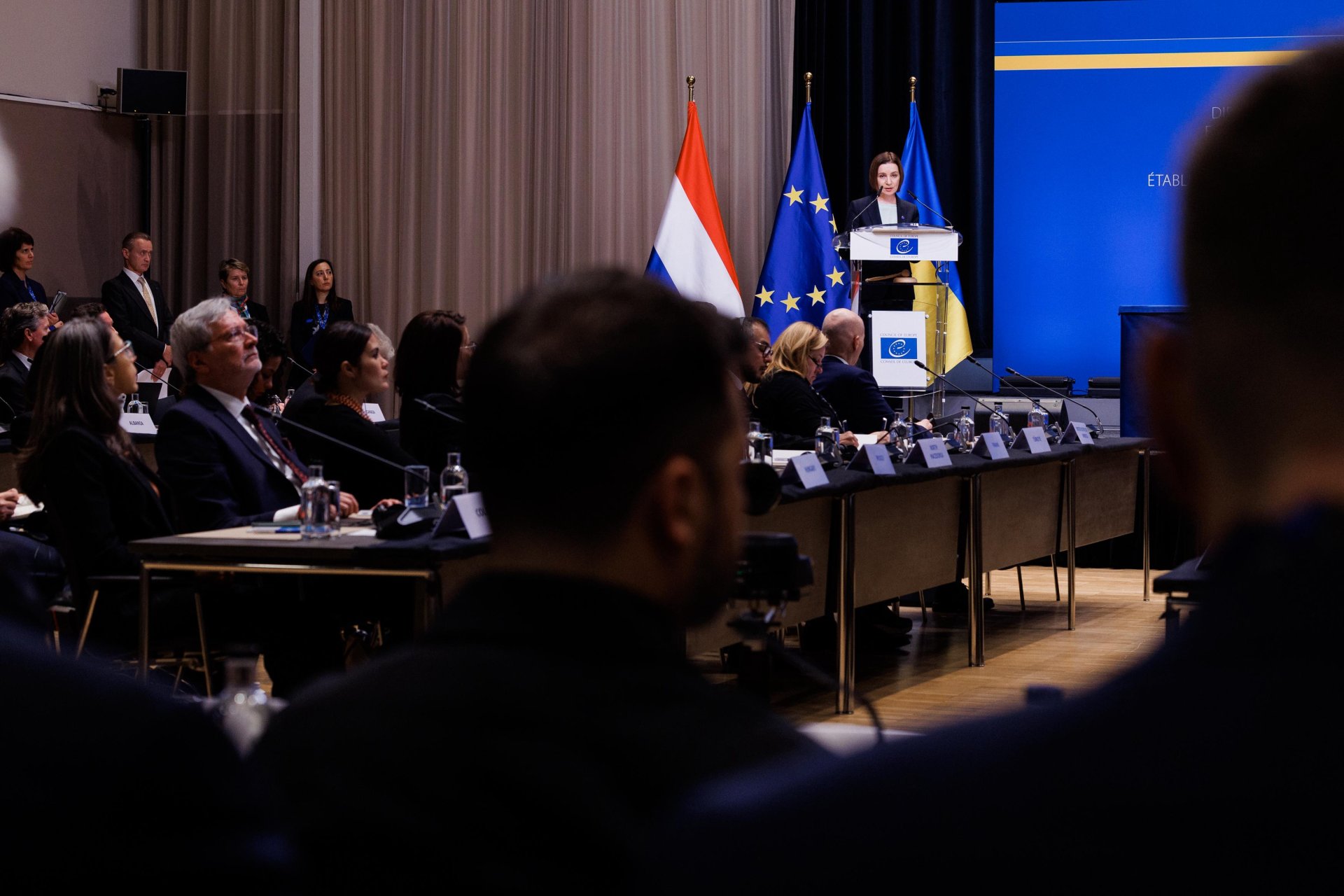
President Maia Sandu’s Speech at the Conference on the Adoption of the Convention Establishing the International Claims Commission for Ukraine
Prime Minister Dick Schoof,
President Volodymyr Zelenskyy,
Secretary General Alain Berset,
Excellencies,
Ladies and Gentlemen,Thank you for bringing us together.
We meet as Russia’s full-scale aggression against Ukraine continues to take lives, destroy cities, and weaken the foundations of European security.
So amid all high-level discussions, we must keep the ultimate objective in mind: to save lives, stop the suffering and bring peace that does not give rise to the next war.
Moldova supports all efforts that bring an end to the war and the suffering it causes, all efforts that lead to a dignified peace, and all efforts that prevent a future war.Because how this war ends will shape Europe’s future.
In this sense, history is consistent. Peace without accountability rarely holds. Where responsibility is affirmed through law and institutions, societies recover. Where accountability is avoided or postponed, violence returns—often in more destabilising forms.
Accountability is about creating the conditions for peace that endures. And therefore accountability is a condition of security – today and for the future.
But accountability is not only about Ukraine. And it is not only about one aggressor and one victim.
Accountability is about Europe. About every country in Europe. It is about whether Europe, as a whole, is willing to defend its peace.
And let us be honest: this war is already affecting our normal ways of life far beyond the front line.
Drones violate European airspace disrupting travel plans.Critical infrastructure is targeted through sabotage.
Cyberattacks disrupt services.
Disinformation seeks to divide our societies from within.This is how modern, hybrid war spreads—quietly, gradually, and deliberately. The front line is not only in Ukraine. It is wherever Europeans expect safety, stability, and normality—and begin to lose them.
This moment is about Ukraine—but it is also about whether free and sovereign nations in Europe can protect their people from evil and harm. Whether we, Europeans, can hold together in solidarity to defend our way of life, our democracies, our peace.
That is why the Convention we sign today, establishing the International Claims Commission for Ukraine, matters.
This matters first and foremost for people. For those who lost family members. For those whose homes were destroyed, whose lives were forever changed. Law cannot undo loss, but it can recognise harm, restore dignity, and affirm that suffering is neither invisible nor forgotten.
Secondly, it also matters for the international system. Accountability, when it is credible, predictable, and institutionalised, tells aggressors that violations will be recorded, assessed, and addressed.
Third: the way this Commission has been created sends a signal. It affirms multilateralism and a rules-based international order. At a time when some argue that power alone should decide outcomes, Europe is stating something different: that stability depends on law, cooperation, and shared responsibility—especially for smaller and more vulnerable states.
The Council of Europe has provided a credible institutional framework for this effort. I also wish to acknowledge the role of the Netherlands. The Hague has long stood as a centre of international law, and its engagement has been essential in moving this effort forward.
Ladies and gentlemen,
We should also be clear-eyed about the reality on the ground. Ukraine is resisting. It continues to defend its territory, its people, and Europe’s security. Russia has not achieved its objectives.
Every meter of advance in Ukraine comes with colossal human and military costs for Russia. This war will soon last longer than Russia’s participation in the Second World War. The fact that Moscow has still failed to take the Donbas is evidence of Ukraine’s extraordinary capacity to resist and adapt.
President Zelenskyy,Ukraine’s resilience matters far beyond its borders. It preserves Europe’s peace.
Europe’s security now depends on whether Ukraine is supported—and whether Russia is denied the capacity to continue this war and prepare the next one.
Ukraine must continue to receive strong, sustained support. Not sporadically. Not cautiously. But with the understanding that Ukraine’s success is a precondition for Europe’s future peace. Supporting Ukraine now is an investment in preventing much larger conflicts later.
At the same time, Russia’s ability to wage war must be reduced. Sanctions matter. Isolation matters. Pressure matters. A war of aggression cannot be allowed to remain economically sustainable. Deterrence that works today avoids far greater military, economic, and human costs in the future.
The EU’s decision to indefinitely freeze Russian assets plays a role in this effort. It reinforces deterrence. It tells future aggressors that war leads to lasting costs.
How this war ends will determine whether Europe faces stability or more wars. And this is Europe’s responsibility. Not someone else’s. Not another continent’s. The responsibility lies with Europe—to stand for peace, to support Ukraine, and to defend the foundations of our security, democracy and well-being. To do so decisively, or to fail history—and in doing so, endanger Europe’s democratic and peaceful future.
Ukraine is fighting. The question before us is whether Europe will rise to the moment—or fail.
I thank all countries represented today for their support to Ukraine.
And as the country holding the Presidency of the Committee of Ministers of the Council of Europe, Moldova stands for a Europe that acts early, decisively, and together. A Europe that understands that supporting Ukraine and deterring aggression today is the price of peace tomorrow.
Thank you.
 Facebook
 Instagram
 X/Twitter
 Telegram
Transnistrian file discussed with researchers from United States
Deputy Prime Minister: Reintegration - complicated, lengthy process with many unknowns
Deputy Prime Minister: Presence of Russian troops on left bank of Dniester River - major impediment to Transnistrian settlement process
Moldovan President to pay official visit to Lithuania
Survey: Help set priorities for Open Government 2026–2028
Health at center of Moldovan president's visit to southern region
Moldovan government proposes simplification of voluntary amalgamation procedure
Reform of local public administration: consultations held with over 3,700 local elected officials, citizens in 29 districts of Moldova
Dialogue on parliamentary platform regarding country’s reintegration policies
Moldovan government encourages individual taxpayers to direct 2 per cent of income tax paid on last year’s earnings to non-commercial, non-profit organizations
Moldovan deputy PM for reintegration pays working visit to central district
Moldovan PM participates in Investment Forum in agri-food sector
Journalists’ access to Joint Control Commission's meetings, to Security Zone topic of discussion in Bender
EU and EBRD strengthen support for Government’s reform agenda
Critical alert on Dniester: Pollution intensifies at border; Moldovan environment minister recommends halting water supply in Naslavcea area
Moldovan PM meets two entrepreneurs developing successful businesses in Causeni
Romanian Language Day to be marked in Ukraine on August 31; Decree signed by Ukrainian President
Moldovan PM visits two major projects completed in Causeni with government's support
Simple motion on Moldovan Defence Ministry’s policies fails
VIDEO // Financial support for farmers of Moldova: over 400 million lei in payments through AIPA, compensation for diesel fuel used in spring agricultural work
PHOTO // Government investments in Căușeni and better conditions for citizens
 National Bank of Moldova
Moldovan PM meets two entrepreneurs developing successful businesses in Causeni
Moldovan PM visits two major projects completed in Causeni with government's support
Moldovan deputy PM for reintegration has meeting with European Commissioner for Enlargement
Joint Control Commission holds meeting in Bender
Prime Minister in talks with mayors from Căușeni district

EcoContact relaunches measures program to protect natural areas
Defense Minister: Institutions analyze every military death case with utmost seriousness, and I have personally committed to closely overseeing intensification of psychological support and monitoring activities
Speaker about situation in agriculture: We acted in time to prevent complications
MIA Instant Payments, two years after launch
Air defense - strategic priority for Moldova, Defense Minister says
Defense Minister reports to Parliament: Defense investments important for security of Moldova
Moldovan Speaker about fuel market situation: We have larger stocks than before war
Crisis Cell: Several Moldovan citizens evacuated from Dubai via route organized by Romanian authorities
Parliament appoints new deputy ombudsperson
Anniversary exhibition inaugurated at National Art Museum of Moldova
PHOTO // Deputy Prime Minister at EU Ambassadors’ Conference: Moldova - responsible partner and continues to implement committed reforms
Authorities in Moldova and Ukraine coordinate actions to manage incident on Dniester River
New rules in eCherha electronic system at border with Ukraine
Moldovan government invests 25 million lei in tourism infrastructure in Valeni village
VIDEO // Authorities intervene on Dniester early morning: filters installed and new water analyses
Prime Minister pays working visit to Căușeni district
Receive the latest news directly to your email

Receive the latest news directly to your email